
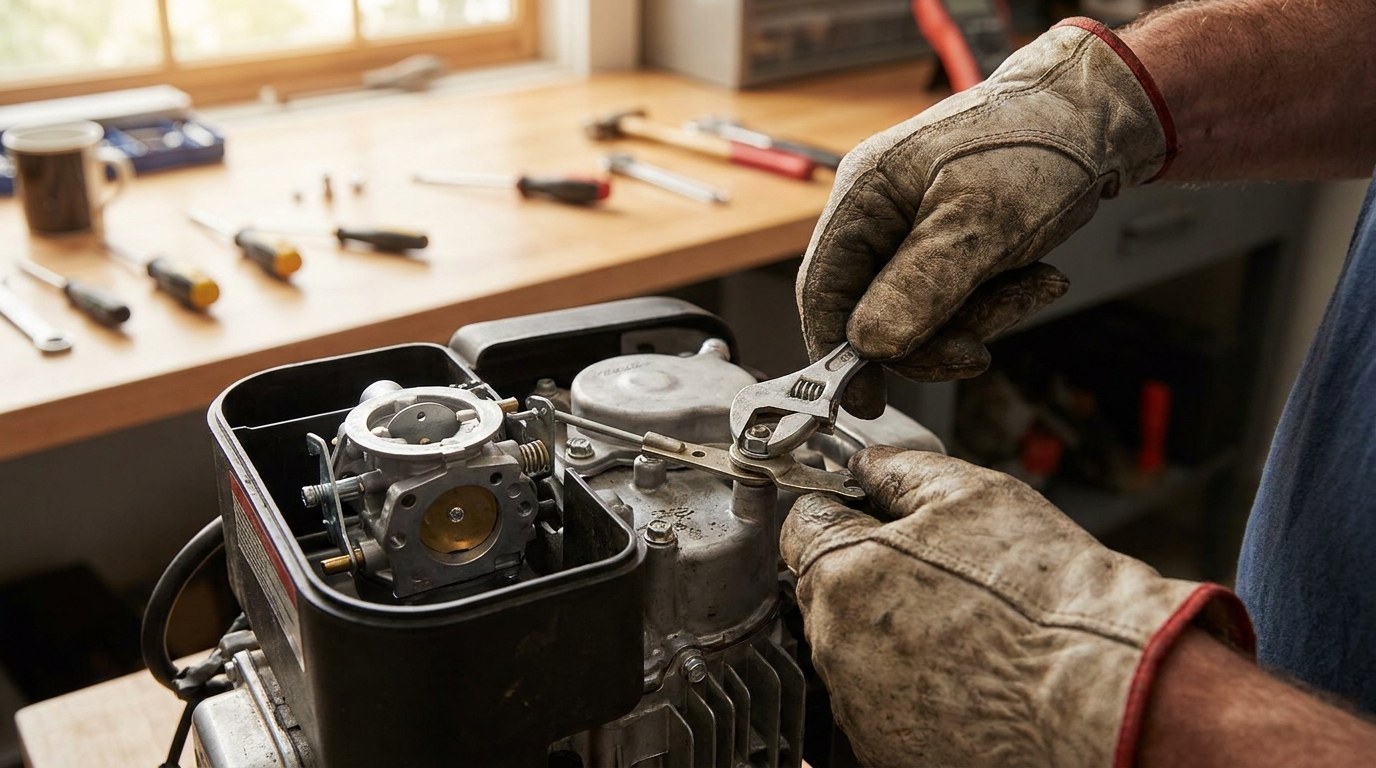
 If someone (you or a "helpful" friend) had the carburetor or intake off your mower and now the engine over-revs the moment it starts - races wide open, sounds like it's about to throw a rod - the governor linkage is reconnected wrong. The fix is usually about five minutes once you know where to look. Just don't run the engine more than a few seconds while it's like this; an unchecked over-rev will throw a connecting rod through the block in a hurry.
Here's the static-set procedure for the most common single-cylinder small engines (Briggs Endurance, Kohler 7000-series, and most Vanguard, Kawasaki FR, and Honda GX-series engines all use the same fundamental setup).
What the governor actually does
The governor is the mechanical brain that holds the engine at the speed the throttle is asking for. Inside the engine block there's a governor gear driven by the camshaft, with weighted flyballs that fling outward as RPM rises. That motion pulls a small shaft that comes out of the side of the block.That shaft connects through a short rigid arm (the governor lever) to a spring and a linkage rod that ties to the throttle plate in the carburetor.
When the engine speeds up: flyballs fling out, shaft rotates, lever moves, linkage pulls the throttle plate closed.
When the engine slows down (under load): flyballs collapse in, shaft rotates back, lever moves the other way, linkage pulls the throttle plate open.
The spring constantly pulls the throttle plate toward open. The governor counters by trying to close it. The balance point is your engine speed.
Why "reconnecting after a carb job" breaks it
Every static-set governor system has one critical assembly step: the relationship between the governor arm position on the shaft and the throttle plate position has to be set correctly with a specific procedure. The pinch bolt that holds the arm to the shaft is loose during this procedure, then tightened.If somebody pulled the carb without marking the linkage position, then tightened the pinch bolt down with the arm in the wrong spot on the shaft, you get one of two failure modes:
Linkage too far open at rest → engine starts and immediately races to redline. Governor can't pull the throttle closed because the arm-to-shaft relationship is offset.
Linkage too far closed at rest → engine starts but won't rev up under load. Throttle plate barely opens even when governor signals to open.
The over-rev case is the one that scares people and breaks engines. Static-set fixes it.
The static-set procedure
Engine off, key out, spark plug wire grounded.1. Locate the governor arm. It's a small steel arm clamped to a shaft sticking out of the engine block, usually on the carb side. The arm has a pinch bolt (8mm or 10mm head, often a flange-head bolt). Linkage rod connects from the arm to the throttle lever on the carburetor.
2. Loosen the pinch bolt. Don't remove it - just loosen so the arm rotates freely on the shaft. The arm will probably want to flop around, that's fine.
3. With one hand, push the throttle plate fully open by hand. Reach to the carb and hold the throttle lever in the wide-open position (or push the governor arm in the direction that pulls the linkage rod to wide-open throttle - depending on the engine, sometimes you push the arm toward the carb, sometimes away).
4. With your other hand, rotate the governor shaft to its hard stop in the SAME direction. The shaft has a hard internal stop where it can't rotate any further. The direction of that stop should match the direction that corresponds to wide-open throttle. Use a small wrench, screwdriver, or pliers on the shaft itself if it's smooth (most have a flat).
5. Holding both positions, tighten the pinch bolt. Use the torque figure in your engine manual. You want it firm so the arm won't slip on the shaft under engine vibration, but it's a small fastener and it'll strip if you lean on it.
6. Let go. The spring should pull the linkage rod and throttle plate back toward closed. The governor arm should rotate freely with shaft motion now, and the entire system should respond when you move the throttle cable or speed lever.
That's it. The arm-to-shaft relationship is now set so that "shaft at wide-open-stop" equals "throttle plate wide open" - the governor can do its job from anywhere short of that.
First start after static set
Before you bring it up to operating speed:- Set the throttle cable to about HALF throttle, not full.
- Start the engine briefly (a few seconds).
- Confirm it idles down when you pull the throttle cable to LOW.
- Confirm it revs up but stops at a reasonable governed speed when you push the throttle cable to HIGH.
If it over-revs again, shut it down immediately. Either the static set wasn't right (try again, paying attention to direction) or there's a separate issue like a broken governor spring, missing return spring on the throttle plate, or a stuck linkage joint.
If it runs fine at half throttle but is sluggish at full throttle, you may have the linkage rod in the wrong hole in the governor arm. Most arms have two or three holes at different distances from the pivot - moving the rod to a different hole changes the leverage and the responsiveness of the governor.
If the rod or spring is missing
When someone "takes the carb off and puts it back on," a small linkage spring or e-clip can disappear into a corner of the garage and never get reinstalled. Common missing parts:- Governor-to-throttle spring (the small coil spring along the linkage rod) - if it's not pulling the rod toward open, the throttle plate just sits where it ends up and the governor can't pull it closed under load
- Throttle-plate return spring (mounted on the carb itself) - same effect from a different angle
- E-clip on the linkage rod ends - the rod can pop out under vibration mid-run
Check the engine's parts diagram (most are online for free) and confirm every linkage piece is present before chasing a hard static-set problem.
When the governor itself is bad
If you do the static set correctly and the engine still over-revs or won't respond to load, the internal governor gear or flyball mechanism may be damaged. Symptoms include the shaft feeling loose or having no resistance when rotated by hand, or the engine revving up correctly but not pulling the throttle down when load is removed.Internal governor repair is a teardown job - case split, governor gear and flyballs replaced. That's hours of labor before you've bought a single part, and on a small engine the labor is usually the bigger half of the bill. Price it out before you commit. On an older engine that isn't worth much to begin with, a new short-block often comes in cheaper than the teardown, and you end up with a fresh engine instead of a repaired one.
Related reading
Engine over-revving and you'd rather not chance it?
A runaway small engine that's been running for a while can hide damage you won't see until you tear it down (rod bearings, valve heads, broken keyways). If you're not confident the engine is sound, don't put it back under load and find out the hard way. We're a Spartan and Echo dealer in Laddonia, MO, so if it turns out the engine's done, we can help you sort out what to put in its place.