
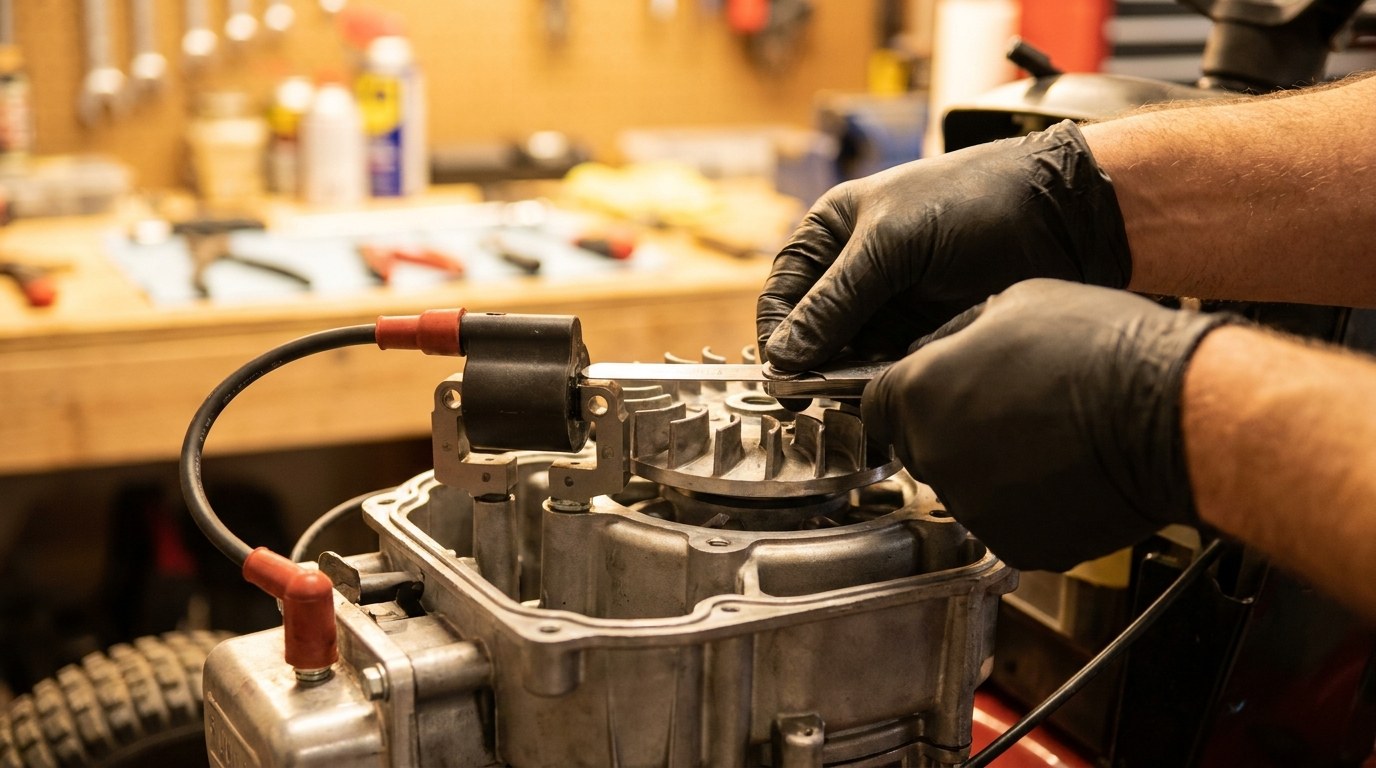
 If your mower, tractor, or generator fires up fine, runs perfectly for about five minutes, then dies and won't restart until it cools off - you've got one of the most common small-engine fault patterns in the book. The good news is the symptom is so specific that you can usually nail the diagnosis in under 10 minutes with no specialty tools.
Here's what's happening, the two most likely causes, and how to tell them apart.
What "runs 5 minutes then dies" actually tells you
When an engine runs and then dies on a consistent timer, it's a heat-sensitive failure. Something in the system works cold but fails when it gets hot. The two parts of the engine that change behavior with heat are the ignition coil (electrical) and the fuel system (vacuum/vapor). One of those two is almost always the answer.Quick way to narrow it down in your head before you touch anything:
- If the engine dies abruptly (running fine, then off, like a switch flipped) - lean toward the ignition coil
- If the engine surges, sputters, then dies (loses power gradually over 30-60 seconds) - lean toward the fuel system
Both are easy to test.
Suspect #1 - Heat-flaky ignition coil
The ignition coil on a small engine has a windings that's wrapped tightly around a core. When the engine warms up under load, the coil heats up too. If there's a microscopic break in the winding insulation, heat causes it to expand and the winding gap opens up - you lose spark, the engine dies. The coil cools off, the gap closes, you can restart.Coils are the #1 cause of this exact symptom on 5+ year old small engines.
The cold-water test (fastest diagnosis): The next time the engine dies, before you do anything else, spray cold water or compressed-air-upside-down directly on the coil. If the engine starts immediately after the coil is cooled, you've nailed it. The coil is bad and replacing it solves the problem.
The spark test (alternative): Pull the spark plug right after the engine dies, ground the threads to the cylinder head, and crank the engine. Watch for spark across the electrode. No spark = coil failed under heat.
Replacement is straightforward on most engines - one or two bolts holding the coil to the flywheel housing, set the air gap with a feeler gauge (0.010" - 0.014" typically), reconnect the kill wire. Aftermarket coils run $25-50 from Rotary, Stens, or Oregon. OEM coils run $60-90 depending on engine. Either works fine for a homeowner mower.
Suspect #2 - Fuel cap vacuum lock
If your engine dies gradually rather than abruptly, the fuel system is more likely. The most common version of this is a clogged fuel cap vent.Fuel caps have a tiny vent hole that lets air into the tank as fuel is consumed. Without that vent, the tank develops a vacuum as fuel level drops, and eventually the vacuum is strong enough to prevent fuel from flowing to the carburetor. Engine starves, sputters, dies. The moment you open the gas cap, you hear a "shhhhk" of air rushing in, and the engine will then start and run fine for another few minutes until the vacuum builds again.
The cap test: Right when the engine dies, loosen the fuel cap. If you hear air rushing in (vacuum release) and the engine starts and runs again, your cap vent is plugged. Either clean the vent hole with a small drill bit (1/16"), or replace the cap - they're $5-15.
Suspect #3 - Vapor lock in the fuel line
Less common but worth checking on hot days, especially on equipment with a plastic fuel line routed near the engine: fuel can boil in the line and form a vapor pocket that blocks flow. Symptoms are identical to the cap-vent issue, but loosening the cap won't fix it.Fix: re-route the fuel line away from heat sources, or upgrade to a heat-shielded line. Stens and several aftermarket suppliers sell heat-sleeved fuel line for $8-12 a foot.
Suspect #4 - Carb float bowl evaporation
Rarer but real, especially on engines with older brass-needle carbs: when the engine sits and gets hot, fuel in the float bowl can boil off. Engine dies because the bowl is empty, then takes a few minutes of cranking to refill before it'll restart.This one has a different signature: instead of dying after 5 minutes of running, it usually only happens after the engine has been shut OFF for a few minutes (hot soak), then it won't start until the bowl refills. Different problem, but lumped under "runs and dies" sometimes.
Fix is usually a carb kit - $15-30 - or just letting the float refill before cranking.
Diagnostic flowchart
The fast way to narrow it down:1. Engine dies abruptly → cold-water test the coil. If it restarts cold, coil is bad.
2. Engine dies gradually with sputtering → loosen the fuel cap when it dies. If it restarts with a vacuum release, vent is plugged.
3. Cap test doesn't fix it → pull the carb bowl and check for fuel level. Empty bowl after running = float or needle issue. Full bowl + still won't start = vapor lock in the line.
Most of the time you'll land on #1 or #2 and be back in business for under $50.
When it's deeper than the easy fixes
If you've replaced the coil and the cap, run the carb cleaner through it, and the problem persists - the next suspects are deeper: a partial fuel pump diaphragm leak, a stator/charging system feeding the coil incorrectly, or in rare cases a cylinder head gasket leak that's pulling combustion gas into the crankcase under load. Those are bench-and-test jobs, and chasing them by buying one part at a time gets expensive faster than most people expect.SERVICE AND MAINTENANCE
Mower maintenance here, equipment road service at the jobsite.
We do zero-turn maintenance on Spartans and other makes, and for the big iron we come to you: road service for construction and ag equipment, most makes, across 15 counties in central and northeast Missouri, quoted on the phone before we roll.
Related reading
Stuck after the easy fixes?
If you've done the cold-water test and the fuel cap and it still dies after five minutes, you're almost certainly into the carb or the coil, and on an older engine that's the point where the repair bill starts competing with the machine's value. We're a Spartan and Echo dealer in Laddonia, MO, so if you're at that fork, give us a call and we'll help you figure out which way to go.