
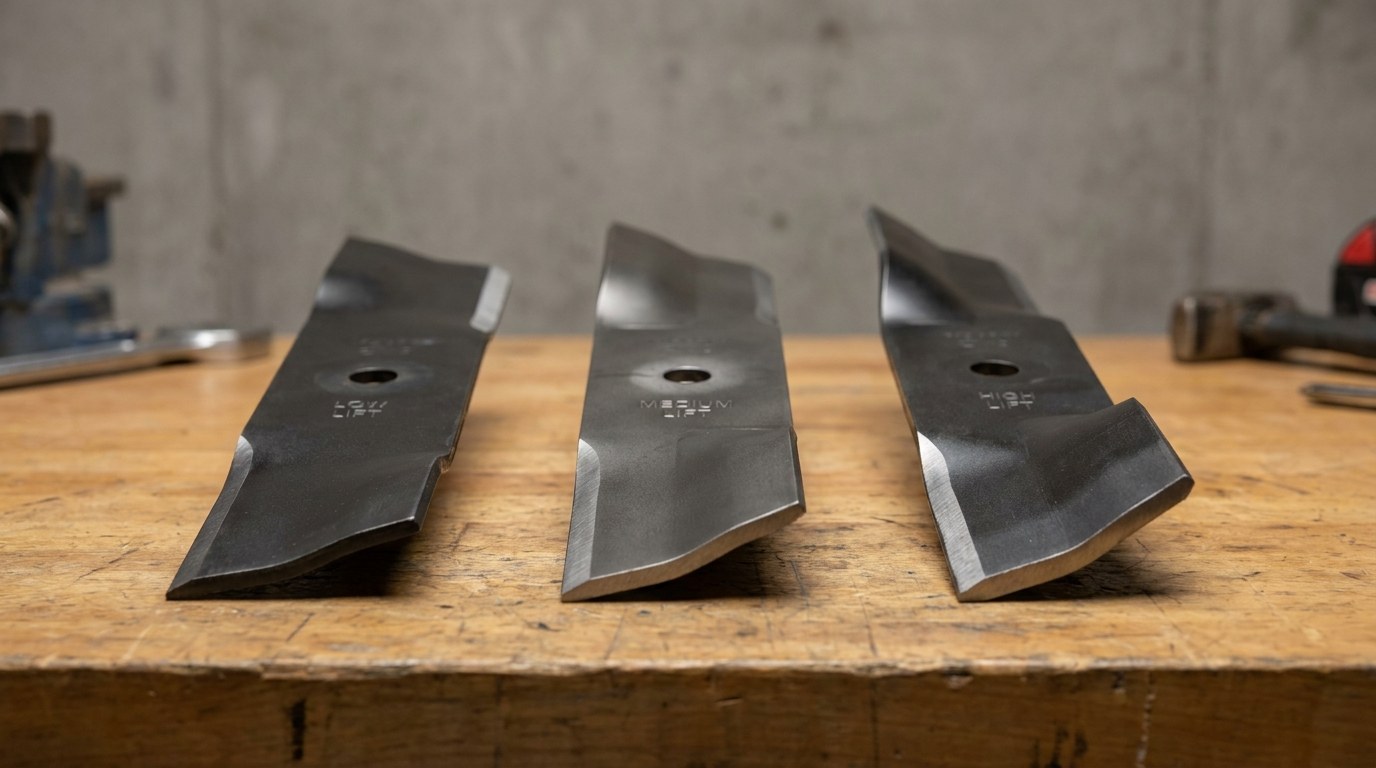
 If you've ever stared at the blade rack at a dealership or parts store and wondered why there are three or four different "lift" levels for the same deck size, you're not alone. The answer matters more than most people realize: the wrong blade lift on your zero-turn or riding mower will dull the cut, walk the deck on hills, eat fuel, and prematurely chew the spindle bearings. The right one disappears - you just get a clean cut and forget about it.
Here's how to pick the right lift for your deck size and your mowing situation.
What "lift" actually means
A mower blade has two functional jobs: cut the grass, and move the grass off the deck. The cutting happens at the leading edge; the moving happens via the curved or angled trailing portion of the blade, which acts like a small airfoil. The bigger the curve or angle, the more air the blade pulls up through the deck - that's lift.- Low lift (sometimes called "regular" or "standard") - mild airfoil, gentle suction. Less debris kicked into the deck, less power required, quieter.
- Medium lift - moderate airfoil, balanced suction. The default OEM choice on most mowers.
- High lift - aggressive airfoil, strong suction. Best for vacuum-bagging and tall thick grass.
- Gator / mulching - serrated trailing edge, recirculates clippings rather than discharging them.
You can think of it like fan blades: a slow-turn fan moves less air with less load on the motor. A high-velocity fan moves more air but draws more current and gets louder. Same engine, different work.
Match the lift to how you discharge
The single biggest factor in choosing lift is what you do with the clippings.Side discharge (most homeowner mowing) - medium lift is the right answer 80% of the time. It lifts enough to stand the grass up for a clean cut but doesn't blow clippings into a sticky clump on the lawn or pull a ton of dust into your face on dry days.
Bagging / vacuum collection - high lift, always. The bagger needs strong airflow to pack the bag tight; medium lift will leave the bag half-full of fluffy clippings and you'll spend the day emptying it. High lift also keeps the bagger chute clear of clogs.
Mulching - mulch / Gator blades. These are specifically designed to recirculate clippings under the deck until they're chopped small enough to drop. Don't try to mulch with a high-lift blade - the strong upward airflow blasts clippings out the back of the deck before they can chop, defeating the purpose.
Striping a lawn - medium or high, plus a striping kit. The lift doesn't make the stripes; the roller behind the deck does. But high lift gives you cleaner, brighter stripes because the grass is standing up properly before the roller flattens it.
Match the lift to your terrain
The second factor is hills. High-lift blades pull harder on the spindle bearings AND create more lateral force on the deck. On hills, that translates to the deck wanting to walk to one side at the worst possible moment.Flat-to-gentle terrain - any lift level works. Pick by discharge method.
Hills more than 10-15 degrees - drop to medium lift even if you'd otherwise want high. The reduced lateral force keeps the deck tracking straight and saves your spindle bearings over time.
Wet grass on hills - low lift sometimes wins here, even though that sounds wrong. Less suction means less wet-clipping clump-up under the deck, which means the deck doesn't slide on the matted layer.
Match the lift to your deck weight
Bigger heavier deck = handles higher lift fine. Smaller lighter deck = high lift overworks the spindle.32-42 inch decks (smaller homeowner mowers, Shield 42, RZ-XD 42) - medium lift unless you're bagging. The lighter spindle and bearing setup on these decks isn't designed for the constant high-RPM load that aggressive high-lift blades put on it. Save the high-lifts for bag days only.
48-54 inch decks - medium or high depending on use case. Either is fine on the standard heavier spindle.
60-72 inch decks (Spartan SRT, SRT-XD, commercial units) - whatever the application calls for. The spindles on these are sized to handle high-lift continuously.
Brand and aftermarket considerations
OEM blades from the mower manufacturer are usually a safe default - the engineering team that designed the deck picked a lift level that works with the spindle, deck shape, and engine. If you don't know what to start with, OEM matches what came on the mower from the factory.Aftermarket from Oregon, Stens, and Rotary is generally equivalent quality at a lower price. The cross-reference is by length and center-hole size, not by mower model directly - which means a Spartan 42-inch blade and a Cub Cadet 42-inch blade might be the same physical part with different stickers.
Ballard is a premium aftermarket option that a lot of Spartan owners swear by. Their high-lifts are popular for bagging, and their mulching blades have a strong following. Just be aware that the 2024+ Spartan RZ-HD Blackout decks moved to a larger center spindle hole - if you've got that machine, double-check Ballard has shipped the bigger-bore version before you order (as of mid-2026 they hadn't fully rolled it out).
Avoid any "no-name" blades from a marketplace listing without a manufacturer name. Cheap stamped steel will dull in a week, bend the first time it hits a stick, and is sometimes out of balance enough to vibrate the spindle bearings to death.
Quick-reference cheat sheet
If you want one line per situation:- Suburban lawn, side discharge, 42-54 inch deck → medium lift OEM or Oregon equivalent
- Rural acreage, mostly flat, 54-61 inch deck → medium lift or high lift, your call
- Bagging weekly → high lift, regardless of deck size
- Mulching weekly → Gator or dedicated mulching blade
- Steep hills, any deck → medium lift, never high
- Wet conditions often → low or medium, never high
- Striping → medium or high, plus a striping kit roller
- Small homeowner deck (32-42 inch), not bagging → medium lift, save the spindle bearings
A note on blade balance
Whatever you pick, blade balance matters more than brand. A new blade out of the box should sit level on a balance cone or a nail through the center hole. If one end dips, file or grind the heavy end (NEVER the cutting edge) until it sits flat. An unbalanced blade vibrates the spindle and shortens bearing life dramatically - dollars-of-savings on a blade can cost you a $200 spindle assembly if you skip this check.Related reading
Need help picking blades for your mower?
We keep OEM and aftermarket blades in stock for most Spartan, Echo, and common box-store machines. If you're not sure what fits your deck or whether you should go medium or high lift for your property, give us a call - usually a 2-minute conversation, no charge.