
 If you turn the key on your tractor or zero-turn mower and all you get is a click (or rapid clicking) instead of a crank, that sound is actually telling you exactly what's wrong. Most of the time it's not the starter and it's not the engine. It's something cheaper, and you can usually find it in 15 minutes with a multimeter and a wrench.
 Here's how to walk through it the way we would in the shop.
One click vs. rapid clicks
The two patterns mean different things.One solid click and nothing else usually means the starter solenoid pulled in but the starter motor itself didn't crank. The likely cause is a bad starter, stuck Bendix gear, or a starter ground that's gone open.
Rapid clicking (chatter) usually means the battery doesn't have enough amps to hold the solenoid engaged. The solenoid pulls in, voltage drops, it kicks back out, voltage recovers, and the cycle repeats several times a second. Almost always a weak battery or a bad connection at the battery terminal, not the starter itself.
Knowing which one you're hearing saves you from chasing the wrong part.
Step 1 - Check the battery voltage
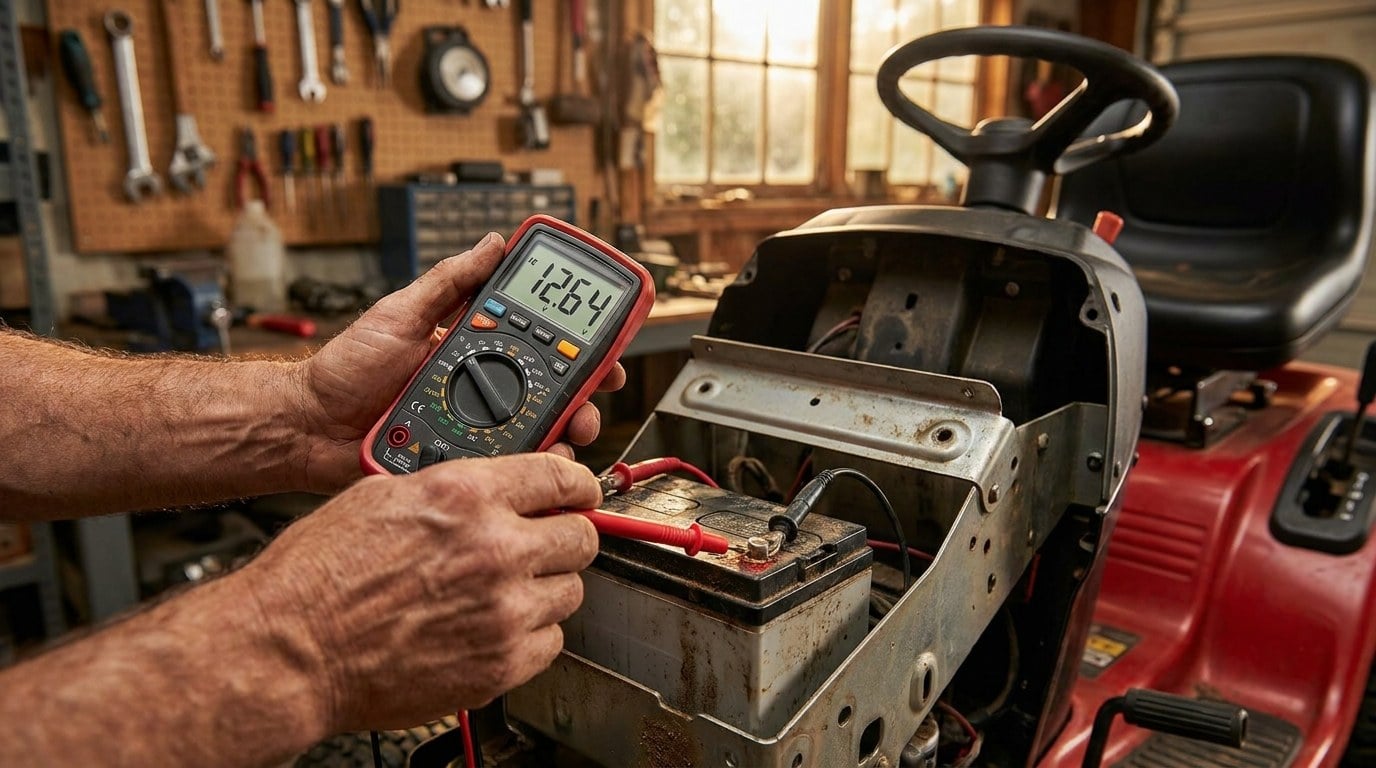
Set a multimeter to DC volts and put the probes on the battery posts (not the cable clamps).12.6V or higher - battery is fully charged. Probably not your problem.
12.2V to 12.5V - battery is okay but not great. Could still crank, but a marginal battery + cold morning + corroded cable will fail.
Under 12.0V - battery is the prime suspect. Charge it overnight on a real charger (not a trickle), then retest.
Under 11.5V - battery is likely toast. A 12V lead-acid battery that won't hold above 11.5V at rest usually has a dead cell internally and a charge won't bring it back.
If you're under 12.0V, charge first before doing anything else. Most "starter problems" on a mower or tractor are actually just a tired battery.
Step 2 - Load test the battery
Voltage at rest doesn't tell you the whole story. A battery can read 12.6V sitting and still drop to 6V the moment you try to crank. That's a failed battery internally.If you don't have a load tester, the cheap trick is to have someone turn the key while you watch the multimeter across the battery posts. Voltage should stay above 9.5V during the cranking attempt. If it dives below 9V, that's a dead cell or sulfated plates - the battery is done.
A new lawn-and-garden battery is $40-80 at most parts stores. Cheaper than chasing electrical ghosts.
Step 3 - Cables, terminals, and grounds
This is where most "I replaced the battery and it still clicks" stories end. The battery can be perfect, but if the cable can't deliver the amps, you'll get exactly the same symptom.Pull the cable clamps off both posts. Look for:
- Green or white powdery corrosion on the post or inside the clamp (sulfate buildup, blocks current)
- A loose clamp that wiggles on the post when wrenched down
- Crimped cable lugs that have separated internally (squeeze the lug - if it flexes against the cable, the crimp is shot)
- A ground cable that goes to a rusty frame point (paint, dirt, or rust on the contact face kills the ground)
Clean the posts and clamps with a wire brush or post cleaner. Tighten until the clamps don't move. If a cable lug is bad, replace the cable - don't try to re-crimp at the end with a soft hand crimper.
For ground problems, find the ground cable's chassis stud, remove the bolt, sand the metal under the lug down to clean steel, and reinstall with a star washer.
Step 4 - Test the safety switches
If the battery is good and the cables are clean and you're still getting a click (or no click at all), the next suspect on a mower or compact tractor is the safety interlock circuit.Most zero-turn mowers and lawn tractors have at least three safety switches that all have to be in the right position before the starter will crank:
- Seat switch (you must be sitting on it)
- PTO/blade switch (must be OFF)
- Brake or parking-brake switch (must be engaged)
- Sometimes a control-lever neutral switch (steering levers must be out in neutral position on a ZT)
A failed switch or a loose wire on any one of these will block the start signal from reaching the solenoid. If you hear NO click at all when you turn the key, the safety circuit is the first place to look - the click only happens when the start signal makes it to the solenoid.
The fast diagnostic is to bypass the safety circuit temporarily by jumping 12V directly to the small "S" terminal on the starter solenoid (with the mower in park, brake on, and no PTO engaged for safety). If the starter cranks when jumped but not from the key, the problem is upstream in a safety switch or the ignition switch itself.
Step 5 - The solenoid itself
If you can hear the solenoid click but the starter doesn't crank, and you've confirmed the battery has plenty of voltage during the click, the solenoid is the likely culprit.There are two flavors:
Starter-mounted solenoid (common on most modern mowers) - the solenoid is bolted directly to the starter housing. Replacement usually requires pulling the starter, but the part is $20-40.
Remote/fender-mounted solenoid (older tractors and some commercial mowers) - it's that round can with two big terminals and one or two small terminals, mounted on the firewall or fender. Easy to replace, $15-30 at any parts store.
To test a remote solenoid: with the key in the start position, you should read 12V on the small "S" terminal. If you have 12V on S but no voltage passing from the big input post to the big output post, the solenoid's contacts are burned and it needs replacing.
Step 6 - The starter itself
The starter is usually the last suspect, not the first - they fail less often than people think. But after everything above checks out, if you've got full battery voltage at the starter's main input post and a 12V signal on the S terminal, and the starter still won't turn, the starter motor is bad.Symptoms of a failed starter:
- Single click, no rotation, full voltage present
- Free-spins without engaging the flywheel (worn Bendix or solenoid plunger)
- Cranks slowly even with a fresh battery and clean cables (worn brushes or armature)
A rebuilt starter for most small-engine applications runs $80-150 with core. Original-equipment new starters can be twice that. Most parts counters can cross-reference the part number off the starter body.
Quick-diagnosis table
If you don't want to walk the whole sequence, here's the shortcut:Rapid clicking, no crank → Battery weak or cable connection loose. Charge battery, clean terminals, retest.
Single click, no crank, lights stay bright → Solenoid contacts burned or starter motor seized. Test solenoid; if good, replace starter.
Single click, no crank, lights dim hard → Battery has voltage but no amps (dead cell), OR a cable has high resistance. Load-test battery first.
No click at all → Safety interlock blocking the start signal. Check seat switch, PTO switch, brake switch, neutral switch. Jump the S terminal to confirm.
Clicks intermittently in cold weather only → Battery losing capacity (cold-cranking amps drop with age). Time for a new battery.
When it's time to call a shop
If you've worked through the steps above and you're still stuck, the next likely suspects are inside the engine itself - a seized crankshaft, hydro-locked cylinder, or sheared flywheel key. Those are tools-and-disassembly jobs and usually worth a shop visit.If you're in Central Missouri, give us a call - we're a Spartan and Echo dealer in Laddonia and our service techs work on most makes. We'll diagnose it for a flat rate and quote any repair before we start cutting into it.
Related reading
Stuck on your starter diagnosis?
If you've worked through the checks above and your mower or tractor still won't crank, bring it in or give us a call. We're a Spartan and Echo dealer in Laddonia, MO and our service techs work on most makes - we'll diagnose the problem for a flat rate and quote any repair before we touch a wrench to it.