
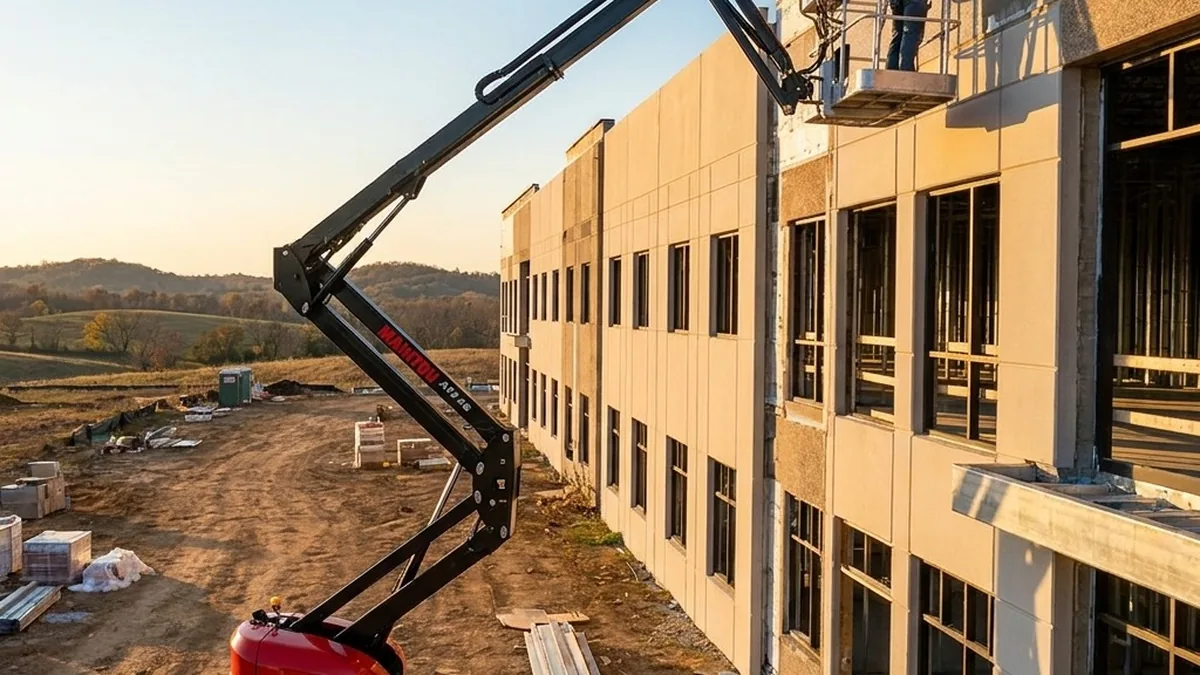
If you're shopping for an aerial work platform for electrical work, the honest answer is that the "best" lift depends entirely on your trade and your job sites. An electrician finishing out a warehouse needs something very different from a sign crew reaching over a storefront, and both need something different from a steel erector standing on raw graded dirt. There's no single AWP that does it all well. This guide walks through how the major lift types match up to four trades that buy them most often around mid-Missouri: electrical and HVAC, sign and facade, steel and framing, and tree work. ESO carries the Manitou aerial line, and we'd rather help you land on the right machine than sell you a lift you fight with on every job.
Two basic decisions drive almost everything: do you work mostly indoors on finished floors or outdoors on rough ground, and do you need to go straight up or reach out and over things in your way. Get those two right and you've narrowed the field fast. Let's break it down by who's doing the work.
Start With Two Questions: Where You Work and What's in the Way
Before you look at any model, picture your typical day. Are you on a slab, a parking lot, or a dirt lot? And when you're up top, are you going straight up to a ceiling, or do you need to swing the platform out over a roofline, a sign, or a row of obstacles?
That second question is the difference between a scissor lift and a boom lift, and between a radial boom and a vertical lift. We dig into both of those splits in our guides on scissor lifts versus boom lifts and radial versus vertical lift, and they're worth reading before you commit. The short version:
- Scissor lift goes straight up and down on a large platform. Great for ceilings, lights, and ductwork when you can drive right under the work.
- Vertical mast lift is a compact straight-up lift with a small footprint, built for tight indoor spaces.
- Articulating boom bends at a knuckle so you can reach up, out, and over obstacles. This is your reach-over machine.
- Telescopic boom extends in a straight line for maximum horizontal reach without much obstruction in the way.
Every trade below leans on one or two of these. Once you know which, picking a machine is mostly about terrain and how high and far you really need to go.
Choosing an Aerial Work Platform for Electrical Work and HVAC
Electrical and HVAC crews are the classic AWP buyers, and they usually split into two camps depending on the job. Choosing an aerial work platform for electrical work really comes down to whether the job is inside or out, so that's the first fork in the road.
Indoor Finish Work
If you're pulling wire, hanging fixtures, setting rooftop unit connections from inside, or running conduit across a finished space, a scissor lift is usually the move. You get a big, stable platform to set tools and material on, and on a flat slab you can drive it right under the work and go straight up. For tight interiors, retail buildouts, and spaces with finished floors you don't want to chew up, a compact electric scissor or a vertical mast lift keeps the footprint small and the floors clean. Electric drive matters indoors. No fumes, quieter, and it won't fail an inspection on emissions in an occupied building.
Outdoor and Service Work
The second you step outside to service a parking-lot light pole, hit a rooftop unit from the ground, or reach a panel on the side of a building, the calculus changes. Now you may need to reach over a curb, a landscaped bed, or a parked vehicle, and you're probably on pavement or gravel, not a polished slab. That's boom territory. An articulating boom lets you tuck up and over the obstacle and set the basket exactly where the work is. For service techs who bounce between sites, a boom that handles a typical commercial lot without drama is worth a lot more than raw platform size.
If your work is genuinely split between clean indoor jobs and rough outdoor service calls, you may be looking at two machines, or one boom that's rated for both. That's exactly the kind of tradeoff we'll talk through with you instead of guessing.
Sign and Facade: Articulating Boom for Reach-Over
Sign installers and facade crews live and die by reach-over. You're rarely able to park directly under the work. There's a sidewalk, a planter, an entry canopy, a drive-through lane, or a row of cars between your machine and the sign face. You need to get the platform up, out, and back over all of that to land where the bolts are.
This is the home turf of the articulating boom. The knuckle in the middle of the arm is what lets you clear an obstacle and then bring the basket back in toward the building. A few things sign and facade buyers should weigh:
- Up-and-over reach beats raw height. A lift that goes very high but only straight up doesn't help when there's an awning in the way. Horizontal and over reach are what put you on the sign.
- Platform maneuverability. Channel letters, raceways, and backlit signs need fine positioning. A boom that lets you nudge the basket in small moves saves a lot of repositioning the whole machine.
- Terrain at the base. Storefront work is often on pavement, but new construction signage might be on dirt. Match the chassis to where you'll actually set up.
For facade restoration, tuckpointing, and exterior detail work, the same reach-over logic applies. You're picking the machine that lets you place a worker at an awkward point on a wall without rebuilding scaffolding every time you shift sideways. If reach-over is your whole business, an articulating boom is almost always the answer, and the question is just how much reach and what kind of terrain.
Steel and Framing: Rough-Terrain Is the Whole Game
Steel erectors and framing crews almost never get a nice flat slab to work from. You're on graded dirt, mud, gravel, ruts, and slopes, often before the building even has a floor. For these trades, terrain capability isn't a nice-to-have. It's the entire decision.
A standard slab scissor lift will get you nowhere on a raw site. You want a rough-terrain machine built for outdoor ground: bigger drive components, more ground clearance, and the stability to work on the kind of uneven, soft surfaces a job site throws at you. That can be a rough-terrain scissor for bolting up at a consistent height across a large footprint, or a rough-terrain boom when crews need to reach individual connection points up in the iron.
A few things steel and framing buyers should think through:
- Ground conditions change by the week. A site that's firm in July is soup after a mid-Missouri spring rain. Buy for your worst day, not your best.
- Stability over slope. Working at height on uneven ground is where lifts get dangerous. Rough-terrain machines are built to stay planted where a slab lift would never be rated to go.
- Move-around without re-trailering. On a big steel job you're constantly relocating the lift across the site. A machine that drives the terrain itself beats one you have to baby or tow.
If you're a contractor who already runs Manitou or Gehl dirt equipment, there's a real case for keeping your aerial line in the same family. One dealer relationship, one brand to deal with, and operators who already know the controls. We get into the broader buy-versus-other-options math in our piece on renting versus buying a loader or telehandler, and the same thinking applies to a lift you'll use week in and week out.
Tree Work: Articulating Reach Into the Canopy
Tree crews, line-clearance work, and utility vegetation management have their own version of the reach-over problem, except now the obstacle is the tree itself. You need to get a worker up into a canopy, around limbs, and out to the work without the trunk or other branches in the way.
That's articulating boom work again. The knuckle lets you weave the basket through and around growth to reach a specific limb, which a straight telescopic boom can't do as well when there's a lot of stuff in the path. For tree and vegetation crews, the things that matter most:
- Reach into and around obstacles. Canopies aren't open columns. The ability to articulate around branches is the difference between reaching the limb and not.
- Terrain at the tree line. Trees rarely grow next to pavement. You're often on grass, easements, ditches, and soft shoulders, so a rough-terrain chassis usually makes sense.
- Outdoor power. Most tree work is outdoor and remote, so engine drive and the range to work away from any power source tend to win out over electric.
One note worth stating plainly: line-clearance and any work near energized conductors has strict requirements around insulated equipment and qualified crews. That's a safety and compliance conversation, not just a machine-shopping one. Tell us if your tree work goes near power and we'll make sure we're pointing you at the right kind of equipment for it instead of just the closest fit.
Electric or Engine, and Why It Comes Down to the Job
Across all four trades, power source keeps coming up, so it's worth its own quick section. The rule of thumb is simple:
- Electric drive wins indoors and on finished surfaces. No emissions, quieter operation, and a cleaner footprint for occupied buildings and tight spaces.
- Engine drive wins outdoors and on rough ground where you need the grunt to move across a site and the freedom to work away from any outlet.
There's also a financing angle here. ESO's current program is 0% for 48 months on skid and track loaders, rates from 1.99% across the line (1.49% on electric machines), through September 30, 2026. If you're leaning electric for indoor work anyway, that lower rate on electric machines is worth factoring into the comparison. You can see the broader picture on our financing page, and we'll run the actual numbers against the machine you're considering.
Don't Buy on Height Alone
The single most common mistake we see is buying a lift on platform height and nothing else. Height is the easy number to compare, so people fixate on it. But it tells you almost nothing about whether the machine fits your trade. A few things that matter more than a big height figure:
- Reach pattern. Straight up versus up-and-over decides whether you can even get to the work. This is the whole scissor-versus-boom and radial-versus-vertical question.
- Terrain rating. A lift you can't safely set up on your actual ground is useless no matter how high it goes.
- Footprint and access. Can it fit through the door, down the aisle, or into the gate at your typical site?
- Drive type. Electric or engine, matched to where you spend most of your hours.
If you're not sure where you land on any of these, our find your machine tool walks you through the same questions a good salesperson would ask, and our aerial work platforms hub lays out the Manitou lift types we carry.
Why Buy Your Lift From a Local Mid-Missouri Dealer
Here's something a lot of buyers around here learn the hard way: most aerial equipment gets sold by dealers a long drive away, which makes every question and every part a road trip. ESO is based in Laddonia, MO, and we're the only Manitou and Gehl dirt-equipment dealer for about 50 miles. We work with contractors across mid-Missouri, including Columbia, Jefferson City, Mexico, Fulton, and the underserved stretch up through Mexico, Vandalia, and Bowling Green that bigger metro dealers tend to skip.
What that means for you is simple. When you're picking a lift, you're talking to someone who knows the local job sites, the ground conditions, and the trades buying this equipment, not a call center three states away. We'd rather take the time to match the machine to your trade up front than have you stuck with a lift that's wrong for the work.
If you also run loaders or telehandlers and are weighing how a lift fits into a broader fleet, our breakdown of telehandlers versus forklifts shows how we think through matching a machine class to the actual task, and the same approach applies to your aerial line.
Tell Us the Trade and the Site, and We'll Spec the Lift
Every section above comes back to the same two things: what trade you're in and what your job sites look like. Give us those and we can do the rest. Tell us whether you're electrical, HVAC, sign, facade, steel, framing, tree, or something else, and tell us the ground you work on and the obstacles you reach around. We'll spec a Manitou lift that actually fits, walk you through the financing, and give you a real quote with no pressure. Start a request a quote and let's get you on the right machine.