
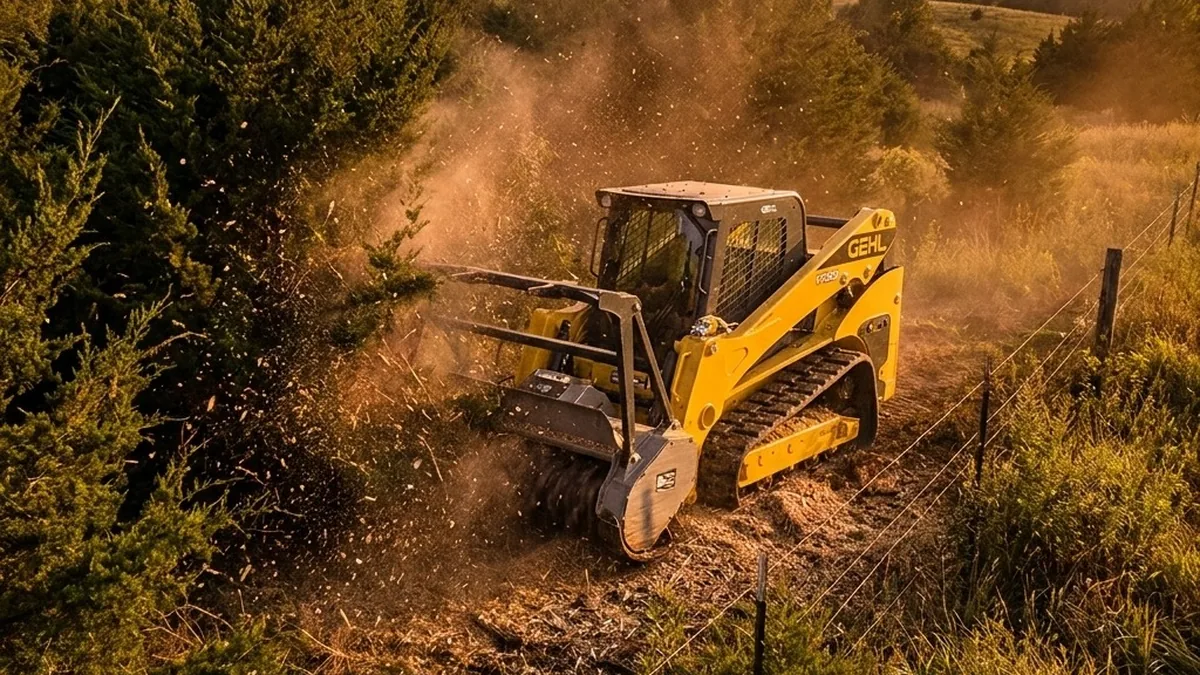
If you're trying to reclaim a cedar-choked fence line, open a hunting road, or take back a pasture that's gone to brush, the tool that gets it done is a forestry mulching skid steer. Around here that almost always means a high-flow compact track loader running a drum mulcher head, set up with severe-duty protection so it survives the work. It grinds standing cedar, brush, and saplings into a mulch layer right where they stood. No piling, no burning, no hauling. We're Equipment Solutions Outdoors in Laddonia, MO, and we sell the Manitou and Gehl machines and attachments that handle this exact job across mid-Missouri. This guide walks through what the work actually takes, why a track loader beats a wheeled machine for it, and how to decide whether to own the rig or hire it out.
The Job: What Mid-Missouri Land Clearing Actually Looks Like
Cedar is the problem child of this region. Eastern red cedar spreads fast, takes over pasture, crowds fence lines, and turns a clean field into a thicket in a few seasons. Left alone, it costs you grazing acres, blocks your sightlines, and becomes a fire load. The classic mid-MO clearing jobs we hear about look like this:
- Fence lines. Years of brush and small cedar growing right up against the wire. You want a clean strip back so you can see, maintain, and eventually replace the fence.
- Pasture reclamation. Grazing ground that's gone to cedar and brush. You want it back to grass, and you don't want a field full of stumps and burn piles.
- Hunting roads and trails. Cutting a clean lane through timber for access, food plots, or stands, without tearing up the ground.
- Overgrown lots and building sites. Clearing a footprint for a shop, a pad, or a new home, where you need to get rid of standing brush and small trees fast.
- Storm and edge cleanup. Knocking back the wood line that's creeping into a field or a yard.
Forestry mulching handles all of these in one pass. The head grinds the standing material into chips that drop in place and break down into the soil. You're not generating piles to deal with later. For a landowner, that one-pass workflow is the whole appeal. The mulch even helps hold moisture and slows regrowth for a while.
Why a Forestry Mulching Skid Steer Setup Is Two Decisions, Not One
People say "forestry mulcher" like it's a single thing. It's really two purchases that have to match: the carrier (the loader) and the head (the attachment). Get either one wrong and the whole rig underperforms. Here's how to think about each.
The carrier: a high-flow compact track loader
A mulcher head is a hungry attachment. It runs off the machine's hydraulics, and the more oil flow you can feed it, the harder and more consistently it cuts. That's why mulching is a high-flow job. A standard-flow loader can spin a small head, but it bogs down in real cedar and you spend the day waiting on the machine to recover. For serious clearing you want a loader built for high-flow auxiliary hydraulics so the head stays loaded and keeps grinding.
The carrier also has to put that power to the ground and stay stable while a heavy head hangs off the front. That's a job for a compact track loader, which we'll get to in the next section. The point here is simple: spec the carrier and the head together, as a system. A capable head on an underpowered carrier is a slow, frustrating machine. We help mid-Missouri buyers match the two on our compact track loader lineup so the pairing actually works in cedar.
The head: a drum mulcher built for cedar
For clearing standing cedar and brush, a drum-style mulcher is the workhorse. The drum carries teeth or knives that grind material as it spins, and a heavy drum keeps its momentum through tough wood instead of stalling on it. Drum mulchers are forgiving on a wide range of material, from saplings up to the kind of standing cedar that takes over a fence line.
What matters when you're picking a head:
- Match it to your carrier's flow. The head has to be rated for the oil flow your loader actually makes. Oversize the head for your machine and it never reaches its rhythm.
- Tooth or knife style. Different cutting setups trade durability against finish. Fixed carbide-style teeth shrug off the dirt and grit you hit at ground level on fence lines. Knife setups can leave a finer mulch. For cedar and brush work, durability usually wins.
- Build for abuse. Mulching is a high-wear job. A head built with serviceable wear parts and solid construction earns its keep, because you will be replacing teeth over the life of the machine no matter what.
We spec mulcher heads alongside the rest of our attachment lineup, and the head you need depends entirely on the carrier it's bolting onto. That's why we don't quote a head in a vacuum.
Why a Track Loader Beats a Wheeled Machine Here
This is the question we get most often: skid loader or compact track loader for mulching? For clearing cedar and brush in mid-Missouri, the track machine wins, and it's not close. Here's why.
Flotation on soft and uneven ground
Tracks spread the machine's weight over a much larger footprint than tires. That flotation keeps you working on soft pasture, in damp bottoms after a rain, and on the kind of uneven, rooty ground you find along fence lines and timber edges. A wheeled skid loader sinks and spins where a track loader keeps moving. In our part of Missouri, where you're often working ground that's wet half the year, that difference decides whether you work or wait.
Traction to keep the head loaded
Mulching needs the machine to push steadily into standing material while the head grinds. Tracks deliver the traction to do that without breaking loose and spinning. More traction means a more consistent cut and less time fighting the machine. On a slope, that grip also keeps you safer and more in control.
Less ground damage
Because tracks spread the load, they tear up turf and topsoil far less than spinning tires do. If you're cutting a hunting trail you want to use, or reclaiming pasture you want back in grass, you care about leaving the ground in good shape. That's a real edge for a track machine on this kind of work.
There's a place for wheeled skid loaders, and plenty of mid-Missouri operations run both. For mulching cedar on soft and uneven ground, though, we point buyers to a compact track loader almost every time. If you want to talk through your own mix of jobs, our guided machine selector is a quick way to narrow it down before you call us.
Severe-Duty and Forestry Protection: Don't Skip It
A loader off the lot is not ready to go grind cedar. Mulching throws wood chips, sticks, dirt, and the occasional rock back at the machine at speed, all day. Run an unprotected machine into that and you'll find the weak points fast, usually in the form of cracked glass, dinged cooling cores, and chewed-up hydraulic lines. Forestry-duty protection exists because the work is genuinely hard on equipment. The pieces that matter:
- Forestry cab glass or guarding. A heavy polycarbonate front, screen, or guard package so flying debris doesn't put a chip through the windshield and into the operator. This is a safety item first.
- Belly and undercarriage protection. Plating that shields the underside from stumps, rocks, and standing material you drive over and through.
- Cooling and intake guarding. Screens that keep chips and chaff out of the radiator and intake. A clogged cooling system overheats a machine fast in this work, so this protection directly affects how long you can run.
- Hose and cylinder protection. Guarding for exposed hydraulic lines and cylinders that would otherwise get sliced or crushed by the material you're clearing.
- Reversible or aggressive tread tracks. Track selection suited to the mud, debris, and rough ground of a clearing job.
None of this is upselling for its own sake. Skip the protection and the work itself will find every gap. We spec the severe-duty and forestry package as part of the machine, not as an afterthought, because a mulching rig without it is a machine you'll be patching instead of running.
What It Costs You to Ignore the Maintenance
Mulching is one of the most demanding things you can ask a loader to do, and the maintenance reflects that. This is buyer education, not a sales pitch for a shop. Know what you're signing up for before you buy, so the rig stays productive and holds its value.
- Teeth and wear parts. Mulcher teeth wear, and dull teeth turn a fast job into a slow, fuel-burning grind that's also harder on the whole machine. Plan on rotating and replacing teeth as part of normal operation. Letting them go dull is the most common way people make a good rig perform like a bad one.
- Cooling system, kept clean. Chips and chaff pack into radiators and screens. If you don't blow them out regularly, the machine overheats and you lose your day, or worse, you cook something expensive. This is the single most ignored maintenance item in mulching, and the most punishing.
- Hydraulic health. High-flow work runs the hydraulic system hard and hot. Stay on top of filters and oil, watch for leaks at the head couplers, and don't let debris damage go unaddressed.
- Undercarriage on a track machine. Tracks, rollers, and idlers wear, and clearing work is gritty. Keeping the undercarriage clean and watching wear protects one of the more expensive systems on the machine.
The honest takeaway: a mulching rig pays you back when it's maintained and costs you when it isn't. We'd rather you go in clear-eyed than be surprised six months later.
Own It or Hire It Out?
Not everyone should own a mulching rig, and we'll tell you that straight. The decision usually comes down to how much clearing you really have and whether it's a one-time job or an ongoing need.
When hiring it out makes sense
If you've got a single fence line or one overgrown lot and you don't expect to do it again for years, hiring a contractor for a day or two is often the smarter money. You get the job done without owning, maintaining, and storing a specialized machine you'll use once. For a true one-and-done, that's the right call.
When owning pays off
Owning starts to make sense when clearing is a recurring part of how you run your ground:
- You're fighting cedar regrowth across a working cattle or hay operation, year after year.
- You manage hunting ground and you're always cutting and maintaining trails, edges, and food plots.
- You're a landowner with real acreage and an ongoing list of clearing, and the machine does plenty of other work too.
- You're a contractor or operator who can put the rig to work on jobs beyond your own property.
Here's the part people overlook: a compact track loader isn't a single-purpose mulching machine. Pull the mulcher head and it runs a bucket, grapple, auger, pallet forks, and more. The mulcher is one attachment in a system. When you weigh the cost of owning, weigh it against everything the carrier does the other fifty weeks of the year, not just the mulching. That's usually what tips an operation from hiring to owning.
If you're somewhere in the middle and weighing the math, our breakdowns on whether to rent or buy a loader and on equipment financing for contractors are a good place to start. And if your clearing list shades into material handling and lifting, the difference between machine classes is worth understanding too, which we cover in our piece on telehandlers versus forklifts.
Financing a Mulching Rig
If owning is the right call, financing usually is too, because a track loader earns across many jobs and spreads its cost over years of work. Right now the current program is 0% for 48 months on skid and track loaders, rates from 1.99% across the line (1.49% on electric machines), through September 30, 2026. A mulching-ready compact track loader falls squarely into the track loader bucket, so the 0%-for-48 program applies to the carrier you'd build this rig around. We can walk through the numbers on your specific setup. Details live on our financing page, and we're happy to talk it through over the phone.
Why Buy Your Clearing Rig From a Mid-Missouri Dealer
You can buy a loader and a head a lot of places. What you can't buy everywhere is a dealer who's down the road and knows the ground you're working. We're in Laddonia, MO, serving Columbia, Jefferson City, Mexico, and Fulton, plus the stretch of country around Mexico, Vandalia, and Bowling Green that's been underserved for years. For dirt equipment like this, we're the only authorized Manitou and Gehl dealer for about fifty miles. That proximity matters when you've got a machine working hard in tough conditions and you want answers from someone who's local, not a call center three states away.
It matters before the sale, too. Specifying a mulching rig is exactly the kind of thing that benefits from a real conversation. Tell us what you're clearing, how much of it, and what else you need the machine to do, and we'll match the carrier, the head, and the protection package to the job instead of selling you whatever's on the lot. That's the difference between a rig that works and one that just sits in the way.
Tell Us Your Acreage and We'll Spec the Rig
The fastest way to a straight answer is to tell us what you're up against. How many acres, what kind of cedar and brush, fence lines or open ground or trails, and what else you'd want the loader doing. Give us that and we'll spec the compact track loader, the right drum mulcher head, and the severe-duty and forestry protection to match, with financing options laid out so you can see the real cost. Start on our track loader lineup or just send us your details through the request a quote form and we'll take it from there.