
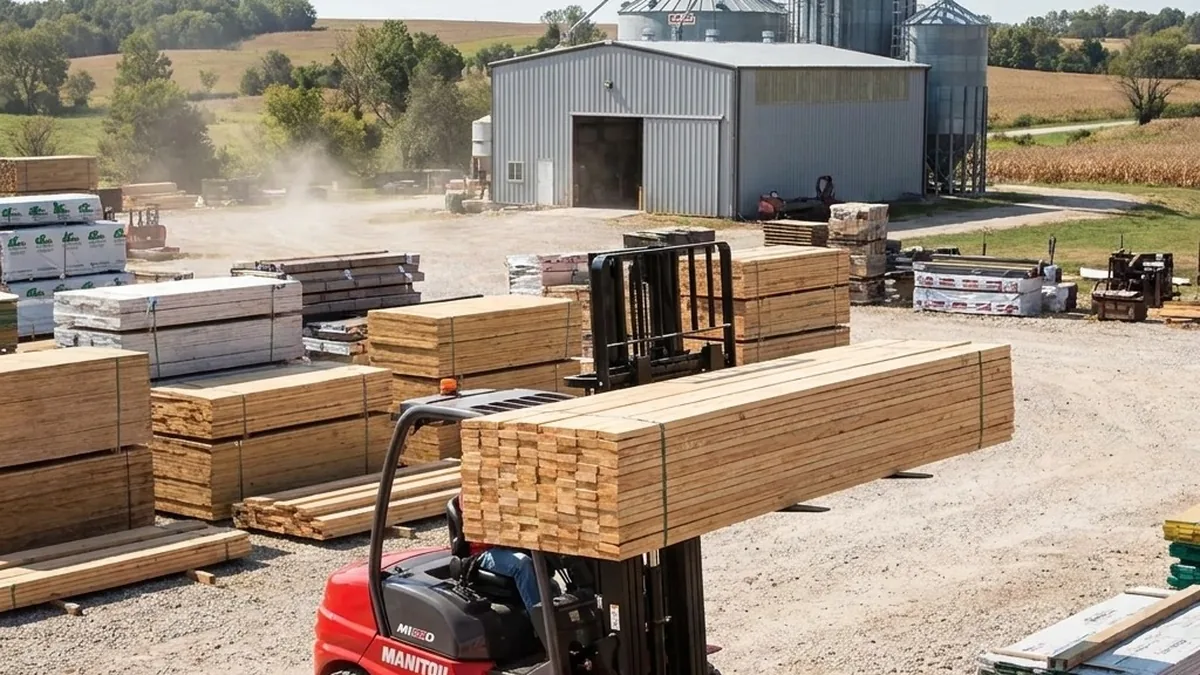
If you're buying a forklift for a lumberyard, a farm co-op, or a grain operation, the single biggest mistake we see is picking the machine before you've described the ground it has to run on. A rough terrain forklift earns its keep in a lumberyard because the work happens outside on gravel, mud, and uneven dirt, and a smooth-floor warehouse lift simply can't do that job. The setting picks the forklift. Paved warehouse, fenced outdoor yard, rough open ground, or a dusty co-op feed room each point at a different class of machine, and getting that match right is the difference between a lift that runs all season and one that's stuck in a corner by August.
We're a Manitou and Gehl dealer in Laddonia, MO, and we spend a lot of time helping operations around Columbia, Jefferson City, Mexico, and Fulton sort this out before they spend a dollar. Here's how we think through it, in plain terms, so you can walk into the conversation already knowing roughly where you land.
Start With the Ground, Not the Brochure
Every forklift decision starts with one question: where does the machine actually work? Not where it's parked. Where it lifts, carries, and turns under load. Walk your yard and answer these honestly.
- Is the working surface paved, sealed concrete, or smooth? Or is it gravel, dirt, mud after a rain, and rutted by trucks?
- Is the work indoors, outdoors, or both? A lift that lives outside has different needs than one that runs a sealed building.
- How far does a load travel? A short hop across a dock is different from hauling units the length of a lumber yard.
- What are you lifting, and how high does it need to go? Banded lumber, palletized seed and feed, tote bags, drums, and bulk bags all behave differently.
- How clean is the air? Grain dust and chaff change what kind of power and filtration make sense.
Once you've got those answers, the machine class almost picks itself. The trap is starting with a spec sheet and trying to force your yard to fit it. Start with your yard.
Pneumatic vs. Cushion Tires: The First Fork in the Road
Tires are where a lot of buyers go wrong, because the two main types look similar but live in completely different worlds.
Cushion tires
Cushion tires are solid rubber pressed onto the wheel, and they ride low and tight. They're built for smooth, sealed surfaces: warehouse floors, sealed concrete, a clean dock. They give you a tight turning radius in narrow aisles, which is great indoors. Put them on gravel or dirt and they slip, struggle for traction, and beat themselves up fast. A cushion-tire truck is a building machine. It is not a yard machine.
Pneumatic tires
Pneumatic tires are air-filled (or solid pneumatic-shaped) and they ride taller with real tread. They're built for outdoor and mixed surfaces. They handle gravel, packed dirt, and the odd patch of mud, and they soak up the bumps that would rattle a cushion truck apart. If any meaningful part of your work happens outside on anything other than perfect pavement, you want pneumatic tires. Most lumberyards, co-ops, and grain sites land here.
Simple rule of thumb: cushion for sealed floors, pneumatic for the yard. If you're split between an indoor warehouse and an outdoor lot, that's a real conversation, and it usually means either two machines or one pneumatic machine that compromises a little indoors. We'd rather talk that through with you than sell you the wrong tire and watch you fight it.
The Rough Terrain Forklift: Why It's the Lumberyard's Machine
A rough terrain forklift is a different animal from a standard pneumatic warehouse lift. It sits higher, runs bigger tires with aggressive tread, and is built specifically to carry a load across ground that was never meant to be driven on. That's exactly the lumberyard's reality: units of dimensional lumber and sheet goods stacked outdoors, customer pickups in a gravel lot, and a yard that turns to soup the first wet week of spring.
Here's what a rough terrain machine buys you in a lumberyard setting:
- Real ground clearance. Ruts, gravel piles, and curbs don't stop the work.
- Traction under load. Carrying a full unit of lumber across wet dirt is where a warehouse lift gives up and a rough terrain machine keeps going.
- Stability on uneven ground. The yard is rarely flat. A machine built for it stays planted where a flat-floor lift gets nervous.
- Reach to the truck bed and the stack. Loading a flatbed or pulling from an outdoor rack is a different motion than dock work, and the right machine is set up for it.
For most mid-Missouri lumberyards, this is the answer. If your business is selling building materials out of an outdoor yard, a cushion-tire warehouse lift will frustrate you and a true rough terrain forklift will quietly do its job. If you want to see the lineup we'd point a lumberyard toward, our forklift category page is the place to start.
Don't Forget the Telehandler Question
Once you're talking about outdoor yards and reach, there's a close cousin you should at least consider: the telehandler. It's not a forklift in the classic sense, but it does a lot of the same work and then some.
A telehandler runs a telescoping boom instead of a fixed mast, which means it can reach forward and up at the same time. In a lumberyard that's stacking high or loading over the side of a truck, or on a job-mixed operation that also moves material around a site, that reach can do things a vertical-mast forklift can't. The tradeoff is that capacity changes as you extend and lift, so the machine that's perfect for high outdoor stacking might be more machine than a flat, low-stack yard needs.
It's a real decision, not a marketing one, and it comes down to how high and how far you actually need to place loads. We wrote a full breakdown comparing the two in telehandler vs. forklift, and it's worth ten minutes before you commit. If a telehandler turns out to be the better fit, our telehandler lineup covers the range we'd recommend from.
Capacity at Height Is the Number That Bites People
This is the spec most buyers misunderstand, so it's worth being clear about how it works without quoting numbers your machine won't actually hit.
A forklift's rated capacity is measured at a specific lift height and load center. The headline capacity is the best case. As you lift higher and as the load sits farther out on the forks, the safe capacity comes down. So a machine that handles a heavy unit at low height can be over its limit lifting that same load up to a top rack. People get burned when they buy on the big number and then try to stack heavy loads high.
What this means for you in practice:
- Tell us the heaviest load you carry and how high it has to go, together. Those two numbers as a pair drive the machine, not capacity alone.
- Think about your tallest realistic stack, not your average one. The machine has to handle your worst day, not your typical one.
- Factor in the load center. A long unit of lumber or a wide pallet shifts weight forward and changes the math.
We won't quote you a capacity figure off the top of our heads, and you should be skeptical of anyone who does without seeing your loads. We spec it against what you actually lift. That's the whole point of buying from a dealer who'll walk your yard instead of emailing you a PDF.
Indoor vs. Outdoor, and Why Power Source Matters
Where the machine works also drives how it should be powered, and the co-op and grain world makes this especially real.
Indoor, enclosed, poorly ventilated spaces favor cleaner-running power because you're breathing the same air the machine puts out. Outdoor and mixed work opens up more options. We break the power-source decision down in detail in our guide on choosing a forklift: diesel vs. electric, and it's the right next read if you're split between a building and a yard.
The short version: match the power to the air. If your forklift spends real time inside a building with the doors shut, factor that into the decision before tire type even comes up. If it lives outside, you've got more room to choose on cost, runtime, and the kind of work it does.
The Co-op and Grain Operation Has Its Own Rules
Co-ops and grain sites are a category of their own, because the environment fights the machine in ways a clean warehouse never does.
Dust is constant
Grain dust and chaff get into everything. It clogs radiators, loads up air filters, and works into places it shouldn't. A machine running in that air needs filtration and cooling that can keep up, and it needs an owner who stays on top of cleaning it. This is buyer education, not a sales pitch: if you ignore filter and radiator maintenance in a dusty grain environment, you'll cook a machine that would otherwise run for years. Knowing that going in is part of buying the right lift.
The work is mixed
A co-op might move palletized seed and chemical out of a building, handle bulk bags and totes in the yard, and load feed and supplies onto farmer trucks in a gravel lot, all in the same day. That's a classic case for a pneumatic or rough terrain machine, because the indoor portion is usually a small share of the work and the yard is where the day is really spent.
Seasonality is brutal
A grain operation's worst week is also its busiest week, and that's exactly when you can't afford a machine that's the wrong fit. Spec for the harvest rush and the mud, not for the quiet days. A lift that's perfect in July and useless in October isn't the right lift.
If you run a co-op or grain site and you're not sure where you land, that's a good reason to start with our guided selector at find your machine. It walks you through the setting questions and points you at a class to start from.
How a Few Real Mid-Missouri Setups Shake Out
To make this concrete, here's how the setting drives the call for the operations we see most around here.
- Outdoor lumberyard, gravel lot, customer pickups: rough terrain forklift, pneumatic tires, set up for truck-bed loading. The yard surface alone settles it.
- Lumberyard that also stacks high or loads over the side: seriously look at a telehandler for the reach, then decide between the two on how high and far loads really go.
- Co-op with a sealed warehouse and a busy gravel yard: usually a pneumatic machine that gives up a little indoors, with power matched to how much time it spends inside. Sometimes two machines if the indoor volume is high enough.
- Grain operation, dusty, seasonal, mostly outdoor: pneumatic or rough terrain with serious attention to filtration and cooling, spec'd for the harvest peak.
- Clean indoor warehouse, sealed floor, no outdoor work: this is the one case where a cushion-tire warehouse lift is genuinely right. If that's truly all you do, don't overbuy a yard machine you don't need.
None of these are universal. They're starting points. Your actual loads, heights, and air quality move the answer, which is exactly why we'd rather talk it through than hand you a chart.
A Word on Buying Smart, Not Just Cheap
The cheapest machine that can't do your job is the most expensive thing in your yard. We've watched operations buy on sticker price, end up with a cushion-tire lift in a gravel lot, and replace it inside a year. Buy the machine the setting actually calls for the first time.
On the money side, we're a real dealer, so financing is part of the conversation. Right now there's 0% for 48 months on skid and track loaders, rates from 1.99% across the line (1.49% on electric machines), through September 30, 2026. If you're weighing how to structure a purchase, our financing page lays out the options, and our piece on equipment financing for contractors is a straight read on making the numbers work. If you're still deciding whether to commit capital at all, rent vs. buy a loader or telehandler covers how we'd think it through.
Tell Us Your Setting and We'll Spec It
Here's the honest pitch. We don't need you to know forklift classes, capacity charts, or tire codes before you call. That's our job. What we need from you is a clear picture of the ground the machine runs on, the heaviest loads you carry, how high they go, and whether the work is inside, outside, or both. Give us that, and we'll tell you exactly what class of machine fits, whether that's a rough terrain forklift, a standard pneumatic lift, or a telehandler. We're the only Manitou and Gehl dirt-equipment dealer for about 50 miles, and we cover the whole mid-Missouri stretch from Columbia and Jefferson City through Mexico, Fulton, Vandalia, and Bowling Green. Describe your yard and request a quote, and we'll spec the right forklift for the work you actually do.