
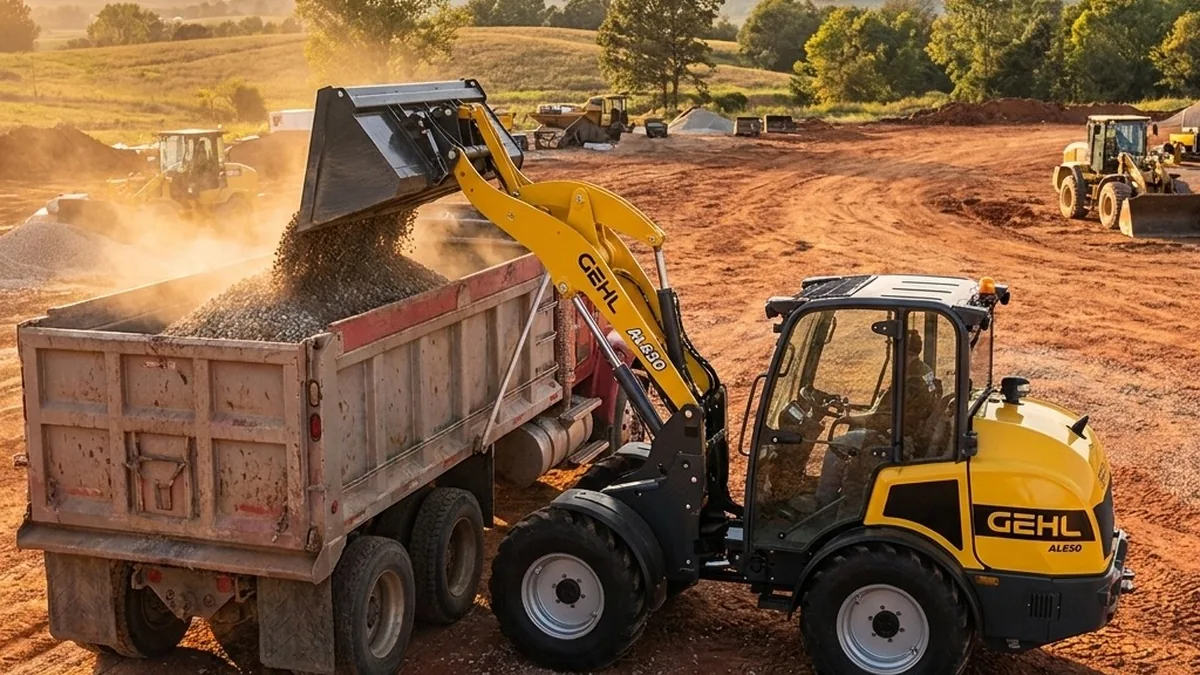
If you've been putting off a loader or telehandler purchase, the calendar matters more than you think. The federal tax code generally lets businesses write off equipment faster than the old slow-drip depreciation schedule, and the Section 179 equipment 2026 rules still reward you for buying and putting a machine to work before December 31. That's the whole game. The deduction usually hinges on the date the equipment is "placed in service," not the date you signed the paperwork or paid the deposit. So a machine that shows up on January 2 is a next-year deduction, even if you ordered it in October. We're a Manitou and Gehl dealer in Laddonia, MO, not a tax firm, so treat this as a plain-English starting point and confirm every number with your CPA. But the timing logic is simple enough to plan around, and right now there's a real reason for mid-Missouri contractors and farms to act before the year runs out.
The short version: buy and place in service by Dec 31
Here's the part that trips people up. Two things have to be true to claim the deduction in this tax year. You have to buy the equipment, and you have to place it in service. "Placed in service" means the machine is ready and available for its intended use, sitting on your job site or your operation, not stuck on a truck somewhere or backordered into next quarter.
That second requirement is why timing beats wishful thinking. If you wait until mid-December to start shopping and the configuration you want has a lead time, you can miss the window by a few days and push the whole deduction into the following year. The fix isn't complicated. Start the conversation early, lock in the machine and the build, and give yourself runway to take delivery and put it to work before the calendar flips.
People also mix up "ordered" with "placed in service," and that confusion costs real money. Signing a purchase order in November doesn't start the clock. A deposit doesn't start the clock. The clock starts when the machine is yours and ready to work. If it's sitting at a depot two states away on December 31, it isn't placed in service, no matter how much you've already paid. That's the single rule worth tattooing on the inside of your eyelids before year-end.
Section 179 and bonus depreciation for your 2026 equipment, in plain English
These are two different tools that often get lumped together. They can stack, and most buyers use them together with their accountant's guidance.
- Section 179 expensing lets you deduct the cost of qualifying equipment in the year you place it in service, instead of spreading it across many years. There are limits and phase-out thresholds, and they change. Ask your CPA about the current limits for your situation before you assume anything.
- Bonus depreciation is a separate allowance that can apply on top of, or alongside, Section 179. The percentages have moved around over the years, so again, your CPA is the one who tells you what applies to your 2026 return.
We're deliberately not quoting dollar figures or percentages here, because those are exactly the things that shift and the things you don't want to get wrong on a tax return. What stays consistent year after year is the structure: qualifying business equipment, placed in service in the tax year, can often be written off far faster than the old default schedule. That's the lever. How hard you can pull it is a CPA question.
Who this actually helps
This isn't just a big-company play. The buyers who tend to benefit most are the ones who already need the machine and are buying it for legitimate business use.
- Contractors and excavation crews picking up a skid loader or compact track loader to take on more work next season.
- Farms and ag operations structured as an LLC, S-corp, or sole proprietorship that run equipment hard and want the deduction in a strong income year.
- Landscape, site-prep, and material-handling outfits adding a telehandler or forklift to move product and pads faster.
- Owner-operators who've been renting or borrowing and finally want a machine in their own name.
The common thread is income. These deductions reduce taxable income, so they're most useful when you actually have income to shelter this year. If 2026 was a good year for your operation, that's the conversation to have with your accountant before December. And here's the flip side worth saying out loud: if it was a lean year, the deduction is worth a lot less to you, and you should not let a tax pitch talk you into a purchase your cash flow can't carry. The machine has to earn its keep with or without the write-off.
Financing doesn't disqualify you, and that's the timing trick
Here's the piece a lot of buyers don't realize. You generally don't have to pay cash to claim the deduction. Equipment that's financed can still qualify, which means you can put a machine to work, deduct it under the current-year rules, and spread the payments out over time. Your cash stays in the business while the tax benefit lands now. That's a powerful combination at year-end, but confirm the details with your CPA since how the deduction interacts with financing depends on the structure.
And right now the financing side lines up well with the calendar. We have 0% for 48 months on skid and track loaders, with rates from 1.99% across the line and 1.49% on electric machines, through September 30, 2026. If you're already planning to buy before year-end, getting the machine placed in service while that financing is on the table is the kind of timing that does double duty. You can dig into the numbers on our financing page, and our older walkthrough on equipment financing for contractors covers how the structure usually works.
What "qualifying equipment" usually looks like
Most of the commercial machines we sell are the kind of business-use equipment these deductions are built for. We're talking about the dirt and material-handling line, not consumer toys.
- Skid loaders for tight job sites and mixed-surface work. See the skid loader lineup.
- Compact track loaders when you need flotation and traction on soft or muddy mid-Missouri ground.
- Articulated loaders for turf-friendly, low-disturbance material handling.
- Telehandlers for reach, lift height, and placing loads where a forklift can't go. If you're weighing the two, our telehandler vs forklift breakdown helps.
- Forklifts and aerial work platforms for warehouse, yard, and overhead work.
- Attachments that turn one machine into several tools across the year.
Whether a specific purchase qualifies, and how, is still a CPA call. But if it's a Manitou or Gehl machine bought for your business and put to work, you're in the right neighborhood. We're not going to throw spec-sheet numbers at you here. The right question isn't "what's the rated capacity," it's "what's the job, and which machine class fits it." That's the conversation we actually want to have.
Don't let the deduction pick the wrong machine
One honest warning. A tax deduction is a reason to buy the machine you already needed, not a reason to buy the wrong one fast. We've seen people rush a year-end purchase, grab whatever's on the lot, and end up with a machine that doesn't fit the work. The deduction feels good in April and the wrong machine costs you every day after.
So start with the job. How soft is the ground you work on most? How much lift height do you actually need? Are you moving pallets, digging, grading, feeding, or all of it? Match the machine class to the work first, then let the tax timing tell you when to pull the trigger. If you're not sure where to land, our guided machine selector walks you through it in a few questions. And if you're still torn between owning and not, the rent vs buy piece lays out the math.
A year-end timeline that actually works
If you want the deduction this year, work backward from December 31. Here's a sane sequence.
- Now through early fall: talk to your CPA about whether this is a year you want the deduction, and roughly how much equipment makes sense.
- Pick the machine class: nail down whether it's a skid loader, track loader, telehandler, forklift, or AWP, and what attachments you need.
- Lock the build and financing: get the configuration and the financing structure settled while the September 30 program rates are still live.
- Take delivery with runway: give yourself enough cushion to receive the machine and place it in service before December 31, not on it.
- Document it: keep your invoice, delivery date, and in-service date clean for your accountant.
The mistake is compressing all of that into the last two weeks of December. Lead times, financing paperwork, and delivery all take real days. The buyers who get this right are the ones who started in fall. The ones who scramble in late December are the ones who either overpay for whatever's available or miss the placed-in-service date and lose the year. Neither one is a good outcome, and both are avoidable with a phone call in September instead of a panic in December.
Does Missouri follow the federal rules?
Generally, Missouri conforms to the federal treatment of these deductions, which means the federal benefit usually carries through at the state level too. But "generally" is doing some work in that sentence, and state conformity can have its own quirks and timing. This is one more thing to put in front of your CPA rather than assume. If you operate across state lines, or your books are structured in a way that's even a little unusual, the state side is worth a specific look.
Why buy it here in mid-Missouri
We're the authorized Manitou and Gehl dealer in Laddonia, MO, serving Columbia, Jefferson City, Mexico, Fulton, and the stretch up toward Vandalia and Bowling Green that's been underserved for years. For dirt equipment, we're the only Manitou and Gehl dealer for about 50 miles in a lot of directions. That matters at year-end for one practical reason: local availability and a straight answer about delivery timing. When the deduction depends on placing the machine in service by a hard date, you want to be talking to a dealer who's close, who knows the ground you work on, and who can tell you honestly whether a build can land in time.
We sell the machine, we help you match it to the work, and we point you to financing that lines up with your timing. The tax math is your CPA's job, and we'll say that as many times as it takes, because getting it wrong on a return is no fun for anyone.
Ready to time your 2026 purchase?
If a loader, telehandler, forklift, or AWP is in your plans, the smart move is to start the conversation now so the machine can be placed in service before December 31. Browse the full equipment lineup, then request a quote and we'll talk machine fit, delivery timing, and financing through the September 30 program. Check the current offers on our financing page, and run the tax timing past your CPA before you sign. We'll handle the equipment side. They'll handle the deduction. Get both right and the timing works in your favor.