
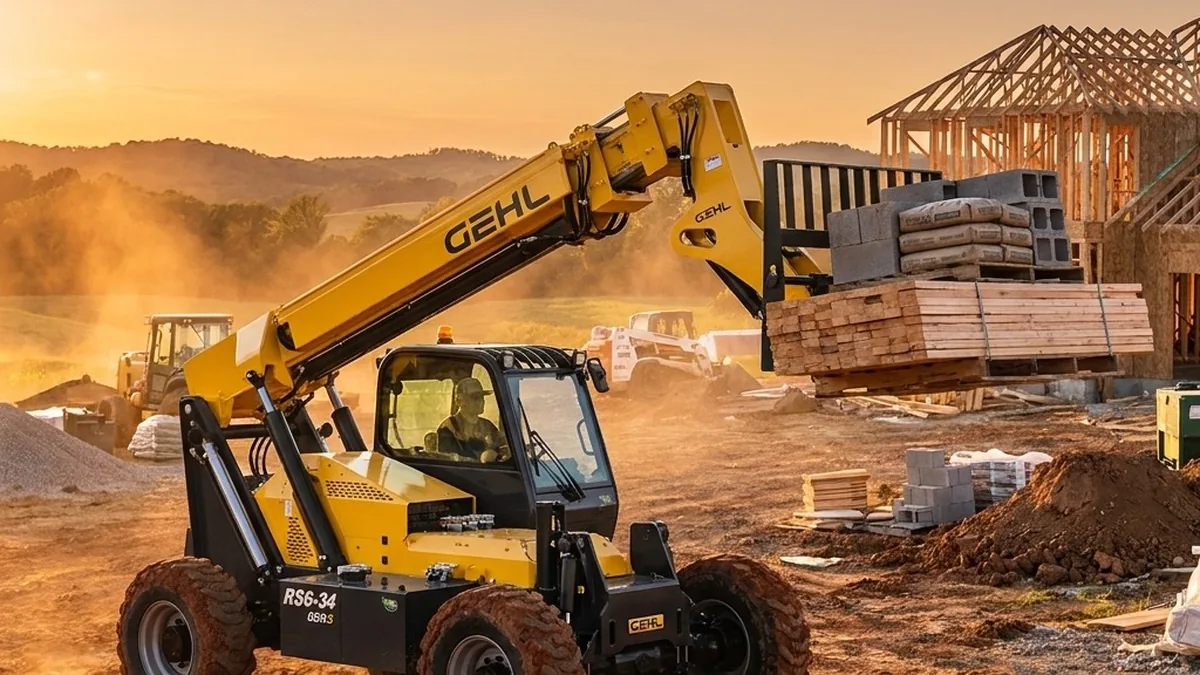
Here's the short version. A telehandler load chart is the sticker in the cab that tells you the most weight the machine can safely lift at every combination of boom height and reach. The rated capacity you see in the brochure is the best case, straight up and tucked in close. The further out and the higher you go, the less it can carry. Read the chart wrong and you can tip a loaded machine, which is the single biggest way these get people hurt. Read it right and you'll buy the machine that actually fits your jobs instead of one that runs out of capacity at the worst moment. This guide walks through how a telehandler load chart works, why capacity drops as you reach out, and how a mid-Missouri contractor should use it to spec the right machine.
What a telehandler load chart actually is
A telehandler is a forklift with a boom. Instead of forks that only go up and down a mast, the forks ride on an arm that extends out and lifts up at the same time. That's what makes it so useful on a jobsite. You can set a pallet on a second-floor deck, feed trusses up to framers, or place block well past the edge of the building.
It's also what makes the load chart non-negotiable. On a plain warehouse forklift, the load stays right in front of the wheels, so capacity barely changes. On a telehandler, the load moves away from the machine as the boom extends. The more weight you hang out in front, the harder it tries to pull the whole machine forward and tip it onto its nose. The load chart is the map of where you can safely put weight and where you can't.
Every telehandler ships with its own chart, printed in the cab and in the operator's manual. It's specific to that exact model and configuration. A chart from one machine does not carry over to another, and swapping attachments can change it entirely. We'll come back to that.
How to read a telehandler load chart
Most charts look like a grid or a fan of curved lines laid over two axes. Once you know what you're looking at, it reads fast.
- Horizontal axis - reach. How far the load sits in front of the front tires, measured out to the face of the forks. Left side is tucked in tight. Right side is fully extended.
- Vertical axis - lift height. How high the forks are off the ground. Bottom is near grade. Top is full boom.
- The capacity lines. Curved or stepped lines run across the grid, each labeled with a weight. Find the zone your load falls into and the number on that line is the most you can carry at that height and reach.
- The boom angle marks. Many charts add tick marks for boom angle so you can sanity-check what the machine is telling you against what you see.
To use it, picture where your load needs to go. How high, and how far out. Find that point on the grid. The capacity line just below or through that point is your ceiling. If your load weighs more than that line says, you cannot safely put it there. Move closer, lower, or get a bigger machine. There's no fourth option.
The number in the brochure - the "rated capacity" - lives in the bottom-left corner of the chart, low and tight to the machine. That's the strongest spot. Almost no real-world lift happens there. So the headline number on the spec sheet is rarely the number you'll actually be working against.
Why lift capacity drops as you reach out
This is just leverage. The same physics as a kid on a seesaw.
The telehandler balances on its front tires. The weight of the machine behind the axle holds the back end down. The load out front tries to lift the back end up and roll everything forward. The further the load sits from the front tires, the more leverage it has, so even a moderate weight way out at full reach can overcome the counterweight of a heavy machine.
Raising the boom adds to it. As the forks go up and out, the load drifts forward and the machine's center of gravity creeps toward the front tires. Get the center of gravity past the front axle and the machine tips, period. The load chart is really a map of that tipping line with a safety margin built in. Stay inside the lines and the center of gravity stays where it belongs.
That's why a machine rated to lift several thousand pounds straight up might only safely carry a fraction of that at full extension. It isn't a weaker machine out there. It's the same machine fighting a lot more leverage. Anyone shopping telehandlers should plan around the reach-out numbers, not the headline rating. We dig into matching height and capacity to your jobs in our telehandler buyer's guide, and it's the first thing we talk through with buyers.
Load center: the number people forget
Capacity ratings assume a load center. That's the distance from the heel of the forks to the center of gravity of whatever you're carrying. Charts are usually rated at a standard load center, meaning the weight is assumed to sit centered a set distance out on the forks rather than jammed against the carriage or hung off the tips.
Here's the catch. If your load's center of gravity sits farther out than the rated load center, you've effectively reached out farther than the chart assumes, and your real capacity drops below the printed number. A long bundle of trusses, an awkward crate, or a pallet stacked deep all push the load center out past standard.
- Long loads. Lumber, pipe, trusses, anything that sticks way out past the fork tips moves the center of gravity forward. Treat your safe capacity as lower than the chart shows.
- Off-center loads. If the heavy end of a load sits at the tip of the forks instead of against the carriage, same problem.
- Unknown loads. When you're not sure where the center of gravity is, assume the worst and stay well inside the lines.
Load center is the detail that trips up experienced operators, not just new ones. The machine doesn't know what you put on the forks. It only knows where the weight ended up.
The stability envelope and what happens when you leave it
Put height, reach, and load center together and you get the stability envelope. That's the three-dimensional zone where the machine stays planted. Inside the envelope, you're safe. Push past the edge and the machine becomes unstable.
Two ways things go wrong:
- Forward tip-over. Too much weight too far out front. The back tires come off the ground and the machine pitches forward. This is the classic telehandler accident and it happens fast.
- Sideways tip-over. The envelope shrinks hard when the machine isn't level or when you're turning with a raised load. A telehandler that's rock solid on flat concrete can roll on a slope or on soft ground with one tire in a rut.
A few things shrink the envelope that aren't on the chart at all:
- Slope. Working across or down a grade tilts the whole balance. Mid-Missouri jobsites are rarely flat. A field approach, a graded pad before it's finished, a sloped yard - all of it eats into your margin.
- Soft or uneven ground. A tire sinking on one side does the same thing as parking on a slope. Spring thaw and after a hard rain, our ground out here gets soft.
- Stabilizers and frame leveling. Many telehandlers have outriggers or frame leveling to widen the envelope at height. The catch is the chart often has separate columns for stabilizers down versus up. Know which one you're reading.
- Wind. A sheet of plywood or a bundle catching a gust at full height adds load you never picked up.
Most machines now include a load moment indicator that warns the operator as you approach the limit, and many will cut the function that would push you past it. That's a great backstop. It is not a substitute for reading the chart and knowing your envelope before the forks leave the ground.
Attachments change the chart
This one catches a lot of buyers off guard. The load chart in the cab is usually for the standard carriage and forks. Hang a different attachment and the numbers change, sometimes a lot.
- The attachment has weight. A bucket, a grapple, a work platform, or a truss boom all weigh something, and that weight counts against your capacity before you pick up a single thing.
- It changes the reach. Anything that pushes the load farther from the carriage - a truss boom or a jib especially - moves the center of gravity way out and slashes capacity at height.
- It needs its own chart. Manufacturers publish separate load charts for approved attachments. Running an attachment without its matching chart means you're guessing, and guessing is how machines tip.
If your work means buckets one day and a material platform the next, factor that into the machine you choose. A telehandler that's comfortable with forks can be right at its edge with a heavy attachment hung way out. We help buyers think through the attachment mix before they commit to a frame size, since it's a lot cheaper to size up front than to find out on the job. You can browse the attachments side of things to see how much the job can shift.
How to use the chart to spec the right machine
This is where the load chart pays for itself. It's not just a safety tool. It's a buying tool. The mistake we see is shopping by the headline capacity number and ignoring the reach.
Work it backwards from your hardest lift:
- Name your worst-case lift. What's the heaviest thing you carry, and where does it have to go? Highest point, farthest reach, real weight. Not your average lift. Your worst one.
- Find that point on the chart. A machine that handles your worst-case lift with margin to spare handles everything easier than that without you thinking about it.
- Don't buy to the limit. If your toughest lift sits right on a capacity line, you've bought too small. Slope, wind, a load heavier than you guessed, an off-center pallet - any of those erases a thin margin. Leave room.
- Account for attachments. If a platform or a truss boom is in your future, spec around the attachment's chart, not the bare forks.
- Match reach to the building. Two-story residential, ag buildings, commercial steel - they all ask for different reach. More reach usually means a bigger, heavier machine. Buy the reach you need, not the most you can find.
If a telehandler turns out to be more than your jobs call for, a loader might be the better fit, and that's a comparison worth making honestly. We lay out the trade-offs in telehandler vs forklift, and our find your machine selector walks you to the right class in a couple minutes. Not sure whether to own one at all? Rent vs buy is the honest version of that question.
Why this matters for a mid-Missouri buyer
Out here the load chart isn't an abstract safety poster. It's tied to the kind of work we actually do. Ag buildings on graded but not finished pads. Commercial sites where the ground is soft half the spring. Hilly approaches that never sit dead level. Every one of those shrinks the stability envelope, which means the reach-out numbers on your chart matter more here than they would on a flat coastal slab.
It also means a machine that's "big enough" on paper can come up short on a real site. The chart tells you the truth the brochure won't. That's the conversation we'd rather have with you before you buy than after.
We're the Manitou and Gehl dealer in Laddonia, serving Columbia, Jefferson City, Mexico, Fulton, and the stretch up through Vandalia and Bowling Green that's been underserved for years. For dirt equipment, we're the only Manitou and Gehl shop for about 50 miles. So when you're trying to match reach plus capacity to your job, you don't have to figure out a load chart alone.
The bottom line
A telehandler load chart looks intimidating until you see what it's really saying. Capacity drops as you reach out because the load gains leverage on the machine. The headline rating is the best case you'll rarely work in. Load center, slope, soft ground, and attachments all shrink your real number further. Spec the machine to your worst-case lift with margin to spare, and you'll have one that's safe and capable for years instead of one that's at its edge every time you raise the boom.
Want help reading a chart against your actual jobs? Come see the telehandlers we carry and request a quote. Tell us your heaviest lift, how high, and how far out, and we'll point you to the machine that handles it with room left over. If financing matters, we've got 0% for 48 months on skid and track loaders, rates from 1.99% across the line (1.49% on electric machines), through September 30, 2026. We'll talk through the numbers with you straight.