
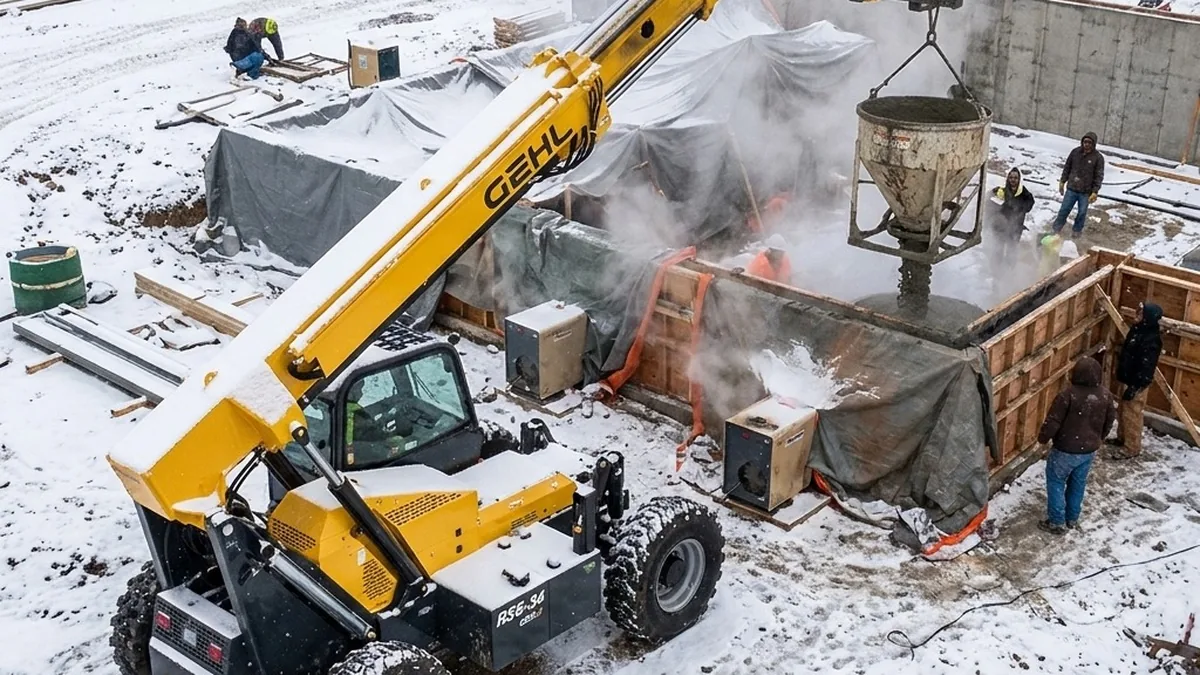
If you've ever poured concrete in a Missouri January, you already know the problem. The job has to keep moving or the mix sets up wrong, and half the time the spot you need to reach is behind a wall, over a heated slab, or boxed inside a tarped enclosure where a pump truck can't get a boom in. That's the gap telehandler concrete placement fills. A telehandler reaches up and over obstacles, sets a concrete bucket exactly where the crew needs it, and does it on uneven, frozen, or mud-rutted winter ground that a wheel loader would struggle with. For cold-weather pours where access is tight and timing matters, it's often the machine that keeps the whole day on schedule.
We're Equipment Solutions Outdoors, the Manitou and Gehl dealer in Laddonia, MO. We sell and recommend this equipment to contractors across mid-Missouri, and winter concrete is one of the jobs where a telehandler earns its spot on the trailer. Here's why reach beats raw lifting power on a cold pour, and why crews keep one parked on the site all winter instead of renting access by the hour.
Why winter pours create access problems in the first place
Concrete doesn't care that it's cold. It cares about temperature, timing, and protection. When the air drops below freezing, crews change how they work to keep the mix from freezing before it cures. That usually means one of two things, and both create reach problems.
- Heated or enclosed pour areas. Crews tarp off a slab, run ground heaters or blankets, and build temporary enclosures to hold warmth in. Those enclosures block the open lines a pump truck boom needs. You can't always swing a long boom into a tented work area without tearing down the protection you just built.
- Staged, sectioned pours. Winter work often gets broken into smaller sections so each one can be placed, finished, and covered fast. That means more setups, more repositioning, and more spots that are awkward to reach from a single fixed point.
On top of that, the site itself is working against you. Frozen ruts, snow, and frost-heaved ground make footing unpredictable. A machine that can't handle rough terrain becomes a liability the moment the lot freezes overnight and thaws by noon. Mid-Missouri winters do exactly that, over and over.
How a telehandler handles concrete placement when a pump can't reach
A telehandler is a rough-terrain machine built around a single idea: extend a boom out and up to place a load where wheels can't go. Hang a concrete bucket on the carriage, and that same reach goes to work placing material. That's the heart of telehandler concrete placement on a winter site.
The practical advantages on a cold pour come down to a few things:
- Reach over and around obstacles. The boom extends out and lifts up, so the crew can set a bucket over a foundation wall, into a tented enclosure through a single opening, or across a section that's already been finished and covered. You place the load where it goes, not where the truck happens to sit.
- Precision at the placement point. A skilled operator can ease a full bucket down to the exact spot, hold it steady, and let the crew control the chute or gate. That control matters in tight forms where an overflow means cleanup in freezing temperatures.
- Rough-terrain footing. These machines are built to work on dirt, frost, and grade. Frozen ruts and snow that would high-center a lighter machine are normal operating conditions for a telehandler.
- One machine, many jobs. The same telehandler that places concrete in the morning can move pallets of block, set trusses, lift insulation and forms, and stage material the rest of the day. On a winter site where every trip in and out is a hassle, that flexibility is real value.
None of this replaces a pump truck on the big open pours where a pump is the right call. It fills the jobs a pump can't reach, the staged sections, the enclosed slabs, and the days when getting a pump truck scheduled and set up isn't worth it for the volume.
Why reach beats a wheel loader on these jobs
Plenty of contractors already own a wheel loader, and a loader bucket can move concrete. So why bring a telehandler? It comes down to what the boom does that an articulated arm and bucket can't.
A wheel loader reaches by driving
To place a load with a wheel loader, you point the whole machine at the spot and drive the bucket in. That works fine in open space. It falls apart when the placement point is over a wall, inside an enclosure, or surrounded by formwork, rebar, and finished sections you can't drive across. The machine simply can't put the wheels where the load needs to go.
A telehandler reaches by extending
A telehandler stays planted and sends the boom to the work. It can place a bucket above an obstacle, set it down with control, and pull back without ever driving into the pour area. On a tight winter site with protected, finished, and active sections all within a few feet of each other, that difference decides whether the job flows or grinds to a stop.
There's also a height factor. If you're pouring elevated forms, footings on a slope, or anything above grade, the telehandler's vertical reach puts the bucket where a loader bucket can't get without ramps and risk. If you want to dig deeper into how these machines stack up against the alternatives, our telehandler buyer's guide walks through the trade-offs in plain language, including how reach changes the math when material handling is part of the job.
Why crews keep a telehandler on site all winter
Winter concrete is rarely a one-and-done pour. Foundations, slabs, footings, and flatwork come in waves through the cold months, and the access problems repeat every time. That's why crews that figure this out stop treating the telehandler as a special-trip machine and just keep one on the site.
The reasons add up:
- No waiting on access. When the machine is already there, a staged section doesn't sit while you schedule equipment. You place it, cover it, and move on while the mix is still right.
- It earns its keep between pours. Material handling, loading and unloading, setting forms and block, lifting bundles up to the deck. The telehandler stays busy even on days you aren't pouring.
- Cold-weather reliability. A machine that lives on the job and gets started and warmed up daily is a machine that's ready when you are. Cold mornings are easier on equipment that isn't sitting cold on a trailer waiting for a call-out.
- Predictable cost. Owning the machine you use all winter, every winter, takes the guesswork out of your budget. You know the cost going in, and the machine is yours when spring framing and dirt work ramp up.
If you're weighing whether to own one outright versus pulling access in piecemeal, our rent vs buy breakdown for loaders and telehandlers lays out the math the way a contractor actually thinks about it. For a lot of mid-Missouri crews running cold-weather concrete on a regular basis, owning wins because the machine never sits idle.
What to look for in a telehandler for cold-weather concrete
Not every telehandler fits every site. The right machine depends on how you pour and where you work. Here's what we walk customers through when they're spec'ing one for winter concrete work.
Reach and lift height that match your pours
Think about the worst-case placement point you hit regularly. How far out, how high, and over what kind of obstacle? You want enough reach to clear your typical enclosures and walls with margin to spare, not a machine that's maxed out on every pour. We help you size that against the work you actually do, not a generic chart.
Maneuverability for tight winter sites
Compact, jobsite-friendly machines move better around tarps, heaters, and parked trucks. If your sites are tight residential foundations, a smaller, nimble telehandler often beats a big agricultural-reach machine. If you're on open commercial pads, the calculus shifts. Both Manitou and Gehl build across that range, so it's about matching the machine to your typical job.
The right attachment setup
A telehandler that places concrete needs the right carriage and bucket. Quick-attach systems let the same machine swap from a concrete bucket to forks to a material bucket in minutes, which is what makes it useful all day instead of just during the pour. Our attachments page covers what's available and how the quick-coupler setups work.
Cold-weather readiness
This is buyer education, not a sales pitch: a machine you run hard in winter needs the basics handled. Cold-rated fluids, a healthy battery and charging system, block heater readiness, and good hydraulic warm-up habits keep a telehandler reliable when temperatures drop. Skipping cold-weather prep is what turns a productive winter machine into a no-start morning and a stalled crew. Whatever machine you buy and wherever you buy it, build that prep into your routine before the first hard freeze.
Why mid-Missouri contractors come to ESO for this
We're in Laddonia, MO, which puts us in the middle of a lot of underserved territory. We serve Columbia, Jefferson City, Mexico, Fulton, and the donut-hole around Mexico, Vandalia, and Bowling Green that doesn't have a local dirt-equipment dealer nearby. We're the only authorized Manitou and Gehl dirt-equipment dealer for roughly 50 miles in any direction.
That matters more than it sounds. When you're running winter concrete and you need answers fast, you want a dealer who knows your ground, knows the weather you're fighting, and can talk straight about which telehandler fits your crew. We sell and recommend Manitou and Gehl because the lineup covers the range mid-Missouri contractors actually need, from compact jobsite machines to bigger-reach units, with the attachment ecosystem to make one machine do several jobs.
We don't push the biggest unit on the lot. We point you at the machine that matches the pours you run, the sites you work, and the budget you're working with. If you're still narrowing it down, a few questions about your typical pour and your tightest site gets you to a starting point fast.
Financing a winter machine
If owning a telehandler makes sense for your winter work, financing can make the timing work too. Right now we've got 0% for 48 months on skid and track loaders, rates from 1.99% across the line (1.49% on electric machines), through September 30, 2026. That's worth a look if you're trying to get a machine on site before the cold-weather concrete season hits its stride. Our financing page has the details, and it's worth thinking about a machine like this as a business decision rather than just a monthly payment.
The bottom line on telehandlers and winter concrete
Cold-weather pours create access problems that a pump truck can't always solve and a wheel loader can't reach. Heated enclosures, tarped slabs, staged sections, and frozen ground all favor a machine that reaches out and up with control and works on rough winter terrain. That's the case for telehandler concrete placement, and it's why crews that pour through Missouri winters keep one on the site instead of chasing access by the job.
The right machine depends on your pours, your sites, and how you work. That's where a local dealer earns the relationship. Take a look at our full telehandler lineup to see the range of Manitou and Gehl machines we carry, then request a quote and we'll help you size the right one for your winter work. Get it on site before the first hard freeze and it'll be earning every day the ground is cold.