
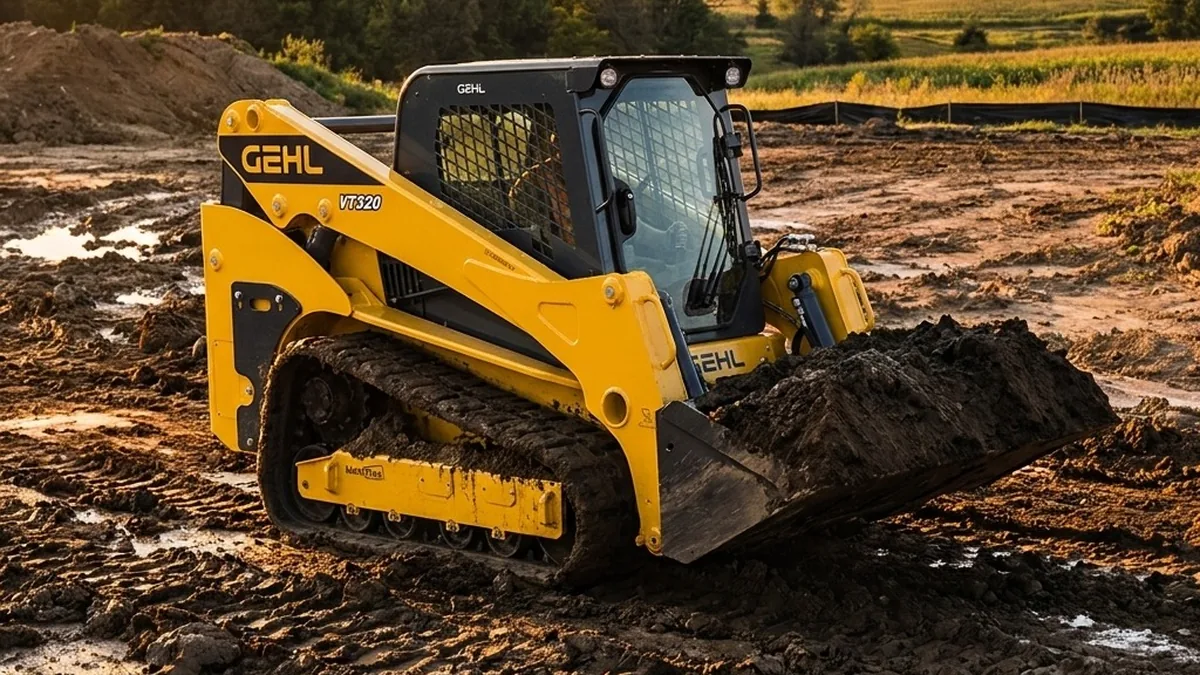
If you own a compact track loader, the undercarriage is where most of your wear money goes. Not the engine. Not the hydraulics. The rubber tracks, the rollers, the idlers, the sprockets, and the tension that holds it all together. Good track loader undercarriage maintenance is the single biggest lever you have over what that machine costs you to own. Get it right and you stretch the life of the most expensive consumable on the equipment. Ignore it and you'll replace tracks and rollers years before you should. This is a buyer-education guide, not a service pitch. We sell Manitou and Gehl track loaders here in Laddonia, and we want the owners around mid-Missouri to protect what they buy.
Here's the short version up front. The undercarriage wears whether you're working or not. Mud, abrasive ground, side-loading, and wrong tension all chip away at it. A few daily and weekly habits cost you minutes and save you real money. Below is what eats tracks, how to slow it down, and roughly what to budget so the bill never surprises you.
Why track loader undercarriage maintenance is the No. 1 wear cost
A compact track loader spreads its weight over rubber tracks instead of tires. That's the whole point. You get flotation on soft Missouri ground, less rutting, and more pushing power. The trade-off is a complicated wear system riding right at ground level, in the dirt, taking abuse every minute the machine moves.
The undercarriage isn't one part. It's a set of parts that all wear together:
- Rubber tracks - the big-ticket item, and the one most owners replace too early because of avoidable damage.
- Rollers - the wheels the track rides on under the machine. They carry the load and wear from the inside out.
- Idlers - the larger wheels at the ends that guide the track.
- Sprockets (drive lugs) - the toothed drive that turns the track. Worn teeth chew up new tracks fast.
- Tensioner - the grease cylinder that keeps the track tight. Get this wrong and everything else wears faster.
Here's the part people miss. These parts wear as a system. A worn sprocket eats a new track. A seized roller drags and grinds. Loose tension lets the track flex and crack. So the real cost of skipping maintenance isn't one part. It's the chain reaction that takes the whole set down at once. That's why undercarriage care sits at the top of any honest cost-of-ownership conversation about a track loader. If you're still weighing tracks against tires for your work, our track loaders and skid loaders pages lay out where each one earns its keep.
What actually eats tracks
Tracks rarely die of old age. They die early from a handful of specific things, and almost all of them are in your control.
Mud-packing
This is the quiet killer in our part of the state. When sticky clay and mud pack into the undercarriage, around the rollers and sprockets, it acts like a grinding paste and it forces the track to ride wrong. Packed mud also adds tension you didn't dial in, which strains the rubber and the bearings. After a wet day in heavy soil, a packed undercarriage is doing damage every time the track turns. Central Missouri clay is exactly the kind of soil that packs.
Side-loading and hard turns
Counter-rotating in place, spinning the machine on a dry abrasive pad, and constant tight pivots all scrub the edges of the tracks and side-load the rollers. Track loaders turn by dragging one track against the other. Do that all day on concrete or gravel and you're sanding the rubber down. Wide, gradual turns when you can manage them save a surprising amount of track.
Abrasives
Concrete, crushed rock, demolition debris, and sharp gravel are rough on rubber. Working on hard, abrasive surfaces wears the lugs and outer track faster than working in dirt. It comes with the job for a lot of contractors, but knowing it lets you plan for shorter track life on those machines and budget accordingly.
Wrong tension
Too tight and you overload the bearings, sprockets, and idlers, and you stress the track carcass. Too loose and the track flexes, slaps, derails, and rides unevenly on the rollers. Either extreme shortens life. Tension that's set right for the conditions is one of the cheapest things you can get correct, and one of the most commonly gotten wrong.
Curbs, edges, and the operator
Climbing curbs at an angle, dropping off ledges, and running half-on, half-off a hard edge all twist and cut the track. So does running with debris already jammed in the undercarriage. A lot of track damage traces straight back to operator habits, which is good news, because habits are free to fix.
Daily habits that add years
None of this takes long. Five to ten minutes a day is the difference between a track loader that holds its value and one that nickels and dimes you.
- Walk around before you start. Look at the tracks for cuts, chunking, exposed cords, or cracking. Catching a small problem early keeps it from becoming a track replacement.
- Clear the packed mud. At the end of a muddy day, knock the buildup out of the undercarriage before it dries into concrete overnight. This one habit pays for itself.
- Check track tension. Follow your machine's procedure and set tension for the conditions you're in. Mud, cold, and load all change what "right" feels like.
- Watch how it tracks. If the machine pulls to one side or a track looks like it's riding off-center, stop and find out why before you run another tank of fuel through it.
- Listen. A roller or idler bearing that's going bad will tell you. New squeaks, grinding, or a wobble in a roller means look closer now, not next week.
That's the whole daily routine. It's the cheapest insurance you'll ever buy on a piece of equipment.
Weekly and monthly checks
On top of the daily walk-around, a slightly deeper look every week or so catches the slow problems before they cascade.
- Inspect the rollers and idlers. Spin them if you can. Look for play, leaks around the seals, flat spots, and ones that don't turn freely. A seized roller drags and grinds the track from underneath.
- Check the sprocket teeth. Worn, hooked, or sharpened-looking teeth are a red flag. A bad sprocket will destroy a brand-new track, so you never want to put new rubber on a worn drive.
- Look for uneven track wear. If one track or one section is wearing faster, that's the machine telling you something is off - tension, alignment, or a worn component pulling things out of true.
- Keep the tensioner clean and serviced. Grease cylinders and adjusters work better and last longer when they're not caked in mud.
- Match the machine to the ground. If a machine spends its life on abrasive surfaces, plan for faster track wear on that unit and rotate work where it makes sense.
The pattern here is simple. You're not just watching the tracks. You're watching the whole system, because the system fails together.
What to budget for
We're not going to throw made-up dollar figures at you, because real numbers depend on your hours, your ground, and how the machine gets run. But here's how to think about it so the bill never blindsides you.
- Treat the undercarriage as a consumable. Tracks and rollers wear out. That's normal. Build their eventual replacement into your cost-per-hour from day one instead of treating it as a surprise repair.
- Your ground sets the pace. Soft dirt and turf are easy on tracks. Concrete, rock, and demolition are hard on them. A machine on abrasive surfaces will go through undercarriage faster, full stop.
- Hours of run time matter more than calendar age. A machine that works hard wears faster than one that sits. Track your hours and plan around them.
- Replace worn drive parts before new tracks. Putting new tracks on worn sprockets, idlers, or rollers is throwing money away. The new rubber wears out fast against worn metal. If the drive parts are already gone, that is a different question: here is when it is time to repair or replace the machine.
- Buy the right machine for the work. The biggest budget lever is matching the machine to the job up front. A track loader earns its keep on soft, wet, or sensitive ground. If your work is mostly hard, flat, and abrasive, a wheeled skid loader may cost you a lot less in wear over its life. We'd rather sell you the machine that's cheap to own than the one that looks good on a spec sheet.
If you're early in the decision and not sure which way to go, our Find Your Machine selector walks you through it in a couple of minutes based on your ground, your work, and your priorities.
Tracks or tires? Match the wear to the work
This is the conversation worth having before you ever buy, because it sets your wear costs for the life of the machine. Tracks and tires aren't better or worse. They're different tools.
A compact track loader shines on soft, wet, muddy, or loose ground. It floats where a wheeled machine would dig in, it leaves less of a mess on turf and finished surfaces, and it pushes hard without spinning out. Around here that's grading, site prep on soft ground, landscaping, snow, and anything where you don't want to rut up the dirt. The cost of all that capability is the undercarriage you just read about.
A wheeled skid loader is the cheaper machine to feed when most of your work is on hard, abrasive, or paved surfaces. Tires are simpler and easier to replace than a full undercarriage, and you're not paying the track wear penalty for ground that doesn't need flotation.
Plenty of mid-Missouri contractors run both for exactly that reason. The track machine for the soft and sensitive jobs, the wheeled machine for the hard and fast ones. If you're weighing how a loader fits against other lift options for your operation, our take on owning versus other paths and the broader equipment lineup are good next stops.
Why this matters more in mid-Missouri
Our ground works against undercarriages. Central Missouri clay packs into a track system and dries hard. Wet springs and muddy fall harvests mean machines spend real time in exactly the conditions that cause mud-packing. Then those same machines move to gravel lots and concrete pads that grind the rubber. It's a tough combination, and it's why we hammer on undercarriage care with every track loader owner we talk to.
We're in Laddonia, serving Columbia, Jefferson City, Mexico, Fulton, and the stretch around Vandalia and Bowling Green that doesn't have a dirt-equipment dealer close by. We're the only Manitou and Gehl dealer for dirt equipment for about 50 miles in a lot of directions. That means when you buy a track loader from us, you're buying from someone who knows the soil you're running it in, not a sales desk three hours away that's never seen your jobsite.
Financing the right machine
If the right answer for your work is a track loader, the cost of ownership conversation includes how you pay for it. Right now there's 0% for 48 months on skid and track loaders, rates from 1.99% across the line (1.49% on electric machines), through September 30, 2026. As an authorized Manitou and Gehl dealer we can also help municipalities and public agencies buy through the Sourcewell cooperative purchasing program, which takes the bidding headache out of it. You can see current terms on the financing page.
The point of good financing is the same as the point of good undercarriage care. It's about owning the right machine at a cost that makes sense over the years you'll run it, not just the day you buy it.
The bottom line
Your track loader's undercarriage is the biggest wear cost you actually control. Clear the mud, set the tension right, ease up on the hard pivots and abrasive scrubbing, and catch worn rollers and sprockets before they take a new track down with them. A few minutes a day is what separates a machine that holds its value from one that bleeds money out the bottom.
And the smartest move of all happens before you buy: match the machine to your ground so you're not paying for capability you don't need. If you want to see the track loaders we carry or get pointed toward the right machine for your work, browse our track loaders or run through Find Your Machine. No pressure, no quote push. Just honest help picking the machine that's cheapest to own for the work you actually do.