
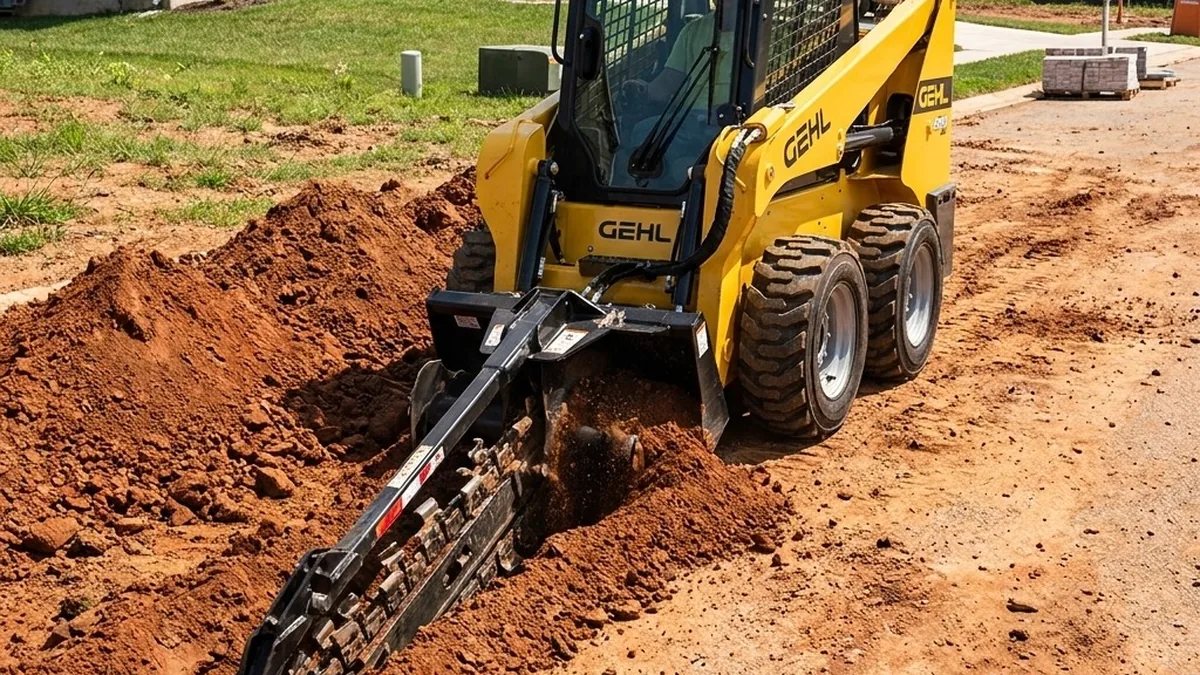
If you've tried to cut a trench through mid-Missouri clay in late July, you already know the problem. The ground turns to concrete. A skid steer trencher in clay soil only works if the loader can feed the attachment enough hydraulic flow and the machine has enough weight and traction to hold its line. Get the pairing right and you cut clean, consistent trenches for water, electric and septic. Get it wrong and you burn a day fighting a chain that won't bite. This guide walks through what actually matters around Columbia, Jefferson City and our home base in Laddonia, so you can spec the machine and attachment once and trench all season.
Why Mid-Missouri Clay Is Its Own Animal
Our dirt isn't average dirt. A lot of mid-Missouri sits on heavy clay loam with a high shrink-swell character. That means it changes a lot with moisture. In spring it's wet, sticky and heavy. In late summer it bakes hard and cracks. Both extremes punish a trencher in different ways, and most rental-counter advice ignores that completely.
Here's the short version of what that clay does to a trenching job:
- Summer-baked clay resists the chain. The teeth need real torque to bite, and the loader has to keep feeding flow without bogging.
- Spring-wet clay packs and balls up. It loads the chain and boom, then smears the trench wall instead of cutting clean.
- Clay holds its shape once cut. That's good for trench wall stability, but it also means a sloppy first pass stays sloppy.
- Rock and chert pockets show up without warning across this part of the state. A trencher set up only for soft ground stalls the second it hits a seam.
None of that is a reason to avoid trenching here. It's a reason to match the machine to the ground instead of grabbing whatever's on the lot.
Hydraulic Flow Is the Whole Game for a Skid Steer Trencher in Clay Soil
A trencher attachment is a hydraulic motor turning a chain. The chain only cuts as hard as the oil pushing it. That's why flow matters more than almost anything else when you're running a skid steer trencher in clay soil.
Standard-flow loaders move trenchers fine in loose, sandy or worked ground. Our clay isn't loose ground. When the chain hits hard-packed or baked clay, a standard-flow machine starts to lag. You feel it as a slow cut, a chain that wants to stall, and a lot of back-and-forth feathering to keep things moving. High-flow is the difference between forcing the cut and letting the attachment do the work.
High-flow loaders push more oil through the trencher motor, so the chain keeps its speed and torque even when the clay fights back. That gets you:
- A faster, more consistent cut through hard ground
- Less stalling when you hit a packed seam or a chert pocket
- Cleaner trench walls because the chain stays at cutting speed
- Less heat and strain on the loader's hydraulic system over a long day
This is the single biggest spec decision, so it's worth getting right up front. If trenching is a real part of your work and you're cutting in clay, we'll steer you toward a high-flow loader. It's the kind of call we talk through before you buy, not after you're stuck. You can start that conversation through our guided machine selector or just tell us the job and we'll point you at the right flow rating.
Track Loader or Wheeled Skid Steer for Trenching
Once flow is sorted, the next question is what carries the trencher. Both a wheeled skid loader and a compact track loader can run a trencher attachment. They behave very differently in our conditions.
When the Track Loader Wins
A compact track loader spreads its weight over a much larger footprint. That flotation is a real advantage on a couple of fronts here:
- Spring-wet clay. Tracks float on top of soft, saturated ground where wheels would dig in, spin and rut. If you're trenching a yard for a service line in March or April, that matters a lot.
- Holding a straight line. More ground contact means more traction, so the machine holds its position while the chain pulls against hard clay instead of skating sideways.
- Finished sites. Lower ground pressure means less damage to a customer's lawn or a graded pad, which matters when you're cutting in a service line on a near-complete build.
If you do a lot of trenching on soft or finished ground, the track loader is usually the answer. You can see what we carry on the compact track loaders page.
When the Wheeled Skid Steer Makes Sense
A wheeled skid steer still has a place, especially if your trenching is occasional and the ground is firm and dry:
- It moves faster between dig spots on hard, dry summer ground
- It's a strong all-around choice if trenching is one of many jobs you run
- On dry, baked clay the flotation advantage of tracks matters less
Plenty of mid-Missouri contractors run a wheeled machine and trench just fine in the dry months. The skid loaders page lays out the lineup. The honest answer is that it depends on your mix of work and your ground, which is exactly the kind of thing we'd rather hash out with you than guess at.
Depth and Width: Spec the Trench Before You Spec the Machine
The trench you need drives the attachment you need, and the attachment helps drive the loader. Work it in that order.
Different lines call for different trenches:
- Electric and low-voltage tend to run shallower, but local code and the utility set the real number. Always confirm before you cut.
- Water lines need to sit below the frost line so they don't freeze, which means a deeper trench than most people expect for our winters.
- Septic and wastewater work is the deepest and the most demanding, because grade and precision matter as much as depth.
Trencher attachments come in different boom lengths and chain widths to hit different depths and trench widths. A deeper, wider trench pulls more material and demands more from the loader, which loops right back to the flow conversation above. The point is simple: tell us the lines you're cutting and how deep, and we'll match a trencher and a loader that can actually deliver it in clay instead of one that runs out of muscle halfway down. Don't guess at the boom length and chain width, let us size the attachment to the depth you actually need.
Summer-Baked vs Spring-Wet: Trench With the Calendar
The same trench is a different job depending on the month. Smart operators around here plan for it.
Trenching Hard, Dry Summer Clay
- Lean on hydraulic flow and chain torque. This is where high-flow pays for itself.
- Expect sharp teeth to wear faster in abrasive, dry clay. Watch them and rotate or replace before they're rounded off, because dull teeth cost you speed and strain the machine.
- Slow your feed rate into hard seams instead of forcing the boom. Let the chain clear material on its own.
- If the ground is brick-hard, a light watering of the trench line ahead of time can soften the top few inches and speed the cut.
Trenching Soft, Wet Spring Clay
- Flotation matters most here, which usually points to a track loader.
- Watch for the chain balling up with sticky clay. You may need to clear it more often.
- Plan your machine path so you're not running the loader across the softest ground over and over and turning the site into ruts.
- Wet clay trench walls can slump. Cut clean, get your line in, and backfill promptly.
The takeaway is that one machine and one approach won't be ideal in both seasons, so spec for the conditions you trench in most. If that's year-round, we'll help you build out a setup that handles both.
The Boone County Septic Update Is a Tailwind for Doing It Right
Here's a piece of timing worth knowing. Boone County updated its residential wastewater and septic inspection requirements effective June 2026. We won't pretend to quote the regulation line by line, and you should always check the current county requirements and pull the right permits for your specific job. The general direction is clear though: more attention on septic and wastewater work means more value on doing the trenching and site work precisely the first time.
That plays right into having the correct machine. Precise grade, clean trench walls and consistent depth get a lot easier when the loader holds its line and the trencher cuts at full speed instead of clawing through. Sloppy, underpowered trenching is exactly what creates callbacks and failed inspections. If septic and wastewater is becoming a bigger share of your work around Columbia, Ashland or the rest of Boone County, this is a good moment to make sure your iron is up to the standard the work now demands.
What It Costs You to Ignore the Setup
You don't have to take our word for it. Just think through what an underpowered or wrong-footed trenching setup actually costs over a season:
- Lost days. A standard-flow machine grinding through baked clay can turn a half-day trench into a full day, and that's billable time gone.
- Worn parts. Forcing a starved hydraulic system and running dull teeth wears the chain, the teeth and the loader faster than they should. That's real money you spend later.
- Torn-up sites. A wheeled machine spinning in wet clay ruts a finished lawn, and now you're fixing landscaping instead of moving to the next job.
- Callbacks. Inconsistent depth or sloppy grade on a septic run can mean redoing the work, and in the current Boone County climate it can mean a failed inspection.
None of these are dramatic on any single day. They add up fast across a season, and they're exactly the costs the right loader and trencher pairing is built to avoid.
Why Buy Your Trenching Setup Locally
We're the only Manitou and Gehl dirt-equipment dealer for about 50 miles, which means contractors out toward Mexico, Vandalia and Bowling Green have been driving way too far for too long. That donut hole is exactly who we set up to serve, alongside Columbia, Jefferson City and Fulton.
Buying the machine and the trencher from the same dealer who knows mid-Missouri ground gets you a few things a far-off rental counter never will:
- A loader and trencher matched to clay, not to whatever's on the floor
- The right flow rating dialed in before you commit, not discovered the hard way
- A relationship with a dealer who's down the road, not three hours away
- Straight answers on track vs wheel for the specific work you do
If you're deciding between owning your trenching iron and chasing it down every time you need it, our take on renting vs buying a loader or telehandler is worth a read. And if cash flow is the question, there's manufacturer financing running right now: 0% for 48 months on skid and track loaders, rates from 1.99% across the line (1.49% on electric machines), through September 30, 2026. The details are on the financing page.
Let's Spec Your Trencher and Loader
Trenching mid-Missouri clay isn't hard once the machine fits the job. The wins come from getting it right up front: enough hydraulic flow to power the chain through baked or packed clay, the right boom and chain width for the depth your water, electric and septic lines call for, and tracks or wheels chosen for the ground you actually work. Tell us the lines you're cutting, how deep, and whether you're in the field more in the wet spring or the dry summer, and we'll spec a loader and trencher that earns its keep. Get a quote started on our equipment quote form and we'll get you the right setup for the clay you're cutting in.