
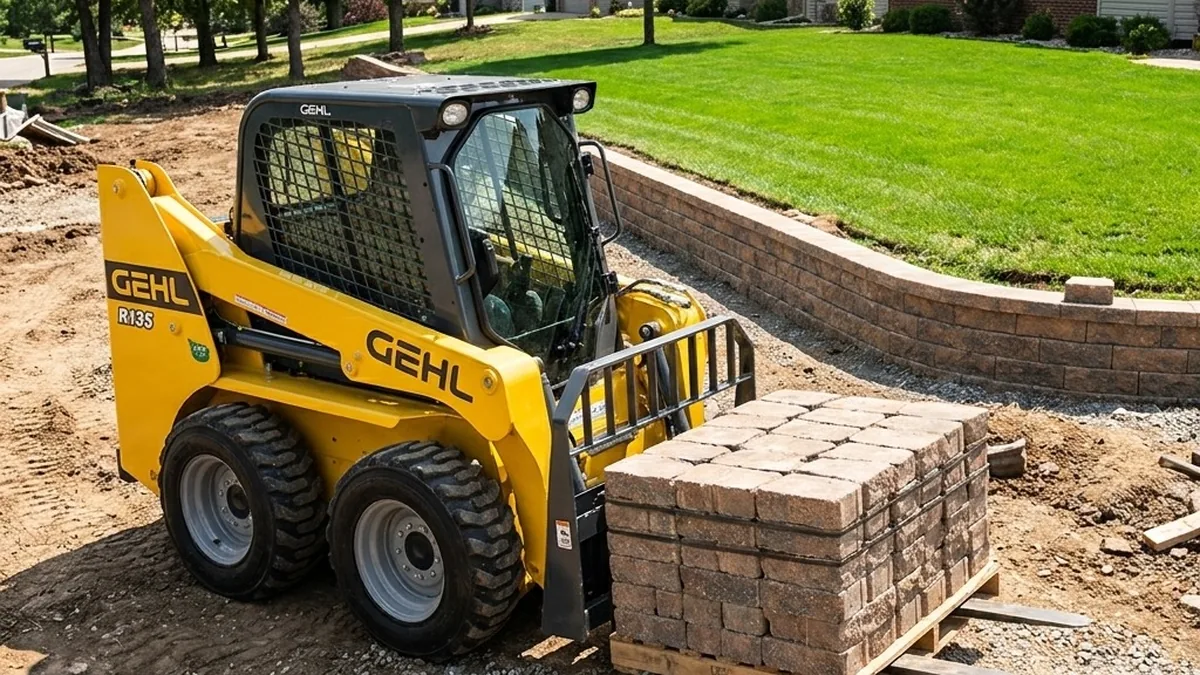
If you're installing paver patios, segmental retaining walls, or natural stone, a skid steer for hardscaping is the machine that does the heavy lifting your crew used to do by hand. It carries pallets of block off the trailer, sets stone close to the wall line, hauls base rock and fill around the site, and grades the pad before you ever lay the first course. That's the whole job in one machine: less wheelbarrow work, fewer torn-up backs, and a crew that's still fresh at 2 p.m. instead of gassed by lunch. The big question for most landscapers isn't whether to run a compact loader. It's which setup actually fits hardscape work, and what attachments earn their keep. Let's walk through it the way we'd talk it through on the lot here in Laddonia.
Why a Compact Loader Belongs on a Hardscape Crew
Hardscape installs are material-heavy. A single mid-size patio can swallow several pallets of pavers, a few tons of base aggregate, and bedding sand on top of that. Walls are worse, because the block is dense and you're often building below grade with backfill and drainage stone. All of that has to come off the truck, move across the yard, and land where the crew needs it without wrecking the lawn.
That's exactly what a compact loader is built for. Pick up a pallet, drive it to the staging spot, set it down, repeat. It turns a half-day of hand-hauling into an hour. And it does it without the manpower a wheelbarrow line eats up, which matters when good labor is hard to find.
A few jobs a loader handles on a typical hardscape site:
- Unloading pallets of block, pavers, and stone straight off the trailer
- Moving base rock, drainage gravel, and fill around the property
- Carrying spoils from the excavation to a pile or a dump trailer
- Rough grading and leveling the base before compaction
- Setting heavy cap stones or boulders closer to the wall line
None of that is glamorous. It's just the work that wears a crew down when it's done by hand. Let the machine take it, and your people spend their energy on the part that pays: clean lines, tight joints, level courses.
A Skid Steer for Hardscaping: Wheels or Tracks?
This is the first real decision, and it comes down to the ground you work on. Both are compact loaders. The difference is wheels versus rubber tracks, and on a hardscape site that difference shows up fast.
The case for a skid loader (wheels)
A wheeled skid loader is quick, turns tight, and is easy to load and unload. On firm ground, established lots, and paved staging areas it's hard to beat. If most of your work is on driveways, commercial pads, and yards that are already solid, a skid loader keeps things simple and nimble. You can dig into the full lineup on our skid loaders page.
The case for a compact track loader (rubber tracks)
Here's the thing about hardscaping: a lot of the time you're working on, or right next to, finished ground. Soft turf, fresh sod, a customer's irrigated lawn. Rubber tracks spread the machine's weight over a much bigger footprint, so they float instead of rutting. That's the whole reason a skid steer for hardscaping often ends up being a track machine. Tracks also claw through mud and wet clay that would have a wheeled unit spinning, and mid-Missouri clay gets sloppy after a rain.
If you're regularly crossing lawns to reach a backyard install, or you build in spring when the ground is wet, tracks are usually the call. Our compact track loaders page covers the options. And if you want the full side-by-side, we wrote a whole piece on it: skid loader vs. track loader.
Short version: firm, paved, established ground leans wheels. Soft turf and wet conditions lean tracks. Plenty of crews keep one of each once the work justifies it, but if you're buying one machine to do hardscape, the track loader is the safer bet for protecting finished surfaces.
The Attachments That Actually Earn Their Keep
The loader is the base. The attachments are where a hardscape setup gets specialized. The universal quick-attach plate is the whole point: one machine, many tools, swapped in under a minute. Here are the ones that matter most on a wall and patio crew.
Pallet forks
If you buy one attachment, buy forks. This is the workhorse of any hardscape setup. Pallet forks turn your loader into the machine that unloads the truck and moves every pallet of block and stone on the job. They slide under a pallet, lift it clean, and set it down level wherever the crew is laying. No more breaking down a pallet by hand to wheelbarrow it across the yard.
Forks are simple, they're tough, and they pay for themselves on the first big delivery. Most crews keep a set on the machine more than any other tool.
Grapples
A grapple is your second buy. Hardscape sites generate a lot of awkward material: boulders, broken-out concrete, root balls, brush from clearing, and loose stone that doesn't bucket well. A grapple grabs and holds it so you can lift and place instead of scooping and spilling. For natural stone walls and boulder work, a grapple lets the operator set big pieces close to where they land, which saves a ton of manual repositioning.
Buckets and other tools
- General-purpose bucket for moving base rock, gravel, sand, and spoils. The everyday material mover.
- Grading or leveling tools for dialing in the base before you compact. Flat base, flat patio.
- Augers if you set footings, posts, or columns as part of the build.
The point isn't to own every tool day one. It's to start with forks and a bucket, add a grapple when the stone work justifies it, and grow from there. Browse what bolts onto these machines on our attachments page, and we'll help you match tools to the kind of installs you actually run.
Working on Finished Ground Without Wrecking It
This is the part that separates a pro setup from a machine that creates callbacks. Hardscaping almost always means operating near, or directly on, surfaces you can't tear up. The customer's lawn. A neighbor's yard. Fresh sod you're trying to save. Pavers you just set.
A few things that keep the ground clean:
- Rubber tracks or turf-friendly setup. As covered above, tracks spread weight and reduce rutting on soft ground. That's the single biggest factor.
- Smooth operation. Easy on the controls, gentle turns, no spinning in place. Sharp counter-rotations are what dig divots in a lawn.
- Plan your travel lanes. Pick a path across the turf and stick to it instead of crisscrossing the whole yard. Lay plywood or mats over the softest stretches if you have to cross repeatedly.
Protecting the lawn isn't just about being tidy. It's about not adding a sod-repair line to a job you already bid. A loader that floats over turf instead of chewing it up is part of how you finish on budget and keep the customer happy enough to refer you.
Sizing the Machine to Your Crew and Your Jobs
Bigger isn't automatically better. The right size is the one that carries your typical pallet, fits where you work, and loads on your trailer without a hassle. We keep the specifics qualitative here on purpose, because the honest answer depends on your jobs, but here's how to think it through.
- What you lift. If you move full pallets of dense wall block, you want enough capacity to handle them with margin, not right at the edge.
- Where you squeeze in. Backyard installs, gates, and fence lines set a width limit. Measure your tightest access before you fall in love with a big machine.
- How you haul it. The machine has to fit your trailer and your tow vehicle. A unit you can't move easily is a unit that sits.
- Who runs it. A machine your whole crew can operate confidently beats one only the foreman trusts.
If you're not sure where you land, that's normal, and it's exactly the conversation we like having. Run through our find your machine guided selector to get a starting point, then call us and we'll sanity-check it against your real job mix. We carry Manitou and Gehl, and we'll point you to the right class instead of upselling you into more machine than the work needs.
Buy or Keep Renting? A Quick Gut Check
If you're renting a loader from a rental yard every time a hardscape job comes up, the math usually catches up with you. Rental costs add up fast across a season, and you're stuck with whatever's on the lot that week. Owning means the machine and your forks are on the trailer every morning, ready, dialed in the way your crew likes it.
That said, it depends on your volume. If hardscaping is a once-in-a-while add-on, renting might still pencil out. If walls and patios are a real part of your book, ownership almost always wins on cost and convenience. We laid out the full decision in rent vs. buy a loader or telehandler if you want to run your own numbers.
And if cash flow is the hold-up, financing is open right now. We've got 0% for 48 months on skid and track loaders, rates from 1.99% across the line (1.49% on electric machines), through September 30, 2026. For a lot of crews, a payment that's covered by one or two installs a month makes the buy decision easy.
Maintenance You Should Watch (and What It Costs You to Ignore)
This is buyer education, not a sales pitch. A compact loader is simple to keep running if you stay ahead of a few basics. Skip them and a cheap problem turns into an expensive one.
- Daily fluid and filter checks. Two minutes before you start. Catch a leak or a low level before it grenades something.
- Greasing pivot points. Pins and bushings wear out fast when they run dry. Grease on schedule and they last.
- Keep it clean. Mud, sand, and stone dust are abrasive. Blowing out the machine at the end of a dusty hardscape day extends the life of just about everything.
- Tracks or tires. On a track loader, undercarriage wear is the big long-term cost, and it's mostly about tension, debris, and how you operate. We broke that down in track loader undercarriage maintenance.
The point is simple: a little daily attention keeps a machine on the job and off the sideline. Ignore it and you pay for it in downtime during your busy season, which is the worst time to lose a machine.
Why Buy It Local, From ESO
We're in Laddonia, MO, and we cover mid-Missouri: Columbia, Jefferson City, Mexico, Fulton, and the stretch up through Vandalia and Bowling Green that most equipment dealers ignore. We're the only Manitou and Gehl dirt-equipment dealer for about 50 miles, so when you buy from us you've got a real dealer down the road, not a salesperson three states away who's never seen your job sites.
That local relationship matters more on equipment than almost anything else you buy. We know the ground you work, we know mid-Missouri clay, and we'll help you spec a loader and a set of forks that fit your crew instead of selling you a stock configuration. If you're municipal, ask us how cooperative purchasing fits your buying process, because Manitou participates in those programs and we're an authorized fulfilling dealer.
Let's Spec the Right Setup for Your Crew
If hardscape and retaining walls are part of your business, the right loader and attachments will pay for themselves in saved labor and faster installs. Tell us the kind of jobs you run, the ground you work, and the pallets you lift, and we'll match you to the right Manitou or Gehl machine, plus the forks and grapple to go with it. Start by requesting a quote and we'll put together a setup built for the work you actually do, not a spec sheet. Give us a few details about your crew and your typical install, and let's get the right machine on your trailer.