
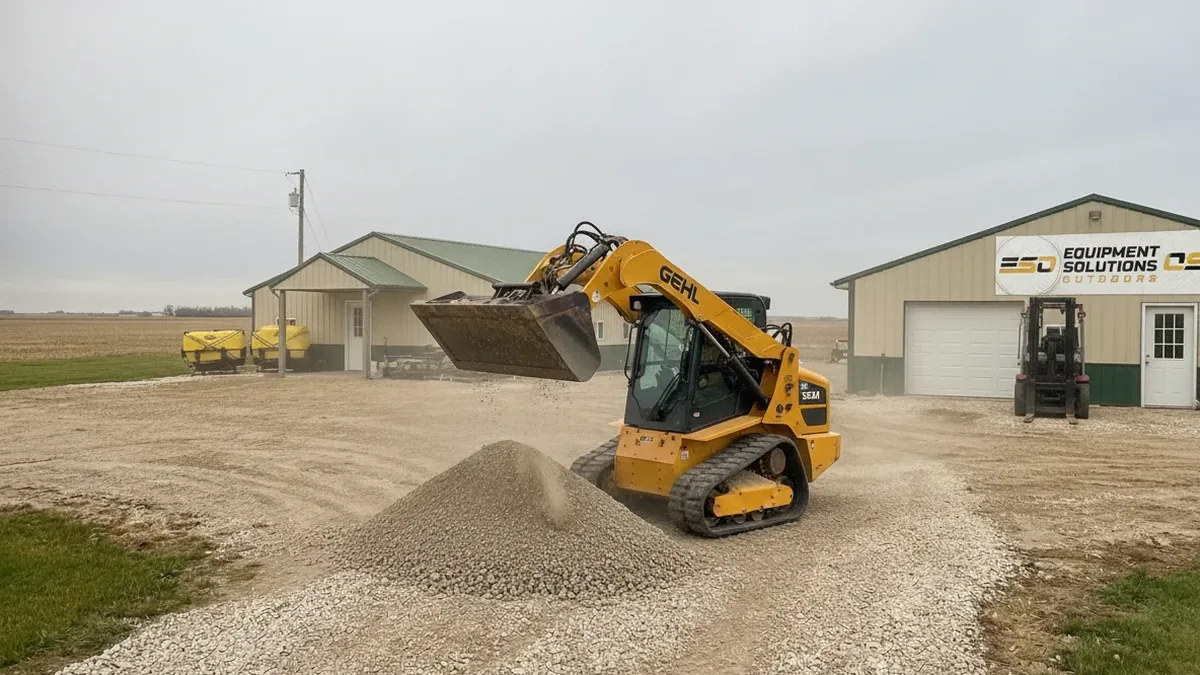
Before you climb in and fire up a skid loader or a compact track loader, give it five minutes. That's the whole point of a skid steer daily inspection checklist. You walk the machine, look at a short list of things, and catch the small problem before it turns into a dead machine on the jobsite. Most breakdowns don't come out of nowhere. They leave a sign first - a wet spot under the loader, a track that's chunked, a loose pin, a coupler that didn't lock all the way. A quick walkaround is how you see those signs before they cost you a day. This is buyer education, plain and simple. We sell Manitou and Gehl skid loaders and track loaders here in Laddonia, and we want the folks running them around mid-Missouri to get every hour out of the machine.
Here's the short version up front. Walk the machine cold, before it's running. Check fluids, look at the tracks or tires, glance at the pins and bushings, make sure the attachment coupler is locked, test the lights and safety gear, and look at the ground for leaks. That's it. None of it takes long, and none of it needs a wrench most days. It's just looking, on purpose, in the same order every time so you don't skip anything.
Why the walkaround matters more than you think
A skid loader is a hardworking machine that lives in dirt, mud, and dust. Things shake loose. Hoses rub. Mud packs where it shouldn't. The machine doesn't fail all at once. It tells you it's about to, usually a few days ahead, if you're looking.
The whole reason a daily walkaround pays off is timing. A hydraulic line that's starting to weep is a two-minute look today. The same line blown out in the middle of a grading job is a stopped machine, a mess to clean up, and lost fluid you're paying to replace. A loose coupler caught in the yard is nothing. A bucket that drops off mid-lift is a safety problem and a bent edge. You're not doing the walkaround to be thorough for the sake of it. You're doing it to move the expensive problems to the cheap end of the day.
Do it cold and do it the same way every time. Cold means before you start the engine, so you can hear, see, and smell things you'd miss with it running. Same way every time means you build a route around the machine and follow it, so checking becomes a habit instead of a decision you have to make tired at 6 a.m.
Start your skid steer daily inspection checklist with fluids
Fluids are where a five-minute look saves you the most. A skid loader runs on oil, hydraulic fluid, and coolant, and running any of them low or dirty is how you turn a healthy machine into a repair bill. Check these before you start, with the loader on level ground.
- Engine oil. Pull the dipstick, wipe it, check the level and the look of the oil. Low is a problem. So is oil that's gone milky or smells burnt.
- Hydraulic fluid. A skid steer is mostly a hydraulic machine. Low hydraulic fluid makes everything weak and slow and runs the pump hot. Check the sight glass or dipstick per your machine's procedure.
- Coolant. Look at the reservoir level, not the radiator cap on a hot engine. Low coolant in a hardworking diesel is how you cook it on a summer day in central Missouri.
- Fuel and water separator. Glance at your fuel level so you're not stranded, and drain the water separator if your machine has one and it needs it.
If a fluid is low, the real question isn't just "top it off." It's "why was it low?" A machine that drinks oil or hydraulic fluid is telling you something. Catching that pattern early, on the dipstick, beats finding out the hard way.
Look at the tracks or tires
What the machine rides on is where a lot of your wear money goes, and it's easy to inspect. The check is a little different depending on whether you're running a skid loader on tires or a compact track loader on rubber tracks.
If it's on tires
- Look for cuts, chunks missing, exposed cords, and sidewall damage.
- Check that they look evenly inflated. A low tire on one corner throws off how the machine sits and works.
- Pull any rebar, wire, or chunks of metal stuck in the tread before it works its way in deeper.
If it's on tracks
- Walk both tracks and look for cuts, chunking, cracking, and any exposed cords.
- Knock off packed mud before it dries into concrete. Central Missouri clay packs hard, and packed mud grinds the undercarriage and messes with track tension.
- Glance at the rollers and idlers for leaks or play, and check that the track tension still looks right.
The undercarriage on a track machine is the single biggest consumable you own, so a daily look there is worth real money over the life of the loader. If you want to go deeper on protecting it, we wrote a full guide on track loader undercarriage maintenance that covers what eats tracks and how to slow it down. And if you're still deciding between tires and tracks for your ground, our skid loader vs track loader breakdown lays out where each one earns its keep.
Check the pins, bushings, and the loader arms
The pivot points on a loader take a beating. Pins and bushings carry the load every time the arms lift and the bucket curls, and they wear. Worn ones rattle, slop around, and eventually fail in a way that's expensive and not fun to fix in the field.
You don't need tools for the daily look. You're checking for movement and grease.
- Look for play. With the machine off, eyeball the pin joints on the loader arms and the bucket. Obvious slop, shiny worn metal, or an elongated hole at a pivot means a pin or bushing is wearing.
- Listen during operation. A clunk or knock when you change direction on the arms often traces back to a worn pin. Once you've spotted it on the walkaround, you know what the noise is.
- Keep them greased. Dry pins wear fast. Hitting the grease points on schedule is one of the cheapest things you can do to make pins and bushings last. A pin that's been greased its whole life outlasts one that's been run dry, every time.
The reason this matters on a daily check is that pin and bushing wear is slow and quiet right up until it isn't. Catching it early means a grease gun and a note to order a part. Ignoring it means slop that beats up the rest of the joint and turns one cheap part into several.
The attachment coupler is the one that bites people
This is the check that prevents the scary kind of failure. A skid loader's whole value is that it swaps attachments - bucket, forks, grapple, auger, brush cutter, whatever the job needs. That quick-attach coupler is what holds the attachment on. If it isn't fully locked, the attachment can come off mid-lift. That's a damaged tool, a possible injury, and a very bad day.
So make the coupler part of every walkaround and every attachment change.
- Confirm the locking pins are fully down and through. Most couplers use levers or pins that drop into the attachment. Don't trust the lever position alone. Look that the pins are actually seated.
- Tilt and tug. After you connect an attachment, curl it back and crowd it against the ground to make sure it's locked tight before you lift a load with it.
- Check the coupler itself for wear and cracks. The plate, the pins, and the lock mechanism all take stress. Bent or cracked is a stop-and-fix, not a run-it-anyway.
- Look at the hydraulic couplers if the attachment uses them. Make sure they're clean, fully connected, and not leaking before you run a powered attachment.
If you run a lot of different attachments, this check matters even more, and it's worth knowing which tools actually fit your machine and your work. Our attachments page is a good place to start that conversation.
Lights, safety gear, and the operator station
The boring checks are still the ones that keep you legal, safe, and working. None of this takes more than a quick glance, but a skid loader with a dead safety interlock or no working lights is a machine you shouldn't be running.
- Lights. Work lights, and road lights if you ever move the machine on a public road. A blown work light turns an early-morning or late-evening job into a guessing game.
- Seatbelt and seat bar. These are your rollover protection on a skid loader. Check the belt for fraying and confirm the seat bar moves and latches like it should.
- Safety interlocks. Most modern loaders won't let the loader arms or drive function work unless you're belted in with the bar down. Don't defeat these. If one isn't working right, that's a real problem to flag, not work around.
- Backup alarm and horn. Quick to test, and the people working around the machine are counting on them.
- The cab itself. Clean glass, working wipers, mirrors where they should be. You can't run safely if you can't see.
This part of the checklist isn't about the machine breaking down. It's about you and the people on the jobsite going home in one piece. That's worth thirty seconds.
Walk the ground and look for leaks
Finish where the machine slept. Before you move it, look at the ground underneath. A skid loader that's parked overnight will leave evidence of a leak you'd never catch while it's running and the wind is drying everything off.
- Hydraulic fluid shows up as a slick, often reddish or amber puddle or drip. On a hydraulic machine, this is the leak you most want to catch early.
- Engine oil is darker and usually under the engine bay.
- Coolant is brightly colored and sweet-smelling, and it points to a cooling problem you want fixed before a hot summer day stops you.
- Fuel you'll usually smell before you see.
Once you've spotted a drip, trace it up to the source while the machine is still cold and parked. A weeping fitting you can tighten or a hose you can schedule to replace is a small thing. The same component letting go under load, on the job, is the breakdown you were trying to avoid. The puddle on the ground is the cheapest early warning you'll ever get, so don't drive away from it without a look.
Build the habit, then run the machine right for it
The whole checklist comes down to a route and a rhythm. Same path around the machine, same order, every morning before you start. Fluids, tracks or tires, pins and bushings, coupler, lights and safety, leaks. Five minutes. Once it's a habit you stop thinking about it, and you start catching things weeks before they'd have caught you.
Here's the honest part. A daily walkaround makes any loader last longer, but it works best on a machine that's the right fit for your work in the first place. A loader that's undersized for your loads gets run hard and wears fast no matter how well you check it. One that's matched to your ground and your jobs holds up. Picking the right size and type up front is the bigger lever, and the walkaround protects the investment after.
See the loaders
If you're shopping a skid loader or a track loader and you want one built to take a daily beating around mid-Missouri, come look at what we carry. We're the Manitou and Gehl dealer in Laddonia, MO, serving Columbia, Jefferson City, Mexico, Fulton, and the Vandalia and Bowling Green stretch that's been short on dealers for a long time. Browse the skid loaders and track loaders, or if you're not sure which machine fits your work, run the find your machine guide and we'll help you sort it out. No pressure, just straight answers from people who'd rather sell you the right loader than the biggest one.