
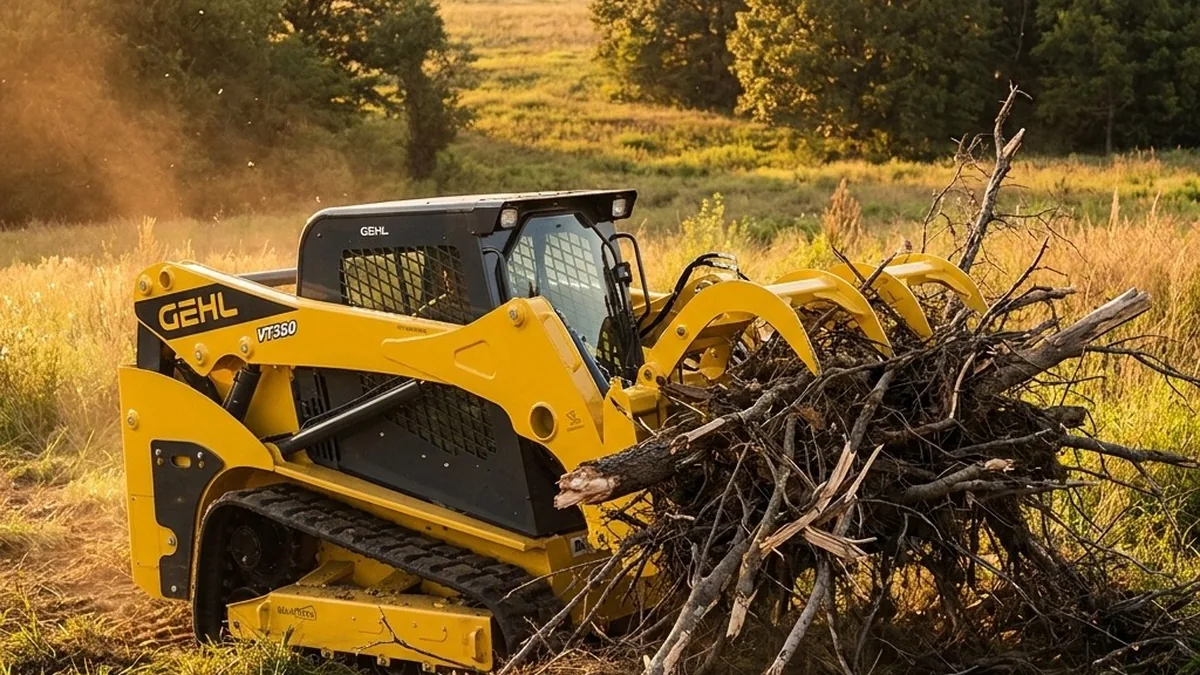
If you've got brush piles, storm debris, or a fence line that's slowly turning into a forest, the right attachment matters more than the machine. Skid steer grapple bucket uses cover the whole mess: hauling brush, picking rock, sorting demolition scrap, and stacking logs. Bolt one onto a loader and you've basically hired a cleanup crew that shows up every morning and never asks for lunch. The trick is knowing which grapple grabs what, because a brush grapple, a grapple bucket, and a root grapple are three different tools that look almost the same in a photo.
We're Equipment Solutions Outdoors in Laddonia, MO. We sell and set up Manitou and Gehl loaders for folks across mid-Missouri, and grapple work is one of the most common reasons people come in. So here's the plain-English breakdown of what each grapple does, what kind of loader you want under it, and how to spec the combo for the cleanup you're actually facing.
Skid steer grapple bucket uses: what a grapple actually does
A bucket scoops. A grapple grabs. That's the whole difference, and it changes everything about what you can pick up.
A plain bucket is great for loose material you can scoop off the ground: dirt, gravel, mulch. But brush, branches, awkward chunks of concrete, and downed timber don't scoop. They roll out, slide off, or bridge across the bucket and fall when you lift. A grapple adds a hinged top jaw (or a set of independent tines) that clamps down and holds the load against the bucket or tines below it. Now that tangled mess of limbs stays put while you drive it to the burn pile.
Here's what that gets you on a typical mid-Missouri property:
- Brush and storm debris. Clamp a pile, lift it, carry it. No more dragging armloads by hand or chaining it to a truck.
- Rock and fieldstone. Pick boulders out of a pasture, clear a creek crossing, sort rock by size.
- Demolition scrap. Old fence, busted concrete, torn-out decking, scrap metal. Grab it and load the trailer or dumpster.
- Logs and timber. Move felled trees, stack firewood rounds, feed a processor.
- Root balls and stumps. Wrestle out small stumps and shake the dirt loose before they go in the pile.
The grapple is what turns a loader from a dirt mover into a true property-cleanup machine. Now let's sort out which grapple you actually want.
Brush grapple vs grapple bucket vs root grapple
These three names get used loosely, and dealers don't always agree on the labels. Here's how we describe them so you know what you're buying.
Grapple bucket (closed-bottom grapple)
This is a real bucket with a solid floor and sides, plus one or two grapple arms hinged on top. Because it has a closed bottom, it holds loose material and grabbable material at the same time. That makes it the do-everything option.
- Best for: mixed cleanup where you're picking up loose junk and bulky stuff in the same pass, like storm wreckage with leaves, dirt, and branches all jumbled together.
- Grabs: brush, scrap, dirt, mulch, debris, small rock, trash.
- Trade-off: the solid floor scoops up dirt and rock you may not want, so it's heavier and not ideal when you're trying to leave the topsoil behind.
Brush grapple (open-tine grapple)
Instead of a solid bucket, this one has tines (steel fingers) on the bottom and a clamping top. The gaps between the tines let dirt and small debris fall through, so you grab the bulky stuff and leave the fines behind.
- Best for: brush piles, limbs, and storm debris where you want the wood and not the dirt. Cleaner burn piles, cleaner loads.
- Grabs: brush, branches, logs, light demolition material.
- Trade-off: won't hold loose soil, mulch, or fine gravel. It falls right through the tines.
Root grapple (heavy-duty open grapple)
A root grapple is the beefed-up cousin of the brush grapple. Wider-spaced, heavier tines and a stout frame built to dig under root balls, pry stumps, and rake up roots while the dirt sifts out. It's the one you reach for when the job involves wrestling things out of the ground.
- Best for: land clearing, stump and root removal, raking a cleared lot, separating rock and roots from soil.
- Grabs: stumps, root balls, big rock, heavy timber, dense brush.
- Trade-off: overkill (and heavier) for light brush cleanup, and the wide tine spacing drops anything small.
Quick rule of thumb. If your cleanup is mixed and messy, lean toward a grapple bucket. If it's mostly brush and you want clean wood loads, a brush grapple. If you're clearing land and fighting roots, a root grapple. Plenty of owners around here end up with two attachments and one machine, which is exactly why quick-attach matters so much. More on that below.
Matching the grapple to the cleanup job
The grapple you pick should follow the work, not the other way around. Here's how the common mid-Missouri jobs sort out.
Brush and fence-line clearing
Cedar encroachment is real out here. Pastures and fence lines fill in fast, and once the cedars get going they take over. A brush grapple pulls cut brush and small whole trees into piles, then loads or stacks them. Pair it with a loader that has enough lift and reach to stack high, and you clear a fence line in an afternoon instead of a weekend. If the brush is heavy and woody enough that you're thinking about grinding it instead of piling it, that's a different attachment conversation, and we cover it in our guide on forestry mulching with a skid steer in mid-Missouri.
Storm and tornado debris
After a storm, the debris is everything at once: limbs, splintered wood, torn metal, shingles, and a lot of dirt mixed in. A grapple bucket shines here because the closed floor catches the small stuff while the top jaw clamps the big stuff. You can clear a yard or a driveway and load a roll-off without picking through it by hand.
Rock and pasture cleanup
Picking rock is miserable by hand and easy with a grapple. A root grapple or a grapple bucket lets you grab fieldstone, clear a creek ford, or build a rock pile for landscaping. The open-tine options let the dirt fall away so you're hauling rock, not mud.
Demolition and scrap handling
Tearing out an old barn, deck, or run of fence? A grapple grabs the broken pieces and feeds the trailer or dumpster fast. The clamping jaw keeps long awkward boards and twisted metal from sliding off mid-carry. Just match the grapple's strength to the load. Demolition scrap is harder on an attachment than brush.
Log and firewood handling
For moving felled trees, stacking rounds, or feeding a firewood processor, a grapple turns a one-log-at-a-time chore into grab-and-go. Open grapples (brush or root) handle logs best because the tines cradle the trunk and the top jaw locks it down.
What loader you want under the grapple
The attachment does the grabbing, but the machine decides how much you can grab and where you can take it. Two things matter most: how the machine moves over the ground, and how much it can lift and carry safely. We won't throw spec numbers at you here, because the right size depends entirely on your acreage, your ground, and your loads. But here's how to think about it.
Skid loader vs compact track loader
On firm ground, gravel, and around hard surfaces you don't want torn up, a wheeled skid loader is fast, nimble, and easy on tires-and-driveway budgets. On the soft, wet, hilly ground a lot of mid-Missouri property has, especially in spring or after rain, a compact track loader floats better, pushes harder, and keeps working when a wheeled machine would be spinning. Grapple work often happens in exactly those soft, brushy, low spots, which is why a lot of cleanup buyers here lean toward tracks. We break down the full trade-off in skid loader vs track loader, and you can browse both lines at our skid loaders and compact track loaders pages.
Size it to your loads, not your ego
Bigger isn't automatically better. A machine that's too big for your gates, your trailer, and your terrain becomes a headache. A machine that's too small struggles to lift a full grapple of wet brush. The sweet spot is the loader that handles your heaviest realistic load with margin to spare, fits where you need it to fit, and doesn't tear up ground you're trying to keep nice. That's a conversation worth having before you buy, not after. If you're not sure where you land, our Find Your Machine selector walks you through it in a few questions.
Hydraulic flow matters for grapples
A grapple's jaw runs off the loader's auxiliary hydraulics. Standard-flow hydraulics open and close a grapple just fine for most cleanup. The reason to care about flow is that if you ever plan to run thirsty attachments on the same machine, like a mulcher, a brush cutter, or a stump grinder, you'll want to spec the hydraulic package up front so one loader covers everything. That's a quick check we run with you when we match the machine.
Quick-attach is the whole point
Here's the part that makes grapples worth it. Modern loaders use a universal quick-attach plate, so you swap attachments in under a minute without leaving the cab on most setups. Pull two levers, back off the old attachment, drive into the new one, lock it, plug the hydraulic lines, and go.
Why that matters for cleanup:
- One machine, many jobs. Run a grapple in the morning, swap to a bucket to grade the driveway, swap to a pallet fork to move the load you just made. Same loader, all day.
- You can own two grapples and still only own one machine. A grapple bucket for mixed messes and a brush grapple for clean wood loads is a common combo. The quick-attach makes that practical.
- Resale and flexibility. A loader with a deep attachment lineup holds its value and earns its keep. The grapple is one tool in a kit, not a one-trick purchase.
When you spec a loader for grapple work, confirm the quick-attach standard and the hydraulic couplers up front so every attachment you buy now or later just clicks on. You can see the attachment options on our attachments page, and we'll make sure the grapple, the coupler, and the machine all speak the same language.
Owning a grapple: what to watch (so it lasts)
A grapple is simple, which is most of its appeal. But cleanup work is abusive work, and a little attention keeps it out of trouble. This is buyer education, not a sales pitch. Here's what costs you money if you ignore it.
- Pins and bushings. The jaw pivots on pins. Grease them on schedule. Dry pins wear oval, the jaw gets sloppy, and eventually you're chasing a repair you could've greased away.
- Hydraulic hoses and couplers. Brush snags hoses and demolition scrap nicks them. Route them clean, check for rubbing, and keep the quick-couplers capped when they're off so grit doesn't get in.
- Tines and cutting edges. They take the beating. Watch for cracks at the welds, especially on root and demolition work. Catching a cracked tine early is cheap. Letting it tear off is not.
- Don't out-muscle the machine. Prying a stump that's bigger than the loader can handle is how you bend tines and over-stress the frame. If it won't come, dig around it or step up to a bigger machine for that job.
None of this is hard. The point is just that a grapple rewards basic upkeep with years of service, and punishes neglect with downtime right when you need it.
Buy it, don't rent the problem
A lot of folks start by borrowing a loader every storm season or every clearing project, then do the math. If cleanup is a recurring part of how you run your property or your contracting business, owning the loader and a grapple usually pencils out better than scrambling for the same machine three times a year. You get the machine when you need it, set up exactly how you want it, with the attachments that fit your work. We lay out that math in rent vs buy a loader or telehandler.
And owning is more reachable than people assume right now. Manitou and Gehl have financing running at 0% for 48 months on skid and track loaders, rates from 1.99% across the line (1.49% on electric machines), through September 30, 2026. That's a real window if a cleanup machine has been on your list. See the details on our financing page.
Get the right loader-and-grapple combo for your cleanup
Skid steer grapple bucket uses come down to one thing: matching the grapple to the mess and the machine to the ground. Brush grapple for clean wood loads. Grapple bucket for mixed storm debris. Root grapple for clearing and stumps. A skid loader on firm ground, a track loader on the soft mid-Missouri stuff. Quick-attach so one machine does it all.
We're the only Manitou and Gehl dirt-equipment dealer for about 50 miles, based in Laddonia and serving Columbia, Jefferson City, Mexico, Fulton, and the Vandalia and Bowling Green stretch that's been underserved for years. Tell us what your cleanup looks like, the acreage, the debris, the ground, and we'll spec the loader and the grapple that fit, then put real numbers to it. Request a quote and let's get your property cleaned up.