
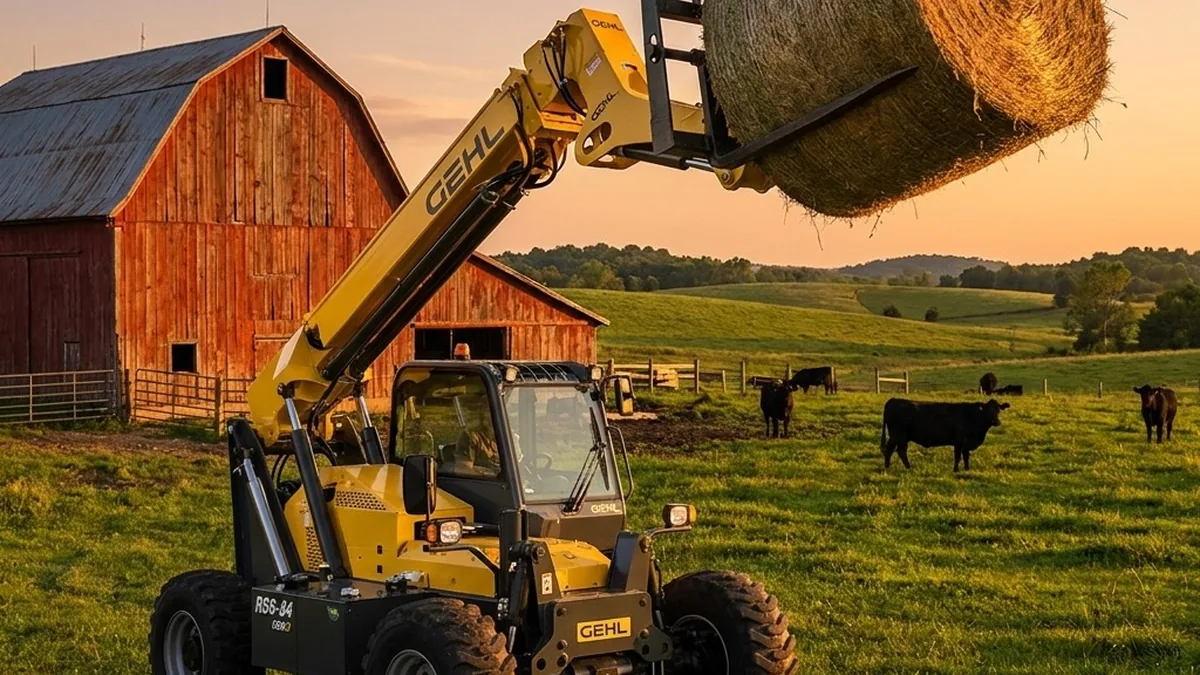
If you run cattle or put up hay in mid-Missouri, you already know the machine you grab first matters. A telehandler for hay handling is usually the answer when you're tired of one tractor for bales, a different rig for feeding, and a third thing to load the truck. The goal here is simple: one ag-spec machine that earns its keep across bale handling, feeding, bedding, barn clearance, and loading. We're a Manitou and Gehl dealer in Laddonia, and we spend a lot of time helping cattle and row-crop guys around Mexico, Fulton, and Vandalia figure out whether a telehandler, a compact track loader, or both is the right call. This is the honest version of that conversation.
Why One Machine Instead of Three
Most farms grow their equipment by accident. You buy a loader tractor, then a bale spear setup, then something with a grapple, then a forklift for the shop. Each one does its job. None of them does all the jobs well, and you've got money tied up in iron that sits most of the year.
A single ag-capable machine changes that math. The point isn't that it does everything perfectly. It's that one operator, one set of keys, and one machine handle the bulk of the daily and seasonal work. Fewer pieces to maintain, fewer to insure, fewer to walk past in the shed wondering why you bought them.
That's the case for thinking in terms of capability instead of brand or model number. Before you shop a spec sheet, get clear on what your operation actually demands day to day. We'd rather spec the right machine for your jobs than sell you the biggest one on the lot.
What a Telehandler for Hay Handling Actually Buys You
A telehandler is a loader with a boom that reaches up and out. That reach is the whole story for a hay operation. You're not just lifting bales, you're placing them.
- Stacking round bales high. Reach lets you build taller, tighter stacks. That means more hay under cover in the same footprint, and less hay rotting in a sloppy outdoor pile.
- Reaching into the barn or over a fence line. A boom places a bale where a straight-mast machine simply can't get to. You stand off and reach in instead of driving in and backing out.
- Loading trucks and trailers from one side. You can set bales onto a flatbed without climbing all over it or repositioning ten times.
- Switching from spear to bucket to grapple. The same carrier runs different attachments, so the machine that stacked hay this morning moves dirt or pushes a feed pile this afternoon.
We keep capacity claims honest here on purpose. The right lift and reach for your farm depend on how high you stack, how heavy your bales run, and how tight your buildings are. That's a load chart conversation, not a number we toss out to make a sale. If you want to understand how reach and weight interact before you ever sit in the seat, our breakdown on telehandler load charts walks through it in plain language. The short version: capacity drops as you reach farther out, and a good dealer sizes the machine so you're not living at the edge of the chart.
Round Bales, Square Bales, and the Daily Feed
Bale handling is where most of these machines prove themselves, so it's worth getting specific.
Round bales
For rounds, you're typically running a single or dual spear, or a grapple-style handler. The questions that matter are how high you need to stack and how far you need to reach. If you store outside in long rows, a basic spear and decent lift gets it done. If you're stacking three high inside a pole barn and reaching past the door, that's where boom reach starts paying for itself fast. And rounds aren't gentle on a machine. A wet round bale is a lot of weight hanging off the front, so a stable platform and the right counterweight matter as much as the spear itself.
Square bales
Big squares are heavy and unforgiving. They reward a stable platform and a forks-style attachment that supports the bale across its width. Small squares are lighter but you're handling volume, so a grapple or a fork basket that lets you move a stack at a time saves your back and your day. If you're loading squares onto a semi for a hay buyer, reach and a clean side-load matter even more, since you're stacking neat and tight without crawling on the trailer.
Daily feeding
Winter feeding is the grind. Every morning, in the mud, in the cold. A machine that starts easy, gives you good visibility to the bale and the feeder, and swaps attachments without a fight is worth real money over a long Missouri winter. This is exactly where a forklift-style straight mast falls short and a loader or telehandler shines, because you're not just lifting, you're maneuvering in tight, sloppy lots. If you're weighing a true forklift against a telehandler for mixed farm duty, our piece on the telehandler versus forklift tradeoff lays out where each one wins.
Bedding, Barn Clearance, and the Dirty Work
Hay's only half of it. The other half is everything that piles up around livestock.
- Bedding. Moving and spreading straw, shavings, or sawdust. A grapple bucket eats this up.
- Manure and pen cleaning. A bucket and a strong machine clear pens and load the spreader. This is heavy, repetitive work that wears out an undersized machine quick.
- Pushing piles and scraping lots. Whether it's a feed pile, a snow pile, or scraping a muddy lot, you want pushing power and traction.
This is where a compact track loader earns a hard look alongside a telehandler. Tracks float over mud and soft ground that would bog a wheeled machine, and that matters a lot in a Missouri lot in February or after a wet spell. A track loader won't reach like a telehandler, but for ground-level pushing, loading, and pen work on soft footing, it's hard to beat. Plenty of operations end up with one of each: the telehandler for reach and stacking, the track loader for the muddy ground-level grind. If you're torn between a wheeled and a tracked machine for your dirt work, our skid loader versus track loader comparison is the next thing to read.
Attachments Are Where the Versatility Lives
A machine is only as flexible as what you can hang on the front of it. The reason one machine can replace three is the attachment carrier. Spec the carrier and hydraulics right up front, and the machine grows with you.
Common attachments that pull their weight on a cattle and hay operation:
- Bale spears, single and dual
- Grapple buckets for bedding, brush, and loose material
- Pallet forks for loading feed, equipment, and supplies
- Standard and high-capacity buckets for dirt, gravel, and manure
- Bale grabs and squeeze-style handlers for soft-core rounds
The thing to get right is matching attachments to the machine's hydraulic flow and lift. An attachment that the machine can't power or safely lift is just expensive parking-lot art. We help you spec the carrier and the attachments together so the whole package works. Take a look at the attachment options we carry to get a feel for what's possible, then we'll narrow it to what your jobs actually need.
Buy Right the First Time: What to Watch
You're going to put thousands of hours on this machine over its life. A few things to think hard about before you commit, framed as what costs you down the road if you ignore them:
- Undercarriage and tires. On a track machine, the undercarriage is the single biggest wear item and the biggest repair bill if you neglect it. Daily knock-out of packed mud and debris, especially in winter, saves you a fortune. We cover this in our undercarriage maintenance guide so you go in knowing what you're signing up for.
- Visibility and comfort. You'll spend hours in the cab feeding in bad weather. A cab that keeps you warm, gives you a clear view of the attachment, and doesn't beat you up matters more than you'd think on day one.
- Hydraulic capacity for future attachments. Buy a hair more capability than you need today. The grapple or specialty attachment you'll want in two years needs the flow to run it.
- Service intervals and access. Easy daily checks get done. Hard ones get skipped, and skipped maintenance is what kills resale value and reliability. Look at how easy it is to check fluids and grease points before you buy.
- Right-sizing. Too small and you're working it to death and it wears out early. Too big and you can't get into your buildings and you overpaid. The sweet spot is specific to your farm.
None of that is a sales pitch. It's the stuff that determines whether you're happy with this machine in year five. We'd rather you know it going in than learn it the hard way two winters from now.
Why Buy Local in Mid-Missouri
Here's the honest reason to buy from a local dealer instead of chasing iron three hours away. When you're feeding cattle in January and you need an answer, distance matters. We're the only Manitou and Gehl dirt-equipment dealer for about 50 miles, which means we cover the Mexico, Vandalia, and Bowling Green stretch that's been a dealer dead zone for years, on top of Columbia, Jefferson City, and Fulton.
We know what mid-Missouri farms deal with. Wet springs, hard winters, clay ground, tight old pole barns. That context shapes what we recommend. We're not going to spec a machine that can't get through your barn door or one that bogs the first time you take it into a muddy lot.
On the money side, there's real financing on the table right now: 0% for 48 months on skid and track loaders, rates from 1.99% across the line (1.49% on electric machines), through September 30, 2026. If buying versus another path is on your mind, our rent versus buy breakdown is worth a read, and you can see the current terms on our financing page. We carry Manitou and Gehl, and we'll point you to the machine class that fits your operation, not the one with the fattest margin.
Not Sure Which Machine? Start Here
If you're early in this and not sure whether you need a telehandler, a track loader, or one of each, you don't have to figure it out alone. Two good starting points: our guided machine selector walks you through a few questions and points you at a class, and the telehandler lineup shows what we carry. Both are just orientation. The real spec comes from a conversation about your actual operation.
Tell us how you run things. How many head, how you store hay, what your buildings look like, what your lots get like in the wet. Give us that, and we'll spec the right machine and attachments for your farm and get you a real quote, no guessing and no pressure. Request a quote and tell us about your operation, and we'll do the homework to get you the machine that actually earns its keep around here.