
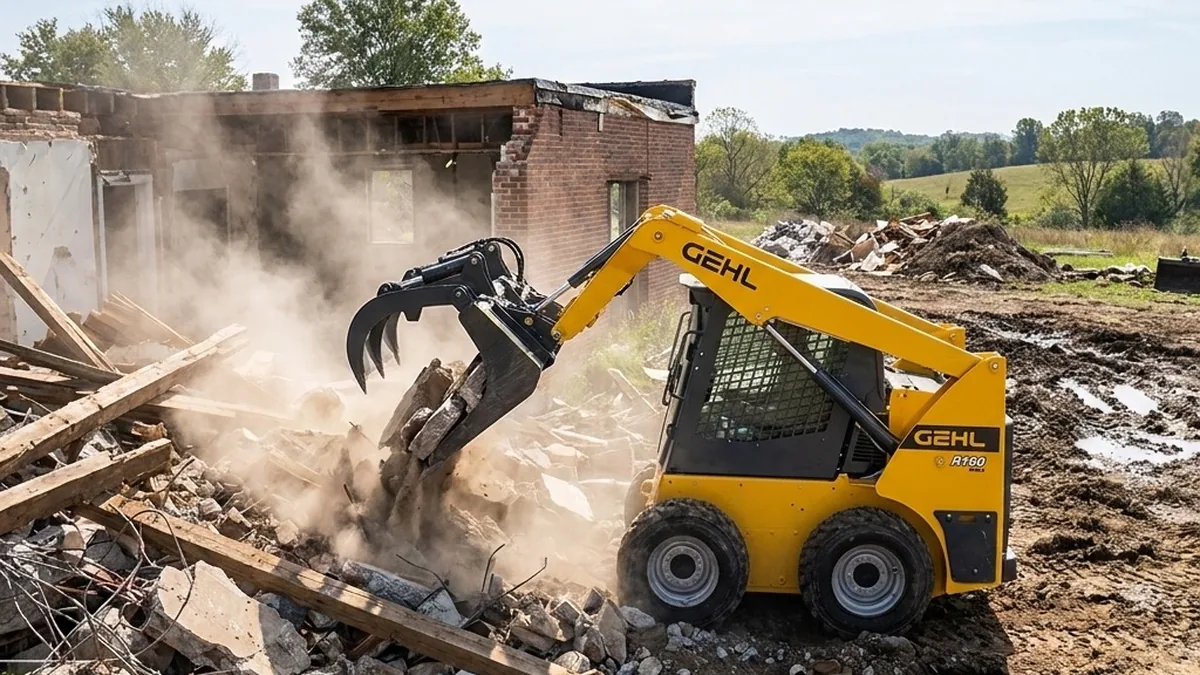
If you are tearing down a house, gutting a commercial space, or clearing a lot in mid-Missouri, the machine doing most of the work should be a compact one. A skid steer for demolition is the right call on the vast majority of residential and light-commercial teardown jobs, because the work is rarely one task. It's breaking, prying, grabbing, scooping, and hauling, over and over, in a tight space, all day. The machine that handles that isn't a single tool. It's a loader built to take abuse paired with the right set of attachments. This guide walks through that setup, who it fits in mid-Missouri, and how to spec it without overbuying or underbuying.
We're Equipment Solutions Outdoors in Laddonia, the area's Manitou and Gehl dealer. We sell these machines to the contractors who actually swing them around all week, so we'll talk straight about what works on demo and what just looks good in a brochure.
Why a Skid Steer for Demolition Beats a Bigger Machine on Most Jobs
The instinct on a teardown is to grab the biggest iron you can get. On a true large-scale demolition, that's fair. But most of the work in our area isn't that. It's a single-family rebuild, a garage that has to come down, a kitchen and bath gut, a strip-mall tenant fit-out, an old barn or shed, a fire-damaged structure. Those jobs reward a compact loader for a few simple reasons.
- It fits where the work is. Backyards, alleys, narrow lot lines, basements with walkout access, finished slabs you don't want to crack. A compact loader gets in and turns around. Bigger equipment gets staged on the street and you eat the cost of moving material to it.
- One operator, one machine, many jobs. Swap an attachment and the same loader goes from breaking concrete to grappling debris to loading the dumpster. You're not coordinating two big machines and two operators to do what one compact unit handles.
- It transports easy. A skid steer or compact track loader rides on a standard trailer behind a properly rated truck. No special permits, no lowboy, no waiting on a hauler. For a contractor running several small jobs a week around Columbia, Jefferson City, and Mexico, that mobility is the whole ballgame.
- It's cheaper to own and run. Lower purchase cost, lower fuel burn, lower transport cost. On the kind of work most mid-Missouri crews do, the math favors the compact machine.
The honest exception: if your demo is mostly heavy structural concrete or you're moving truly large volumes of rubble fast, you'll want to talk through whether a bigger machine or a different setup makes more sense. We'd rather tell you that up front than sell you the wrong tool. That's a five-minute conversation, and you can start it on our guided machine selector or by reaching out directly.
Skid Steer vs. Track Loader for Teardown Work
This is the first real fork in the road, and it depends on what's under your feet.
A skid steer loader rides on wheels. It's quick, it's nimble, it turns on a dime, and it's at its best on hard surfaces. Slabs, paved lots, driveways, packed gravel, finished commercial floors. On a teardown where you're working off concrete and pavement most of the day, wheels are fast and they hold up well.
A compact track loader rides on rubber tracks. It spreads weight over more ground, so it floats over soft, torn-up, muddy, or unstable footing instead of sinking into it. After a Missouri rain, on a lot that's been ripped open, or anywhere you're working over bare dirt and debris, tracks keep you productive when a wheeled machine is spinning. They also leave less of a mark on ground you care about.
For demolition specifically, here's the simple way to think about it. If most of your work happens on solid, dry, hard surfaces, the skid steer is faster and a better value. If you're regularly on soft ground, fresh demo sites, or mixed conditions, the track loader earns its keep by keeping you moving. A lot of contractors who do varied teardown work land on a track loader for the flexibility, then run a wheeled skid steer as a second machine for the hard-surface days. We broke this decision down in more detail in our skid loader vs. track loader guide if you want to go deeper before you pick.
The Attachments That Make It a Demolition Machine
The loader is the muscle. The attachments are what turn it into a demo rig. The right teardown setup usually starts with three or four of these, and you build out from there based on the work you take. Browse the full attachment lineup when you're ready to spec, but here's what actually matters on demo.
Hydraulic Breaker
This is your concrete, masonry, and rock tool. A hydraulic breaker turns the loader into a mounted hammer, so you're busting slabs, footings, foundations, and stubborn masonry without a crew swinging by hand. For breakers to work right, the loader has to supply enough hydraulic flow to feed the attachment. That's the most important spec on the whole job, and it's where buyers get tripped up. We'll match the breaker to the machine's flow so it actually hits with the force you paid for instead of pecking at the concrete.
Grapple
The grapple is the workhorse of teardown. It grabs, holds, and moves the awkward, jagged, mixed mess that demolition creates. Busted lumber, brush, sheet goods, broken concrete, twisted metal, full sections of wall and roof. Instead of a crew hand-loading a dumpster, the grapple grabs a pile and sets it where you want it. There are a few flavors worth knowing about:
- Root or rock grapple. Open tines that let dirt and small debris fall through while you grab the bulky stuff. Great for mixed site cleanup.
- Grapple bucket. A bucket with a hinged top jaw. It scoops loose material and clamps bulky material, so it does double duty when you're alternating between loose rubble and big chunks.
- Industrial or demolition grapple. Built heavier for the rougher, sharper debris a real teardown produces.
If you buy one attachment beyond the breaker, make it a grapple. It's the piece that turns hours of hand labor into minutes of machine time.
Buckets, Heavy-Duty
You still need a bucket. A standard or low-profile bucket scoops loose debris, dirt, and broken material, then loads it into the truck or dumpster. For demo, lean toward heavier-duty buckets with reinforced edges and bolt-on cutting edges or teeth, because you're scooping abrasive, sharp material that chews up light buckets fast. A good bucket plus a good grapple covers most of your debris handling.
Other Attachments Worth Knowing
- Pallet forks. For moving stacked material, loading reusable salvage, and handling anything that comes off the job on a pallet.
- Sweeper or broom. Final cleanup. A swept site is what you hand back to the GC or the homeowner, and it's the difference between getting called back and getting the next job.
- Concrete or pavement breaker bucket and rakes. Niche, but useful if your work runs heavy on one type of material.
One thing to confirm before you buy any attachment: hydraulic flow and the coupler. Most compact loaders use a universal quick-attach plate, which means a wide world of attachments will physically mount. But hydraulic attachments like breakers and powered grapples need the machine to deliver the right flow and pressure. Standard flow handles a lot. High-flow opens up the heavier hydraulic tools. We spec the machine and the attachments together so you don't end up with a hammer your loader can't feed, and so you're not paying for high-flow you'll never use.
Buy a Machine Built to Take Abuse
Demolition is the harshest work you can put a compact loader through. Constant impact, abrasive dust, sharp debris, heat, and dirt everywhere. A machine that's fine for landscaping can get beaten up fast on demo. So when you're specing a demolition loader, you're not just buying horsepower and hydraulics. You're buying durability. Here's what to look at.
- Build quality and frame. A heavier, well-built frame and reinforced structure take impact and vibration without rattling apart. This is where the Manitou and Gehl machines we sell earn their reputation. They're built for commercial duty cycles, not weekend chores.
- Sealed and protected components. Demo dust gets into everything. Good sealing on the cab, the electronics, and the hydraulics keeps grit out of the parts that fail expensively when grit gets in.
- Cooling. Running a breaker hard, in summer, on a closed-in site, puts real heat into the machine. Adequate cooling keeps you working instead of waiting for the machine to cool down.
- Operator protection. A demo site throws debris. A solid cab with proper guarding, good glass or screening, and a clean line of sight protects the operator and keeps them comfortable enough to stay productive all day.
- Serviceability. Easy access to daily check points and filters means the routine upkeep actually gets done. On a demo machine, neglected daily care is what kills it early. More on that below.
Debris Handling and Loading: The Part People Underestimate
Breaking things is the satisfying part of demo. Handling and hauling what you break is most of the actual work, and it's where jobs run over on time and budget. Your compact setup should be built around moving material efficiently, not just destroying it.
The efficient teardown flow looks like this. Break or pull the structure down with the breaker or grapple. Sort as you go, because separating clean fill, metal salvage, wood, and trash on the front end saves you real money on disposal. Grapple the bulky debris into piles or straight into the container. Bucket the loose material to load out. Sweep the site clean at the end.
A few things that make this part go smoother:
- Sort for disposal. Around mid-Missouri, separating metal, clean concrete, and general construction debris can cut your dump and recycling costs noticeably. The grapple makes sorting fast instead of being a chore you skip.
- Match the bucket and grapple to your container. If your loader can load the roll-off or dump trailer in clean, full passes instead of dribbling material, you cut your loading time down hard.
- Plan your staging. A compact machine is great in tight space, but you still want a clear path from the teardown to the container. Less shuffling means more loading.
If your work also involves clearing brush, trees, or overgrown lots before the teardown, that's a related but separate attachment conversation. We covered the cutting side of it in our piece on forestry mulching with a skid steer in mid-Missouri.
What Demolition Costs Your Machine (and How to Protect It)
This is buyer education, not a sales pitch for a shop. Demo is hard on equipment, and knowing what to watch saves you from expensive surprises. Here's what teardown work does to a compact loader and what it costs you to ignore it.
- Abrasive dust accelerates everything. Concrete and demo dust is brutal on filters, seals, and moving parts. Air filters clog faster than the manual's normal interval suggests, and a clogged filter starves the engine. On a demo machine, check and service filters more often than you would on lighter work. Skipping it is how you turn a cheap filter into an expensive engine repair.
- Undercarriage wear, especially on tracks. If you're running a track loader through rubble, the tracks and undercarriage take a beating. Sharp debris and constant abrasion wear them faster. Cleaning out the undercarriage at the end of the day and watching for wear is the cheapest insurance you'll ever buy. We laid out the specifics in our guide to track loader undercarriage maintenance, and it's worth a read before you put a track machine on demo.
- Hydraulic heat and contamination. Running a breaker hard heats the hydraulic system, and demo dust contaminating the hydraulics is a real failure path. Keeping the system clean and the cooling clear matters more on demo than on almost any other job.
- Impact on the frame and quick-attach. Constant hammering and prying stress the machine. Buying a machine genuinely built for this duty cycle is the front-end decision that prevents the back-end heartbreak.
The takeaway: a demo machine needs tighter daily attention than a machine that does lighter work, and the machine you buy should be built to absorb the abuse in the first place. Get those two right and the loader earns its keep for years.
Spec the Setup for Your Mid-Missouri Jobs
There's no single demo package that fits everyone. The right setup depends on what you actually tear down. Here's how we think about it with buyers.
- Mostly concrete and masonry? Prioritize a machine with the hydraulic flow to run a breaker well, plus a heavy bucket for loading broken material. Wheels are often fine if you're on slabs and pavement.
- Mixed residential teardowns? A track loader with a grapple, a heavy bucket, and a breaker covers most of what you'll hit, on whatever ground the job throws at you.
- Light-commercial interior and tenant work? Compact size and maneuverability matter most. A grapple and bucket do the heavy lifting, with the breaker on call for the slab and footing work.
- Demo plus site prep and clearing? You're looking at a more versatile attachment set, and possibly a higher-flow machine to run the full range of hydraulic tools.
If you're weighing whether to own this machine or just get through one job, that's a real question and we won't dodge it. We walked through the trade-offs in rent vs. buy on a loader or telehandler. For a contractor running steady teardown work in our area, owning almost always wins because the machine pays for itself across jobs. For a one-off, it's worth thinking through.
Why Buy From a Local Dealer in Laddonia
You can buy a compact loader from a lot of places. Here's why buying it from the dealer down the road matters on a working demo machine.
We're in Laddonia, and we're the only Manitou and Gehl dirt-equipment dealer for about 50 miles. That covers Columbia, Jefferson City, Mexico, Fulton, and the stretch up through Vandalia and Bowling Green that's been underserved for years. When you buy local, you're buying from people who know the ground you work on and who you can actually reach when you have a question about the right attachment or the right flow for the job.
We sell Manitou and Gehl because they're built for commercial duty, which is exactly what demo demands. We'll spec the machine and the attachments together so the setup actually works as a system instead of a pile of parts. And on financing, there's a strong program running right now: 0% for 48 months on skid and track loaders, rates from 1.99% across the line (1.49% on electric machines), through September 30, 2026. For a contractor adding a demo machine to the fleet, that's worth timing around.
Ready to Build Your Teardown Setup?
The right demolition rig is a compact loader built to take abuse, matched to the ground you work on, with a breaker, a grapple, and a heavy bucket as the core. Get the hydraulic flow right, get the durability right, and the machine handles residential and light-commercial teardown all day. Tell us what you tear down and where, and we'll spec the loader and attachments that fit your work, then put real numbers on it. Start with our guided machine selector, compare skid steer loaders and compact track loaders, and when you're ready for pricing, request a quote and we'll get you a setup built for the job.