
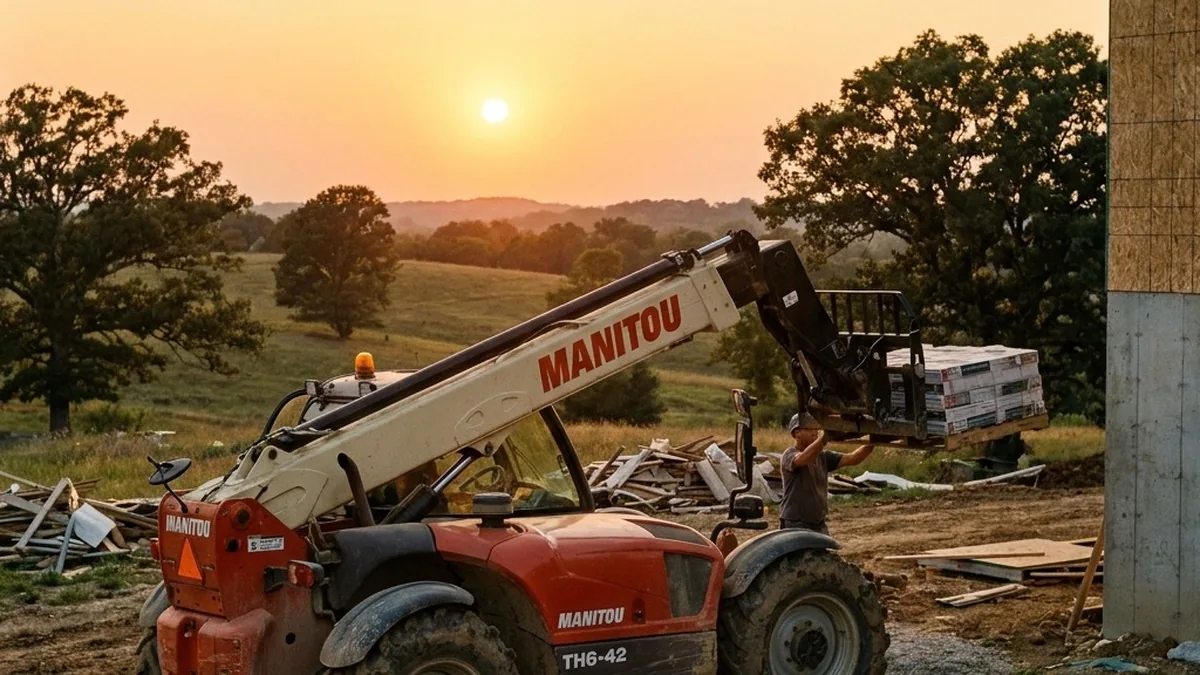
A telehandler isn't really one machine. It's one carrier and a whole rack of jobs waiting on the right attachment. The boom and the cab stay the same. Swap the front end and you go from setting trusses to scooping gravel to lifting two guys up to a roofline. That's the whole point of the platform, and it's why telehandler attachments are the part most buyers underthink. Get the carrier right and the attachments wrong, and you've bought an expensive single-purpose lift. So this guide walks through the attachments that matter for mid-Missouri work, what each one is actually for, how quick-attach changes your day, and the one thing that ties it all together: matching the attachment to the machine that's carrying it.
We're a Manitou and Gehl dealer in Laddonia, and we sell across the telehandler line. We see the same mistake over and over. Folks fixate on the headline reach and forget that the attachment in front of the boom decides what the reach is worth. Let's fix that.
Why telehandler attachments matter more than reach
Reach and capacity get all the attention on the spec sheet. They should. But a telehandler with one set of forks does one thing. The contractors who get real value out of these machines are the ones who treat the carrier as a base and build a small kit around it.
Think about a typical week for a mid-Missouri builder or farm operation. Monday you're unloading a flatbed of block. Wednesday you're feeding a hopper with a bucket. Friday a crew needs to get up to a gutter line safely. That's three jobs, one machine, three attachments. The alternative is renting a different piece for each, which gets old fast and never builds equity.
The attachment is also where the safety math lives. Every attachment shifts the load center and changes what the boom can hold at a given height and reach. So you don't just pick the attachment for the task. You pick it knowing how it reads against the machine's load chart. If load charts are new to you, start with our breakdown on how telehandler load charts work before you commit to a setup.
Pallet forks: the attachment you'll use most
If you only ran one attachment all year, it'd be pallet forks. They're the default, and for good reason. Most telehandler work is material handling. Block, brick, bagged product, lumber bundles, palletized anything. Forks let the machine reach into a truck, pull a load, place it on a second-floor deck, and back out.
A few things worth knowing before you assume all forks are the same.
- Carriage width matters. A wider carriage spreads the fork tines and stabilizes wide or awkward loads. Narrow loads in tight spots want a tighter setup. Some carriages let you slide the tines; some are fixed.
- Side-shift and fork positioning save your back and your time. Being able to nudge a load left or right from the cab means you place it once instead of repositioning the whole machine.
- Tine length should match your typical load. Long tines reach deep into a bundle but stick out where you don't always want them. It's a real tradeoff on a tight site.
For lumberyards, co-ops, and grain operations, forks do a lot of the daily lifting, and the choice between a telehandler and a dedicated forklift comes down to terrain and reach. We dig into that in forklifts for lumberyards, co-ops, and grain and in the broader telehandler vs forklift comparison.
Buckets: when you need to scoop, not lift
Bolt a bucket on the front and a telehandler becomes a loader with reach. That reach is the difference. A wheel loader can't dump over a tall wall or into a high hopper the way a telehandler boom can. So buckets earn their keep on sites where you're moving loose material and also need to place it up high.
There's more than one bucket, and they aren't interchangeable.
General-purpose buckets
Dirt, gravel, sand, mulch, snow. The everyday material-moving bucket. Good for backfill, site cleanup, feeding a screen or a mixer. If you're only buying one bucket, this is it.
Grapple buckets
Add a hydraulic top clamp and you can hold what a plain bucket would spill. Brush, debris, demolition material, odd-shaped loads. For anyone clearing land or handling cleanup, a grapple is the upgrade that stops half your load from rolling off on the way to the pile. If land clearing is your world, our piece on forestry mulching in mid-Missouri covers the wider attachment picture.
High-dump and light-material buckets
Bigger capacity, lighter material. Snow, mulch, light aggregate. The high-dump style raises the dump height so you can clear the side of a truck or a tall bin. Match it to material that's actually light, because a big bucket full of wet sand reads very differently on the load chart.
That's the recurring theme with buckets. A bucket changes both your load center and how much material you can scoop before you're over capacity. The machine doesn't know what's in the bucket. You do. So size the bucket to the carrier and the material, not to the biggest number you can bolt on.
Jibs and hooks: turning the boom into a crane
A jib extends a single lifting point out past the carriage so you can hook a load and place it precisely. Think roof trusses, steel, HVAC units, anything you'd otherwise need a small crane or a lot of guys for. A lifting hook does the same job in a simpler form, giving you a single rated point to rig from.
This is where a telehandler quietly replaces equipment you didn't think it could.
- Fixed jibs give you a set extension and a known lift point. Simple, strong, predictable.
- Telescoping or swing jibs add reach or side-to-side placement so you can thread a load into a tight spot without repositioning the machine.
- Hooks are the minimal version, a single rated point for slinging and rigging.
Two rules with jibs and hooks, and they aren't optional. First, the load chart changes hard when you hang a load off a jib, because you've moved the load center way out in front. The rated capacity at the hook is a fraction of what the same machine handles with forks tight to the carriage. Read the chart for that exact attachment. Second, rig it right. A jib is a lifting tool, and lifting demands proper slings, proper rigging, and an operator who respects the chart. Used correctly, a jib is one of the highest-value attachments on the rack. Used carelessly, it's the fastest way to get hurt.
Work platforms: getting people up safely
A work platform turns a telehandler into a way to get people up to height. Roofline work, signage, gutter and fascia, building maintenance, anything that would otherwise mean a ladder you don't trust. The platform mounts to the carriage and gives a crew a railed, secured place to stand and work.
This one comes with the strongest cautions, so here they are plainly.
- A work platform has to be the right rated, approved platform for that machine. You don't improvise lifting people. The platform, the carrier, and the controls all have to be set up for personnel handling.
- Lifting people is different from lifting material, full stop. Different rules, different controls, different operator expectations. If your work genuinely lives at height, a dedicated aerial work platform may be the safer, more productive tool. We carry those too, and you can compare on the aerial work platforms page.
The honest take: a telehandler with a work platform is great for occasional, well-planned access. If you're up at height every single day, look hard at whether a purpose-built lift fits your jobs better. Happy to walk through that tradeoff with you instead of just selling you the attachment.
Bale spears and ag attachments
Plenty of mid-Missouri telehandlers earn their living on a farm, not a job site. Bale spears are the obvious one. A single or double spear lets you pick, stack, and move round bales without chewing them up. Stack them high in the barn, load a trailer, feed a lot. The telehandler's reach beats a tractor loader for stacking, because you can place a bale on the top row without driving the stack down.
Bucket-and-grapple combos, manure forks, and material buckets all cross over to ag work too. The same carrier that sets trusses on Tuesday feeds cattle on Saturday. That flexibility is exactly why a lot of farms here run a telehandler instead of a second tractor.
Quick-attach: why swapping fast actually matters
None of this flexibility means much if changing attachments is a 20-minute fight every time. That's what quick-attach solves. A good quick-attach carriage lets one operator drop forks and pick up a bucket in a couple of minutes, often without leaving the comfort of the cab for hydraulic attachments.
Why it matters for the way you actually work.
- You'll swap more, so you'll use the right tool more. When changing is a hassle, people force the wrong attachment through a job. When it's quick, they grab the right one.
- Hydraulic attachments need couplers that match. Buckets with grapples, swing jibs, anything with a moving part runs off the machine's hydraulics. Make sure the carrier's hydraulic setup supports what you plan to run.
- One operator, no extra hands. A clean quick-attach system means you don't need a second person standing around for every change.
When you buy the machine, buy the carriage and coupler setup that fits your whole attachment plan, not just the first attachment. It's a lot cheaper to get this right up front than to discover later that your favorite grapple won't run off your machine.
Matching the attachment to the carrier
Here's the part that ties the whole article together, and the part we spend the most time on with buyers. An attachment is only as good as the machine carrying it, and every attachment changes what the machine can safely do.
Three things to keep straight.
- Capacity and load center. Every attachment moves the load center. Forks tight to the carriage read very differently than a jib reaching well out past it. The same machine has a different safe capacity for each. The load chart is the source of truth, every time.
- Hydraulics and controls. Powered attachments need the flow and the couplers to run. A machine spec'd for plain forks may not be set up to run a grapple or a swing jib without the right options.
- The carriage and quick-attach standard. Attachments and carriers have to speak the same language. Get the carriage right and your attachment options open up. Get it wrong and you're stuck adapting.
This is exactly why we'd rather start with your jobs than with a model number. Tell us what you're lifting, how high, on what kind of ground, and how often you'll swap tasks. From there we can spec a telehandler and a sensible attachment kit that covers your real week. If you'd rather poke at it yourself first, the find your machine selector is a good starting point, and the full lineup lives on the telehandlers page with the broader catalog on the attachments page.
The local angle, and why it matters
We're in Laddonia, and we're the only Manitou and Gehl dirt-equipment dealer for about 50 miles. That covers Columbia, Jefferson City, Mexico, Fulton, and the Mexico-Vandalia-Bowling Green stretch that's been underserved for years. If you're working anywhere in mid-Missouri, you don't have to drive halfway across the state to get the right attachment or a straight answer about whether it'll fit your machine.
It also means we can talk through the boring-but-important stuff. Which buckets read safely on your load chart. Whether your hydraulics will run the grapple you want. What it costs you down the road to skimp on the carriage now. That's buyer education, not a sales pitch, and it's the part that saves you money after the sale.
On financing, the current program is worth knowing about: 0% for 48 months on skid and track loaders, rates from 1.99% across the line (1.49% on electric machines), through September 30, 2026. If a telehandler-plus-attachment package is on your radar, that window is worth timing around. Details are on the financing page.
Ready to spec your telehandler and attachments?
The carrier gets you reach. The attachments get you a whole jobsite. The trick is matching them, and that's the conversation we actually enjoy. Come tell us what your week looks like and we'll build the right setup around it. Browse the telehandler lineup and the attachment catalog, then request a quote and we'll spec a machine and kit that fits your jobs, your ground, and your budget. No pressure, just a straight answer from your local mid-Missouri dealer.