
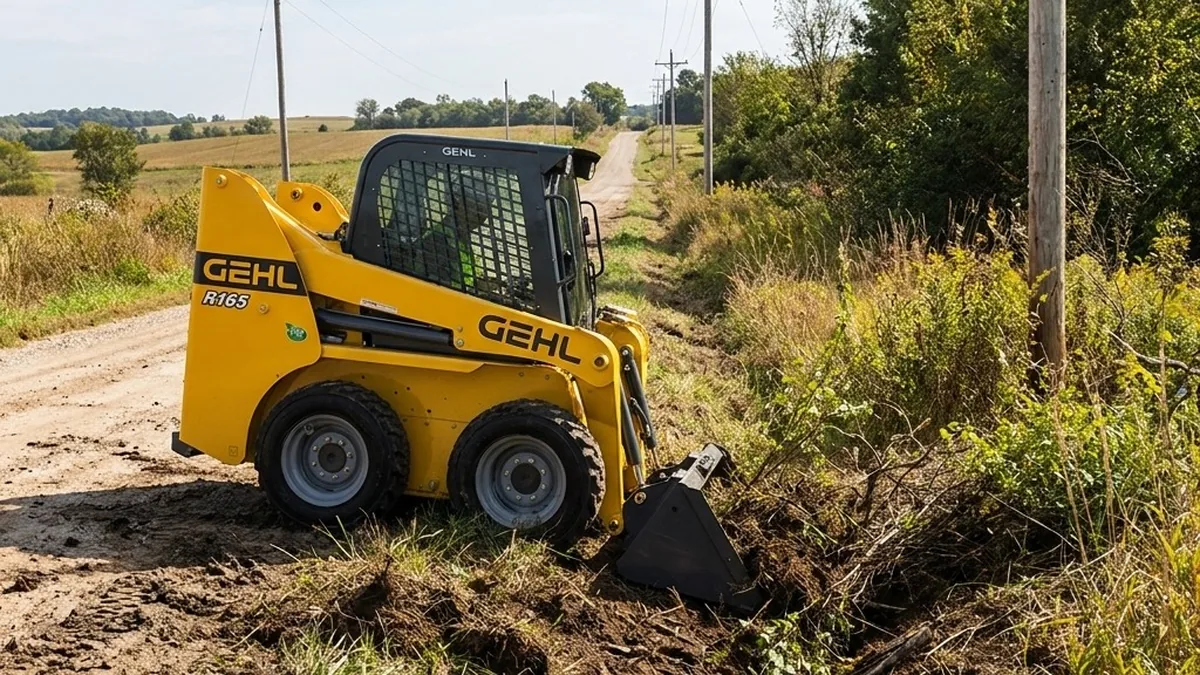
If you run a city street department, a county road crew, or a rural water district in mid-Missouri, you already know the machine that does the most work for the money is usually a skid steer. A skid steer for municipal use earns its keep year-round: it pushes snow in January, mows ditches and clears brush in summer, digs a water-main repair in the fall, and loads salt or gravel the rest of the time. Swap the attachment, change the job. That's the whole pitch. This guide walks through what city, county, and utility crews actually reach for, how compact track loaders and telehandlers fit alongside the skid steer, and one purchasing path that lets public agencies buy without running a formal bid.
We're Equipment Solutions Outdoors in Laddonia, MO. We sell and recommend Manitou and Gehl loaders, telehandlers, forklifts, and aerial work platforms, and we're the only Manitou and Gehl dirt-equipment dealer for about 50 miles. That covers a lot of crews that have been driving to Columbia or farther just to talk to somebody, including the Mexico, Vandalia, and Bowling Green stretch that's been underserved for years.
Why a Skid Steer for Municipal Use Is the Workhorse
Most public works budgets can't justify a one-job machine. A skid steer for municipal use is the opposite of that. The base machine is a compact, maneuverable loader, and the attachment coupler turns it into whatever the work order calls for.
Here's the range of work a single skid steer covers for a typical mid-Missouri crew:
- Snow and ice. Push boxes, angle blades, and pushers for clearing lots, sidewalks, and cul-de-sacs the big trucks can't reach.
- Right-of-way and ditch work. Boom flail mowers, brush cutters, and grapples for keeping shoulders and drainage open.
- Utility digging. Backhoe and trencher attachments for water, sewer, and conduit runs.
- Material handling. Buckets and forks for loading salt, gravel, pipe, and debris.
- Storm cleanup. Grapples and buckets for downed limbs and washouts after a system rolls through.
The reason it works is the universal quick-attach plate. Crews keep a rack of attachments and rotate them onto one or two carriers. That spreads the cost of the machine across every season instead of letting it sit idle half the year. If you want to see how the attachment side stacks up, our attachments overview lays out the common municipal tools by job.
Snow and Ice: What Crews Reach For First
Snow is where a lot of crews first justify the purchase, because the alternative is renting or running everything through the plow trucks. A compact loader gets into the tight spots a truck can't: downtown sidewalks, fire-hydrant clearance, the back corners of municipal lots, school and library entrances.
The attachments that matter for snow:
- Snow pushers and pusher boxes for moving volume across open lots.
- Angle and V-blades for windrowing along curbs and narrow runs.
- Snow buckets for loading piles into trucks and hauling off downtown.
- Broom attachments for the light, packed stuff on sidewalks and crosswalks.
One thing worth deciding up front: wheels or tracks. A wheeled skid steer is the classic snow machine, quick on pavement and easy to clear off. A compact track loader gives you more flotation and grip, which matters if your crew also runs the same machine across soft ground, ditches, and unimproved shoulders the rest of the year. There's no universal right answer. It depends on what surfaces your crew lives on. We broke the trade-offs down in skid loader vs. track loader, and it's worth a read before you commit a budget line.
Right-of-Way and Brush: Keeping the Shoulders Open
Right-of-way clearing is the unglamorous work that never stops. Ditches grow up, sightlines disappear at intersections, brush creeps into the shoulder, and culverts plug with growth. A loader with the right cutting attachment turns a multi-day hand-and-chainsaw job into an afternoon.
Where a track loader earns its spot
For heavy right-of-way and brush work, a compact track loader is often the better carrier than a wheeled skid steer. The tracks spread the machine's weight, so it stays on top of soft ditch banks and wet shoulders instead of rutting them or getting stuck. That flotation is the whole reason crews working off-pavement lean toward tracks. Our track loader hub covers the carriers we sell, and the skid loader hub covers the wheeled side if your right-of-way work stays closer to the road.
Attachments for the cutting work
- Boom and flail mowers for ditch banks and sloped shoulders.
- Rotary brush cutters for heavier brush and saplings along the line.
- Forestry mulching heads for fence lines, easements, and overgrown right-of-way that needs to be reduced in place.
- Grapples for stacking and loading what you cut.
Forestry mulching is its own discipline, and it's a big one for clearing easements and utility corridors without burning or hauling. If your crew is looking at recurring vegetation work, forestry mulching with a skid steer in mid-Missouri gets into what the head demands of the carrier and what to expect on the ground.
Water Mains and Utility Work: Digging and Backfilling
Water districts and city utility crews live in the trench. A main breaks, a service line needs replacing, a hydrant has to be reset, or a new run goes in. A skid steer or track loader with a trencher, backhoe, or auger attachment handles a lot of that without calling in a separate excavator for every small job.
What the work looks like with a compact loader:
- Trenching for water, sewer, and conduit with a dedicated trencher attachment.
- Spot digging with a backhoe attachment for repairs, valve boxes, and tie-ins.
- Augering for posts, signs, and small footings.
- Backfill and cleanup with the bucket once the line's in.
Mid-Missouri clay is its own challenge. The ground around Audrain, Boone, and Callaway counties doesn't dig like sand, and that changes how a trencher behaves and how hard you work the machine. We wrote up what that means for attachment choice and pace in trenching with a skid steer in Missouri clay. If your crew does a lot of repair digging, that's the read before you spec a machine.
One honest note on maintenance, because it's your money either way: if you run a track loader hard across utility and ditch work, the undercarriage is the part that quietly racks up cost when it's neglected. Sprockets, rollers, and track tension all wear, and ignoring them is how a cheap adjustment turns into an expensive replacement. This is buyer education, not a sales pitch. Just know what you're signing up for. Track loader undercarriage maintenance covers what to watch so you're not surprised.
When a Telehandler Makes More Sense Than a Loader
Not every municipal job is at ground level. When crews need to place material up high or reach out over an obstacle, a telehandler does what a skid steer can't. Think pipe and culvert handling, placing material across a ditch, loading and unloading flatbeds, and reaching into spots where you can't park a loader directly under the load.
A telehandler is a forklift with a reach boom, basically. It lifts, extends, and places. For a public works yard or a utility crew staging pipe and materials, that reach is the difference between one machine and two. Our telehandler lineup covers the carriers, and if you're weighing a telehandler against a plain forklift for yard work, telehandler vs. forklift breaks down which one fits which job.
One thing crews underestimate is the load chart. A telehandler's lift capacity drops as the boom extends and reaches out, and reading that chart correctly is a safety issue, not a suggestion. If a telehandler is on your list, telehandler load charts explained is required reading for whoever's going to run it.
Building the Right Fleet: Don't Over-Buy or Under-Buy
The trap public works crews fall into goes both directions. Some buy one machine and force it onto every job, including work it's wrong for. Others buy three machines when two would've covered everything with the right attachments. The goal is matching carriers and attachments to your actual work orders.
A few questions that usually sort it out:
- What surfaces does the crew work on most? Mostly pavement points you toward wheels. Mostly soft ground and ditches points you toward tracks.
- How much of the work is digging vs. handling vs. clearing? That tells you which attachments earn their rack space.
- Do you ever need to lift or reach high? If yes, a telehandler or forklift belongs in the conversation, not a bigger loader.
- Is one machine getting double-booked across departments? That's the signal you need a second carrier, not more attachments.
If you'd rather just answer a few questions and get pointed at the right class of machine, our find your machine selector walks you through it. And if budget timing is the real question, rent vs. buy a loader or telehandler lays out how to think about owning versus other paths for a fleet that runs year-round.
Cooperative Purchasing: Buying Without the Formal Bid
Here's the part a lot of city and county buyers don't realize they have access to. Public agencies can buy equipment through cooperative purchasing programs, which lets you skip running your own formal bid process. The cooperative already competitively solicited and awarded the contract, so your agency can purchase off it directly and stay compliant with public procurement rules.
What that means in plain terms:
- No writing and advertising your own bid for the equipment.
- No waiting out a bid cycle to get a machine your crew needs now.
- A purchasing path your finance office and auditors are already comfortable with.
Manitou equipment is available through cooperative purchasing, and we're an authorized dealer that can fulfill those orders. We don't hold the contract ourselves, and this isn't about a discount percentage. It's about a cleaner, faster path to compliant purchase for your city, county, water district, or utility. When you reach out, just tell us you're a public agency and ask about cooperative purchasing. We'll walk you through how it applies to the machine you're after.
Financing for Public Works and Utility Buyers
If your agency finances equipment, there are current factory programs worth knowing about. Right now there's 0% for 48 months on skid and track loaders, rates from 1.99% across the line (1.49% on electric machines), through September 30, 2026. Those programs can pair with a cooperative purchase, and they matter for budgeting a machine across more than one fiscal year. Our financing page has the details, and we'll lay out the numbers for your specific build when you request a quote.
Talk to a Dealer Who Knows Mid-Missouri Crews
You don't need a spec sheet. You need the right machine for the work your crew actually does, from somebody close enough to pick up the phone. We're in Laddonia, serving Columbia, Jefferson City, Mexico, Fulton, Vandalia, Bowling Green, and the rural districts in between, and we're the only Manitou and Gehl dirt-equipment dealer for about 50 miles.
Tell us what your crew's up against, whether that's snow routes, right-of-way miles, water-main repairs, brush, or all of it, and we'll point you at the carrier and attachments that fit. If you're buying for a city, county, water district, or other public agency, mention it and ask about cooperative purchasing when you reach out. Request a quote and we'll get you a real answer, not a brochure.