
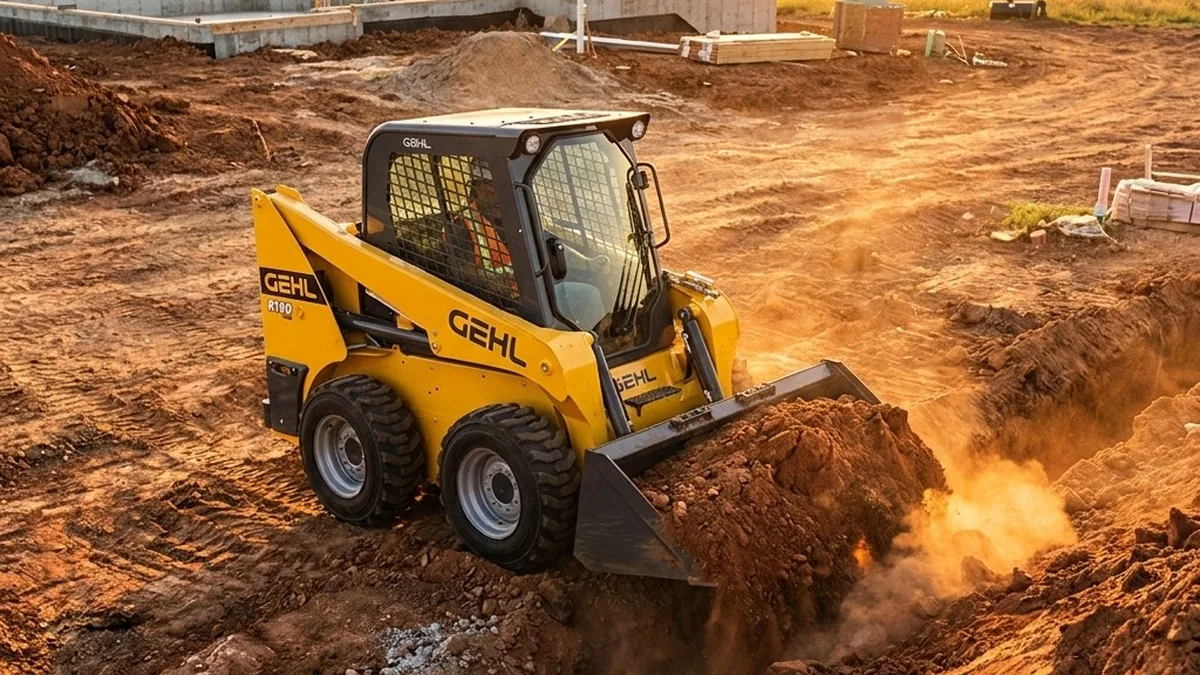
Few things kill a work day faster than climbing into a skid steer that won't start, or worse, one that fires right up but won't move an inch. The good news is that most skid steer no-starts and no-moves aren't blown engines or fried pumps. They're an unbuckled seatbelt, a raised seat bar, a dead battery, or a safety interlock doing exactly what it's designed to do. Before you call anybody or load the machine on a trailer, it's worth ten minutes with a checklist. This guide walks through the usual suspects in the order a dealer would check them, from the 60-second stuff to the "okay, now it's real" stuff. We sell Gehl and Manitou compact equipment here in Laddonia, so we field these questions a lot, and we'd rather help you get running again than watch you spend money chasing the wrong thing.
Work top to bottom. The checks are ordered from most common and cheapest to least common and most expensive, so if you go in order you'll usually find the problem before you get very far down the page.
Start Here: The 60-Second Safety-Interlock Checks
Skid steers are built with more safety interlocks than almost anything else on a job site, and for good reason. The machine is designed so it physically will not start, and often will not move, unless the operator is seated and secured. That's a feature, but it's also the number one reason a healthy skid steer "won't start." Run through these first, every time:
- Sit down and mean it. The seat has a pressure switch. If you're perched on the edge, leaning out, or the seat cushion is worn, the switch may not register that anyone's aboard. Plant yourself square in the seat.
- Buckle the seatbelt. On a lot of machines the belt is wired into the start circuit. No belt, no crank. It sounds too simple to be the answer, and it's the answer more often than anyone likes to admit.
- Lower the seat bar or restraint bar. That bar across your lap isn't just a comfort item. It's an interlock. Up means the machine assumes you're getting on or off, and it locks out both starting and the hydraulics that move it.
- Check the parking brake. Most machines want the park brake set before they'll crank. Set it, then release it once you're running.
- Controls in neutral. If you left the drive controls or joysticks out of the detent, the machine may refuse to start until everything's centered.
Ninety percent of the "my skid steer won't start" calls that come in around here end right here. If you've confirmed all five and it still won't crank, keep going.
If It Won't Crank at All (No Turnover, Clicking, or Dead Silence)
"Won't crank" means you turn the key and the starter doesn't spin the engine. You might hear a single click, rapid clicking, or nothing. That's almost always electrical, and it's almost always upstream of the engine itself.
Battery and Connections
Start with the battery, because it's the cheapest and most common culprit. A skid steer that sat over a cold weekend, or one with a battery a few years past its prime, will click or go silent when you turn the key.
- Look at the terminals. Corrosion, that white or green fuzz on the posts, chokes the current the starter needs. Clean the posts and clamps until they're bright metal and snug them down.
- Check the ground strap. The heavy cable from the battery to the frame does as much work as the positive cable. A loose or rusty ground gives you all the symptoms of a dead battery on a battery that's fine.
- Load-test the battery. A battery can read 12 volts sitting still and still collapse the moment the starter pulls on it. Any parts store will load-test it for free, or a multimeter under crank tells the story.
- Try a jump. If it fires right up off another battery or a pack, you've found your problem. Replace the battery before you trust it on a job.
Fuses, Relays, and the Safety Circuit
If the battery's strong and the connections are clean, the trouble is usually in the low-current circuit that tells the starter to engage. A blown fuse or a failed relay in the start circuit will leave you with a machine that has power to the lights and gauges but won't turn over.
- Pull the fuse panel cover and check the fuses tied to the start and safety circuits against the legend. A cheap blown fuse hides behind a lot of expensive-sounding symptoms.
- Listen for the start relay to click when you turn the key. No click can mean the relay, or it can mean an interlock upstream still thinks you're not seated.
- If your machine has a keypad or anti-theft code, make sure it's entered and accepted. A machine locked out on a security code acts exactly like a no-crank.
If the fuses are good and you've triple-checked the interlocks, a failed starter, ignition switch, or a wiring fault is next on the list, and that's the point where a meter and a wiring diagram from your operator's manual earn their keep.
If It Cranks but Won't Start (Turns Over, Won't Fire)
When the starter spins the engine over strong but it won't catch, the machine's telling you it's missing one of three things: fuel, air, or, on a cold diesel, enough heat to light off. Skid steers are almost all diesel, so the diagnosis leans that way.
Fuel and Filters
- Confirm you actually have fuel. Gauges lie, especially on a machine parked on a slope. Don't laugh, it's a real service call more often than you'd think.
- Bleed the fuel system if you ran it dry. Run a diesel out of fuel and it pulls air into the lines. It won't restart on fuel alone until you bleed that air out. Your manual shows the bleed procedure for your model.
- Check the fuel filter and water separator. A clogged filter or a separator full of water starves the engine. Drain the separator bowl and, if the filter's overdue, that's a likely fix and cheap insurance either way.
- Look at the air filter. A filter packed with dust from a season of mulching or demolition can choke the engine down to a no-start. Pull it and look.
Cold Weather, Glow Plugs, and Diesel Gelling
Cold is its own category, and in a Missouri winter it accounts for a big share of the "it ran yesterday and won't start today" calls.
- Let the glow plugs or intake heater cycle. A cold diesel needs its preheat cycle. Turn the key to run, wait for the wait-to-start light to go out, then crank. Skipping that on a cold morning gives you a long crank and no start.
- Watch for gelled fuel. Untreated diesel starts to cloud and gel in hard cold, and gelled fuel won't flow through the filter. If the machine sat outside through a cold snap and cranks fine but won't fire, gelling is a strong suspect. Warming the machine and treating the fuel gets you moving, and keeping the tank topped off with a winter fuel treatment before the cold hits is cheap insurance against it happening again.
- Check the block heater. If your machine has one and it's plugged into a dead outlet, you're cold-starting the hard way.
If it's warm out, you've got fuel and air, and it still won't fire after a preheat cycle, you're into injection and compression territory, and that's a diagnosis best done with the machine's fault codes and a manual in front of you.
If It Runs but Won't Move (The Skid-Steer-Specific One)
This is the one that's unique to skid steers and track loaders, and it throws people because the engine is running fine. The machine idles, the lights are on, the loader arms might even work, but push the drive controls and nothing happens. Almost always, this is a hydraulic lockout, not a hydraulic failure. Same safety system as before, different symptom.
- Seat bar and seatbelt, again. On most machines the drive and lift hydraulics are locked out until the seat bar is down and you're belted in. If the arms won't move either, this is your first and best suspect. Cycle the bar fully up and fully down and make sure it seats.
- Release the parking brake. Obvious, but a set park brake will hold a running machine dead still. Some machines also need the brake released before hydrostatic drive will engage.
- Look for a hydraulics-disable or "creep" mode. A bumped switch or a mode left on can neutralize the controls. Check the dash for any lit warning that the drive system is disabled.
- Check the fault display. If the machine has a display, a hydraulic or interlock fault will usually throw a code. Match it against your operator's manual rather than guessing, since the codes are model-specific and there's nothing to gain from a wrong assumption.
- Cold hydraulic oil. On a bitter morning, thick cold oil can make a machine sluggish or unwilling to move until it warms up. Let it idle and come up to temperature before you decide something's broken.
If the seat bar, belt, brake, and modes all check out and the machine still won't drive, you may genuinely be looking at a hydrostatic or charge-pressure issue. And if the loader arms and attachment are weak or dead too, rather than locked out, that's a hydraulics problem, and we walk through diagnosing it in skid steer hydraulics weak, slow, or not working. Either way, that's the point where guessing gets expensive and a proper diagnosis pays for itself.
When It's Not Worth Chasing Anymore
Sometimes the honest answer isn't a fix, it's a decision. If you're on your third no-start this month, if the machine's old enough that parts are getting hard to find, or if a day of downtime costs you more than the repair keeps saving you, it's worth doing the math on what you're really spending to keep an aging machine limping along. Chronic starting and hydraulic gremlins on a high-hour loader have a way of stacking up, and the repair bills plus the lost days often add up to more than the payment on something reliable.
That's the part we can actually help with. We're your local Gehl and Manitou dealer right here in Laddonia, and we'd rather have a straight conversation about whether your machine's worth keeping than sell you something you don't need. If it's time, take a look at the current skid loaders and compact track loaders, or browse the full Manitou and Gehl lineup. Not sure what size or configuration fits the work you do? Our Find Your Machine tool walks you through it in a couple of minutes, and there's equipment financing that can put a newer, dependable machine to work for a monthly payment that's easier to plan around than surprise breakdowns.
Either way, start with the checklist at the top. Most of the time you'll be back to work in ten minutes with nothing spent but a little patience. And when you do hit the wall where it's not worth chasing, you know where to find us.