
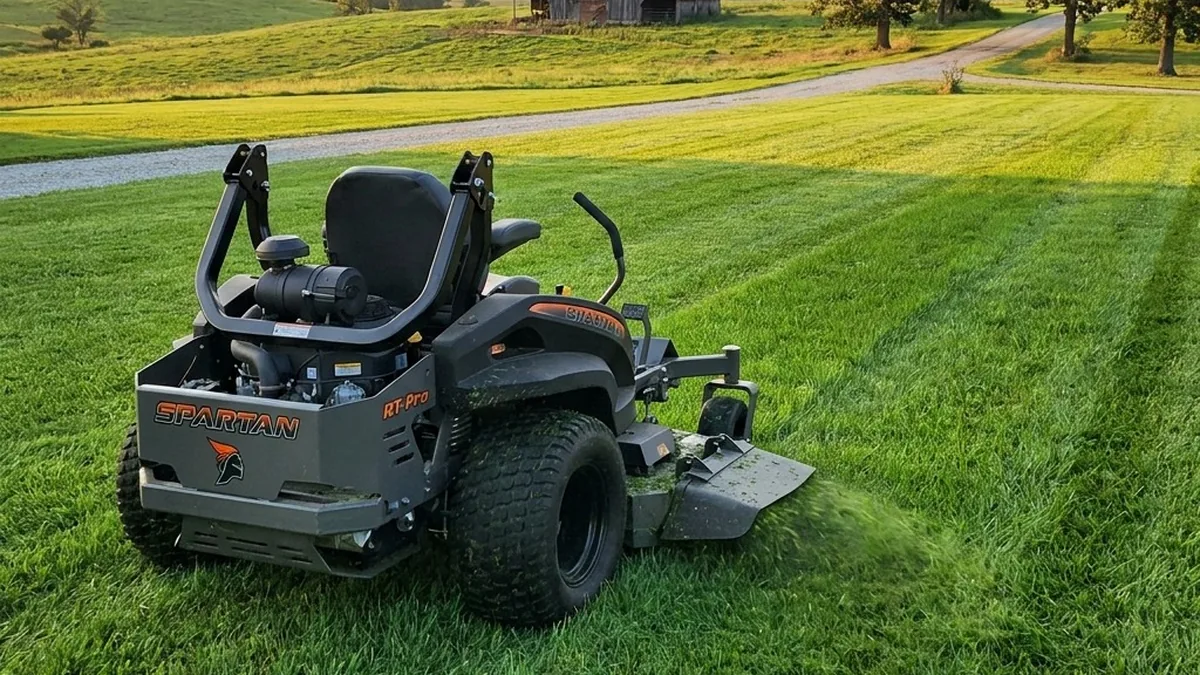
You turn the key on your riding mower and get a click. Maybe one solid clunk, maybe a fast machine-gun rattle, maybe a soft tick from somewhere under the seat. The engine doesn't turn over. Grass keeps growing. If you've been searching "riding mower won't start just clicks" or "lawn tractor clicks but won't start" or "zero turn won't start just clicks," you're in the right place, and the good news is that a click is one of the more honest noises a mower makes. It means power is getting somewhere. It just isn't getting all the way to the starter.
Here's the part most guides skip: on a riding mower or a zero-turn, the most common cause isn't the battery or the starter. It's the safety interlock circuit, and mowers have more of it than almost anything else you own. We sell Spartan zero-turns here in Laddonia, and this is the question we hear most in spring. So this guide skips the generic electrical stuff and goes after the switches, circuits, and habits that are unique to a machine with a seat, a deck, and a parking brake.
If it does turn out to be plain electrical, don't reinvent it. Our tractor and mower clicking diagnosis walkthrough covers battery voltage, load testing, cable and ground cleanup, and solenoid testing step by step.
First, What Kind of Click Is It?
Not all clicks mean the same thing, and telling them apart takes about three seconds.
- Rapid clicking, like a fast rattle. The starter is trying and giving up over and over. That's a power problem, not a switch problem, because the signal is clearly reaching the solenoid. Battery, cables, grounds.
- One solid click, then nothing. The solenoid is pulling in but the starter isn't spinning. Power delivery or the starter side.
- A soft tick from under the seat or the dash, not from the engine. The mower-specific one. Usually a relay picking up while the starter never gets the command.
- No click at all, just silence. The start signal never left the circuit. On a mower, the interlocks are the first place to look, not the last.
First two buckets, use the electrical walkthrough linked above. Last two, keep reading. Not sure which you've got? Try it with the hood open and a helper turning the key. Where the noise comes from matters more than how loud it is.
Why Mowers Do This More Than Other Machines
A mower lives a weird life compared to a truck or a tractor. It runs hard for two hours, then sits for a week. Then it sits for five months. That pattern is rough on a battery in a specific way.
- Short runs never fully recharge it. Starting is the biggest draw a mower battery sees, and a short mow doesn't always put back what the start took out. The charge creeps down across a season instead of holding.
- Sitting is worse than running. Batteries self-discharge on their own, and anything electronic on the machine adds a small constant draw. Park it in October a little low and it can be flat by April.
- Heat and vibration age everything. Deck shake plus hot, dusty, wet routing means connections that were fine last year get loose or corroded on their own schedule.
- A weak battery mimics a bad starter. Enough charge to click the solenoid but not enough to spin the starter feels exactly like a dead starter. People replace the starter and the click comes right back.
That last one is why a charge and a load test come before any parts purchase. Costs nothing, settles the question.
Suspect 1: The Seat Switch
Every riding mower and zero-turn has a switch under the seat that has to know a person is sitting there before the machine will crank. It's the most common interlock failure we hear about, for good reason.
The switch sits under a seat that gets sat on thousands of times, rained on, pressure washed, and bounced across ruts, and its wiring flexes every time the seat pivots up. Failures usually look like one of these:
- The connector under the seat has worked loose or been snagged when someone tipped the seat up to check the battery.
- The wire has chafed where it passes through the seat pan.
- The switch plunger is stuck, corroded, or the seat mount has sagged so it doesn't press hard enough.
- You're sitting a little off-center, or leaning to reach something, and the seat isn't pressing the switch.
Dumb test first: sit square and firm in the seat, brake set, deck off, and try the key. If it cranks when you sit heavy and clicks when you perch on the edge, you've found it. Then tip the seat and look at the connector and wire with a flashlight before you buy anything.
Suspect 2: The Parking Brake Switch
The brake switch is the second suspect and it's a close race with the first. On most riding mowers the parking brake has to be fully engaged before the starter circuit will close.
What goes wrong is usually mechanical, not electrical. The lever or pedal has to travel far enough to physically trip a switch, and over a few seasons the linkage stretches, a return spring gets tired, or the detent wears. The brake still holds the machine fine. It just doesn't push the switch far enough to register.
Check it without tools: set the brake, then push it harder or pull the lever a click further than usual, and try the key while holding it there. If it cranks on the overtravel and clicks when you set it normally, that's linkage adjustment or a switch that's moved. On zero-turns where the brake ties to the control levers, make sure the levers are all the way out and not just close.
Suspect 3: The PTO and Deck-Engagement Circuit
The PTO switch, the one that spins the blades, has to be off before the mower will crank. Obvious, and also the suspect people rule out wrong. The failure isn't usually "I left it on." It's that the switch or circuit no longer reports off correctly:
- Electric PTO switches wear out. They carry real current and get worked with dirty gloves, so the contacts pit. A switch can be physically off but electrically ambiguous.
- The knob can sit between positions. Pull it up and push it firmly down until it seats, rather than assuming down means off.
- Deck-engagement levers have their own switch. That lever has to return fully to disengaged. Almost home has the same effect as left on.
- A dragging PTO clutch can throw the circuit off on machines that monitor it, usually alongside blade or belt problems rather than on its own.
Cycle the PTO all the way on and off a few times before you try the key again. That alone clears a lot of tired switches, at least long enough to confirm where the problem lives.
Suspect 4: Control Levers Out of Neutral (Zero-Turns)
This one is specific to zero-turns and it catches people who move over from a lawn tractor. A zero-turn has neutral switches tied to the steering levers, and both levers have to be out in the parked or neutral position before it'll crank.
Two things go wrong. A lever isn't quite out far enough, especially if the machine got bumped or the levers were set for a different operator. Or the neutral switch drifts out of adjustment, so a lever that looks parked no longer reads as parked.
Push both levers firmly out to their stops and hold them there while you turn the key. If it cranks, the levers or switches need adjustment. Your operator's manual has the correct positions and the adjustment procedure for your model, and that's the source to follow instead of guessing.
Related Symptom: It Starts, But Now It Won't Move
These two problems get tangled together constantly. If your mower finally cranks and runs but rolls like it's in neutral, check the hydro bypass rods before you panic.
Hydrostatic mowers have bypass rods or levers near the rear transaxles that open the hydraulic loop so you can push the machine by hand. Anybody who has pushed a dead mower out of a shed has pulled them. Left open, the engine runs fine and the wheels do nothing. Look behind the machine and make sure both rods are pushed back to engaged. Thirty-second check. And a dead-battery no-crank is exactly what gets those rods pulled in the first place, which is why this shows up right after a clicking problem so often.
Quick-Diagnosis Table
| What you hear or see | Most likely cause | Check this first |
|---|---|---|
| Rapid clicking from the engine | Not enough power reaching the starter | Charge and load test the battery, clean cables and grounds |
| One solid click, no crank | Solenoid pulling in, starter not turning | Battery under load, then the solenoid and starter |
| Soft tick under the seat or dash | Relay picking up, safety circuit blocking the start | Seat, brake, PTO, and lever positions |
| Total silence when you turn the key | Start signal never leaves the circuit | Interlock switches, then the ignition switch |
| Cranks when you sit heavy, clicks when you don't | Seat switch or its wiring | Connector under the seat, chafed wire, switch plunger |
| Cranks when you overtravel the brake | Brake switch or linkage worn out of range | Brake linkage adjustment and switch position |
| Cranks after cycling the PTO knob | Tired PTO switch or a knob between positions | PTO switch seating and contacts |
| Cranks with both levers held out (zero-turn) | Neutral switches or lever adjustment | Lever stops and neutral switch adjustment per your manual |
| Clicked all spring after sitting all winter | Battery discharged from storage | Charge fully, load test, then a maintainer for next winter |
| Runs fine but won't move | Hydro bypass rods left open | Rods behind the rear transaxles |
How to Keep the Click From Coming Back
Most clicking problems are preventable, and the prevention is boring in the best way.
- Put the battery on a maintainer for the off-season. Highest-value habit for a machine that sits half the year. A battery kept topped up lasts years longer than one drained flat every winter.
- Clean the terminals once a season. Corrosion builds slowly and its first symptom is usually a click. Pull the cables, wire brush the posts and clamps, reassemble tight.
- Check the ground strap too. A bad ground looks exactly like a bad battery, and it gets missed because everybody checks the positive side.
- Don't hose down under the seat. Pressure washing at the seat pan and dash is how interlock connectors get wet and corroded.
- Glance at the harness during blade and belt work. Look for chafe marks where it passes through the frame.
- Fix the small stuff in fall, not spring. A switch that's flaky in September is a no-start in April.
Our essential mower maintenance list covers the rest of the seasonal routine.
When the Mower Itself Is the Problem
A seat switch, a brake adjustment, and a battery are cheap fixes worth doing on almost any machine. The math changes when the clicking is a symptom of general wear instead of one bad part. Signs you're past chasing individual switches:
- Several interlock switches failed the same season, which usually means the harness and connectors are going, not the switches.
- The deck, spindles, and hydros are all due at once, and the no-start is just what finally stopped you.
- You're losing mowing days waiting on parts for a machine that owes you nothing.
- The mower is undersized for the property you're on now, so every fix is money into a machine that was never going to keep up.
That's a real decision and it deserves a straight answer instead of a sales pitch. We wrote a zero-turn buying decision framework for exactly that moment, and it's honest about when keeping what you have is the right call. If you're past that point, the Spartan lineup we carry is a good place to compare deck sizes and build. We're right here in Laddonia and we'd rather talk you through the tradeoffs than watch you buy more mower than the job needs.
Related Reading
- Tractor or mower won't start and just clicks: the full electrical diagnosis for battery, cable, solenoid, and starter testing step by step
- The essential mower maintenance list for the seasonal routine that prevents most of this
- Zero-turn buying decision framework for when a repair stops making sense
- Spartan zero-turn mowers to compare deck sizes and models
- No click at all? That's a different fault
- How to test a starter solenoid
Most of the time, a clicking mower is a seat switch, a brake that's drifted, or a battery that spent the winter going flat. Work the switches before you work the wallet, and you'll be cutting again the same afternoon.