
You turn the key and nothing happens. No click, no clunk, no groan from the starter, no dimming lights. Just silence. That's a different problem from a tractor that clicks, and it points you somewhere else entirely. A click means the start signal made it to the solenoid and something downstream of it fell short. Silence means the signal never got there at all, so the fault is upstream, in the circuit between your key and the solenoid. We sell mowers and compact equipment here in Laddonia, and this is one of the most common no-start calls we hear about, so here's how to walk it in order.
If yours actually does click, stop here and read our tractor won't start, just clicks walk-through instead. And if the engine turns over normally but never fires, that's a fuel, air, spark, or compression question, covered in tractor cranks but won't start. This guide is only about total silence.
Silence tells you a lot before you touch anything
A starter circuit has two halves. The control side is the small-wire path: key switch, safety interlocks, fuses, and the wire that feeds the solenoid. The power side is the big-cable path: battery, cables, solenoid contacts, starter motor. A click is the sound of the control side working and the power side struggling.
No click at all means the control side didn't complete. So you're looking for a break, not a weak component. That's actually good news, because breaks are usually cheap and often free to fix.
One thing to check before you go any further. Turn the key to the run position and look at the dash lights, the hour meter, or the fuel gauge. If they come alive, the battery is at least talking to the machine, and you can skip ahead. If everything is dead, start at the battery.
Step 1 - Prove the battery is actually connected
A dead-silent machine with no dash lights usually has a connection problem, not a bad battery. Work through these in order.
- Wiggle the terminals by hand. If a cable end moves on the post, that's your fault right there. It doesn't take much corrosion or looseness to open the circuit completely.
- Pull the cables and look at the posts. White or green powder under the clamp is resistance. Clean both the post and the inside of the clamp until you see bright metal, then reassemble snug.
- Check the negative side too. People clean the positive terminal and stop. The ground cable does the same job and fails the same way, usually where it bolts to the frame or the engine block.
- Look for a disconnect switch. A lot of tractors and mowers have a battery cutoff, and it's easy to bump one to the off position while working around the machine.
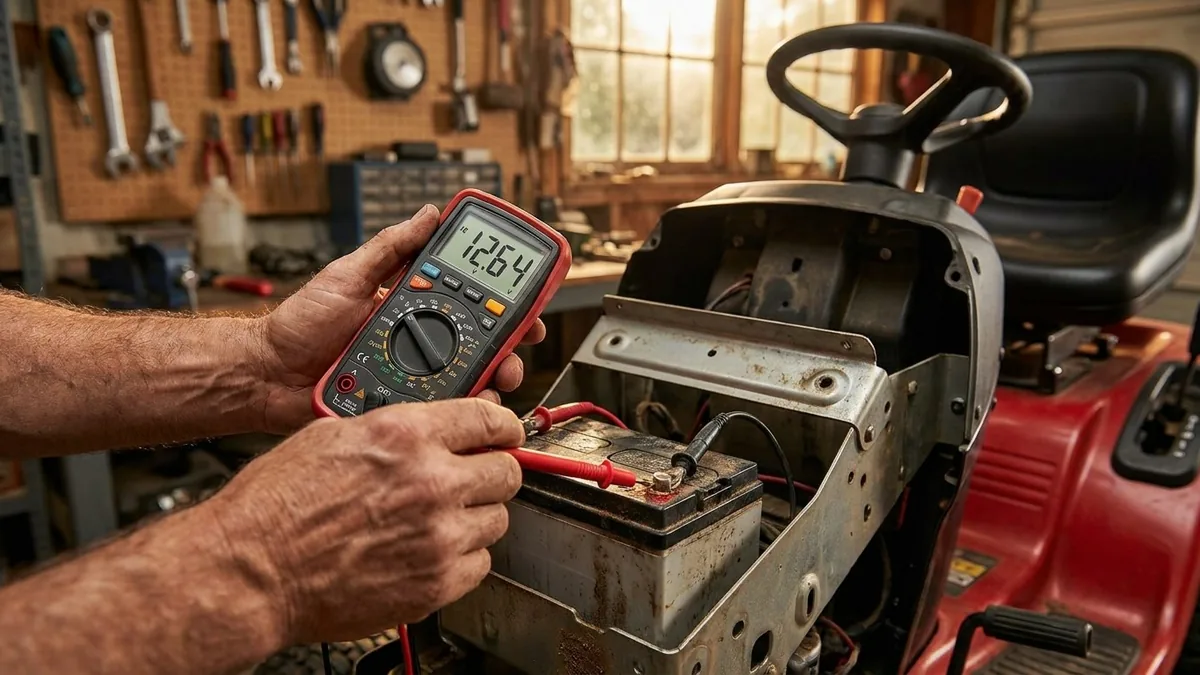
- Check the battery voltage with a meter if you have one. Compare what you read to the resting voltage your operator's manual lists for your machine. A battery that reads way below its target is either flat or has a dead cell, and either way it can leave you with a completely silent machine.
If the dash comes alive after you clean things up, try the key again. A surprising number of no-crank calls end here.
Step 2 - Go straight to the safety interlocks
If the dash lights work and the machine still gives you nothing, safety switches are the single most likely cause. Every mower and tractor built in the last few decades has a chain of them, and any one of them will block the start signal silently. No warning, no click, nothing.
Sit down properly and run the full sequence, deliberately, one thing at a time.
- Sit all the way back in the seat. The seat switch reacts to weight in a specific spot. Leaning over the machine from the side or perching on the edge won't always trip it.
- Set the parking brake fully. Not most of the way. All the way, until it latches.
- Push the PTO or deck engagement off. If it's a lever, make sure it's seated in the disengaged detent, not just close to it.
- Put the drive controls in neutral. On a zero-turn, that means both levers swung fully out to the park position. A lever that's out but not latched reads as engaged.
- Check the clutch pedal on a gear-drive tractor. Many won't crank unless the clutch is pushed to the floor.
Now cycle the key. If it cranks, you found it, and you learned which switch was marginal. If it still does nothing, wiggle each control while a helper holds the key in the start position. An intermittent crank while you jiggle a lever tells you which switch is worn or out of adjustment.
Mowers hit this more than anything else because they carry more interlocks than a tractor does. Our riding mower safety switch guide covers each switch, where it lives, and how to tell a bad one from a misadjusted one.
Step 3 - Fuses, and the ones people miss
A blown fuse in the start circuit gives you exactly this symptom. Pull every fuse in the box and look through it, don't just eyeball it in place, because a hairline break is easy to miss under a fuse cover.
Two things people overlook. First, some machines have an inline fuse tucked into the harness away from the main fuse block, often near the battery or behind a panel. Second, a fuse that blows again right after you replace it is telling you there's a short, and chasing that short matters more than the fuse does. Check your operator's manual for the fuse locations and ratings on your specific machine, and use the rating it calls for.
Step 4 - The key switch and the wire out of it
Ignition switches wear out. The contacts inside get pitted, and eventually the start position stops passing current even though the run position still works fine. That's why a machine can have a live dash and a dead starter.
The quick tell is to have a helper hold the key in start while you check whether any voltage shows up at the small wire on the solenoid. If nothing arrives there, the break is between the key and the solenoid, which means the switch, the interlocks, a fuse, or the wire itself. If voltage does arrive there and the machine still sits silent, the control side is fine and the problem has moved to the solenoid or starter.
While you're in there, follow that small wire with your eyes and hands. Rodent damage, a chafed spot where the harness crosses a frame rail, and a connector that's backed out of its housing all produce total silence and all show up on a careful look.
Step 5 - Grounds, the fault that hides
Current has to get back to the battery. A bad ground creates symptoms that make no sense: nothing happens on the key, but a light works, or the machine cranks fine one day and not the next.
Find the main ground strap from the battery to the frame, and the one from the frame to the engine. Take them loose, clean both the cable end and the mounting surface down to bare metal, and bolt them back tight. Paint, rust, and powder coat under a ground lug are all insulators, and a ground bolted onto paint will pass just enough current to fool you.
Step 6 - When the circuit is fine and it still won't turn
If the control side checks out and the power side is solid, you're down to the starter or the engine. A starter with an open winding or worn-out brushes can sit dead silent instead of clicking. So can an engine that's seized or hydro-locked, though those usually announce themselves other ways.
Here's the difference worth knowing. Try to turn the engine over by hand at the flywheel or the crank bolt, following whatever procedure your manual gives for doing that safely. If it turns freely, the engine is fine and the starter is the suspect. If it won't budge, the problem is inside the engine, and no amount of electrical work is going to fix it.
Quick-diagnosis table
If you'd rather jump straight to the likely cause, use the symptom you actually have.
No dash lights, nothing at all → Battery connection, ground, or a battery with a dead cell. Clean terminals and grounds first.
Dash lights work, key does nothing → Safety interlock. Run the full sit-brake-PTO-neutral sequence deliberately.
Worked yesterday, dead today, nothing changed → Blown fuse or a corroded connection that finally opened up.
Runs fine, but sometimes won't crank → Worn ignition switch or a marginal safety switch. Wiggle-test each one.
Voltage reaches the solenoid and it's still silent → Solenoid or starter. Confirm the engine turns by hand before buying either.
Engine won't turn by hand → Seized or locked engine. Stop chasing the electrical side.
When the machine stops being worth chasing
Most no-crank silence traces back to a terminal, a ground, or a safety switch, and those are cheap days. But a high-hour machine that keeps finding new ways to not start is telling you something. Corroded harnesses, a worn ignition switch, and interlocks that have all aged together tend to arrive as a group, and each one costs you a morning.
If you're getting to that point, it's fair to weigh what another season of downtime is worth against a machine that starts every time. We carry Spartan zero-turn mowers and Manitou and Gehl compact equipment, and financing can make a dependable machine easier to plan around than a string of surprise repair days. No pressure either way, and we'd rather you fixed a ground strap and got another five years out of what you've got.
Start with the terminals and the interlocks. That's where the answer usually is.