
If your tractor cranks over strong but never fires, that's actually good news. The starter works, the battery works, and the wiring that gets you to a crank is fine. You've already ruled out half the possibilities just by hearing the engine spin. What's left is one of four things: fuel, air, spark, or compression. An engine needs all four, and when it turns over without catching, one of them has gone missing.
This guide walks the four in the order that finds the problem fastest, free checks first. Most of the time it's stale fuel or a clogged filter and you'll have it running the same afternoon. We sell Spartan mowers and Echo outdoor power equipment here in Laddonia, and we get asked about this one constantly.
First, make sure it's really cranking
People describe this problem a dozen different ways and half of them mean something else. Get the symptom right before you start chasing parts.
- It cranks, turns over, or spins normally but won't fire or catch. That's this article. The starter is doing its job and the engine isn't lighting off. Keep reading.
- It clicks once, clicks rapidly, or does nothing at all when you turn the key. That's a different failure entirely, and it's electrical. The engine never turns, so fuel and spark aren't your problem yet. Go to our tractor won't start, just clicks diagnosis instead and work that one first.
- It cranks slowly, like it's dragging. Also electrical, usually a tired battery or a bad cable. Same article as above. A slow crank can be too slow to fire at all, so fix the crank speed first.
- It fires, runs a few seconds or a few minutes, then quits. That's a fuel-delivery or carb problem with its own pattern. Our runs five minutes then dies diagnostic covers that one.
Still with us? Good. Here's what's missing.
Step 1 - Is there actually fuel in it, and is it any good
Start here every time, even if you're sure. The two most common causes of a crank-no-start after a machine's been parked are an empty tank and fuel that's gone bad.
Look in the tank instead of trusting the gauge. Gauges stick and floats sink. If there's fuel in there, the next question is how old it is.
- Gasoline goes stale fast. Pump gas with ethanol in it starts breaking down in a matter of weeks, not years. Old gas smells sour or varnishy instead of sharp, and it loses the light, volatile part that makes a cold engine fire. An engine will often crank forever on stale fuel and never catch.
- Water is the other tank problem. Condensation collects in a half-empty tank, and ethanol fuel holds it until it separates out and sits on the bottom, right where the pickup is. Drain a little into a clear jar. Water settles into a distinct layer under the fuel.
- Diesel has its own version. Diesel doesn't go stale the same way, but it grows algae and gels in cold weather. Cloudy fuel or a machine that quit starting when the temperature dropped points that direction.
If the fuel looks or smells wrong, drain it. Running fresh fuel through a system full of old fuel usually doesn't fix it, because the varnish is already in the carb or the injectors.
Step 2 - Confirm fuel is reaching the engine
Fuel in the tank doesn't mean fuel at the cylinder. Between the two there's a shutoff valve, a filter, some line, and a pump or a carburetor bowl. Any one of them stops the show.
- Check the fuel shutoff first. Dumbest cause, and it happens constantly on a machine somebody else parked or that's been trailered. Make sure the valve is open.
- Pull the line at the carb or filter inlet and see if fuel flows. On a gravity-feed system it should run steadily. A dribble or nothing means a plugged filter, a kinked line, or a tank vent that isn't venting.
- A blocked tank vent does exactly this. As fuel leaves, air has to come in. Plug the cap vent with dirt or a wasp nest and the tank pulls a vacuum until flow stops. Quick test: loosen the cap and try again.
- Change the fuel filter if it's been a while or you can't see through it. A partially plugged one causes this symptom, sometimes intermittently.
- Check the carb bowl on a gas engine. Most have a drain. A dry bowl means fuel isn't getting there. A full bowl means fuel is arriving and the problem is downstream.
The classic version is a machine that sat all winter. Fuel evaporated out of the carb bowl and left varnish that plugged the tiny main jet. There's fuel in the tank, fuel in the line, and none of it gets through the passage that matters. That's a carb cleaning, not a mystery.
Step 3 - Check the air side
An engine that can't breathe won't start, and the air side takes about two minutes to rule out.
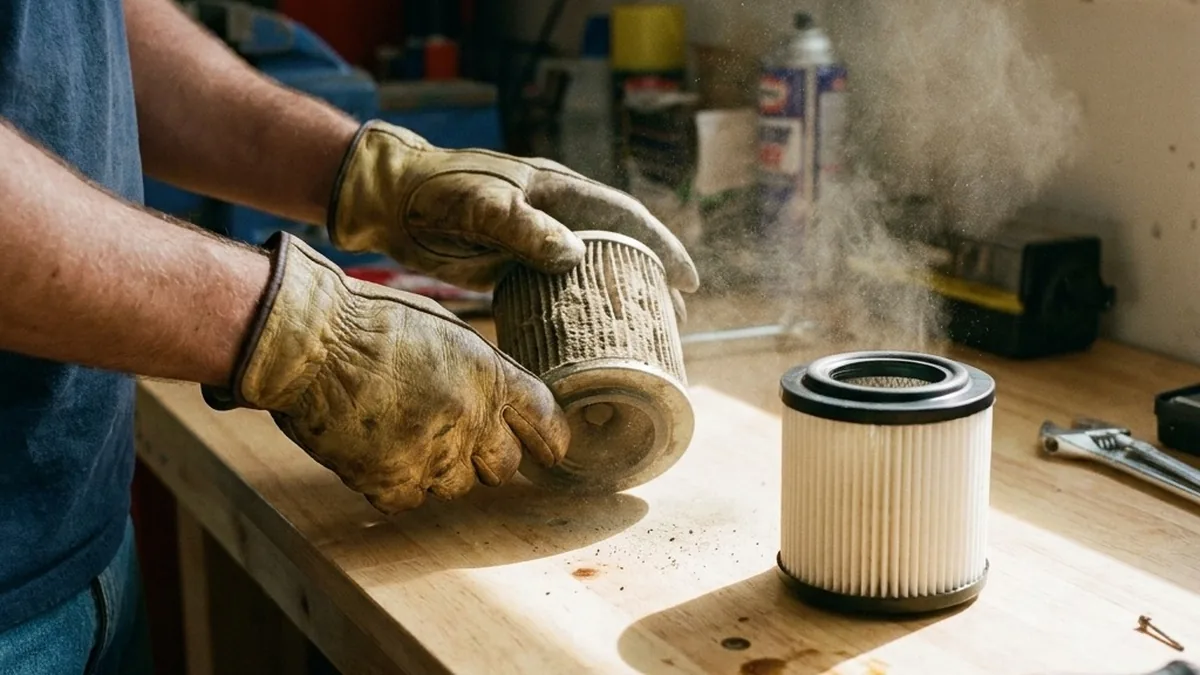
- Pull the air filter and look at it. Packed with dust, chaff, or mouse bedding is enough to keep a cold engine from firing. Try a start with the filter out, briefly, just to confirm.
- Check for a nest. Mice love intake tracts and mufflers on anything that sits. A blocked exhaust does the same thing as a blocked intake, because the engine can't push burnt gas out to pull fresh air in.
- Verify the choke on a gas engine. A cold engine needs a rich mixture to fire and the choke provides it. Take the air cleaner off and watch the plate while somebody works the control. It should close all the way.
- The opposite problem is flooding. Strong gas smell and a soaked plug means too much fuel and not enough air. Hold the throttle wide open with the choke off and crank to clear it.
Step 4 - Test for spark on a gas engine
If fuel and air are both getting there and a gas engine still won't fire, spark is next. Diesels have no ignition system, so skip to the next section.
Pull a spark plug, reconnect the plug wire, ground the plug body against clean bare metal, and crank it. You should see a bright blue snap across the gap. Weak orange spark or none at all is your answer.
While the plug is out, read it. It's the cheapest diagnostic on the machine.
- Wet with fuel means fuel is arriving. Your problem is on the spark side, not the fuel side.
- Bone dry means fuel isn't getting to the cylinder. Go back to Step 2.
- Black and sooty means it's been running rich, which points at the choke, the air filter, or the carb.
- Wet with oil is a wear signal and it belongs with the compression discussion below.
- Cracked porcelain or a burnt electrode means replace it and try again. Plugs are cheap and they do fail.
No spark on a small engine usually comes down to a short list: a fouled or dead plug, a kill wire grounding out (a pinched or chafed wire kills spark just like the switch does), a safety interlock cutting the ignition, or a failed coil. Sheared flywheel keys show up here too. When the key shears the timing jumps, so the spark fires at the wrong moment and the engine cranks fine and never catches. That one usually follows hitting something solid with the blade or the PTO.
Step 5 - Diesel-specific: glow plugs, air, and the fuel solenoid
A diesel that cranks strong and won't fire is a different short list, because there's no spark to chase.
- Cold-start aids. A cold diesel relies on glow plugs or an intake heater to get the cylinder hot enough to fire. If those quit, the machine starts fine in July and refuses in January. Cold-weather-only no-starts point right at this.
- Air in the fuel system. Diesels don't tolerate air in the lines. Run a tank dry, change a filter, or crack a line and you'll need to bleed it before it'll fire. Most machines have a bleed screw and a hand primer, and the procedure is in your operator's manual.
- The fuel shutoff solenoid. Most diesels have an electric solenoid that has to energize to let fuel through. If it doesn't pull in, the engine cranks with zero fuel delivery. You can often hear or feel it click when the key goes on.
- Gelled fuel or a plugged filter. Cold-weather diesel that hasn't been treated will wax up and plug the filter. A machine that started fine yesterday and won't today, with the temperature dropping, is telling you exactly that.
Step 6 - Compression, when it's none of the above
If you've confirmed good fuel, clean air, and strong spark, and it still won't fire, the engine isn't sealing well enough to build the pressure it needs.
You don't need a gauge to catch the obvious version. A healthy engine pushes back when you turn it over, and you can hear and feel that resistance. An engine that spins unusually fast and easy, with no bump of compression, is a strong hint.
Common causes on a small engine include a stuck or misadjusted valve, a sheared flywheel key throwing the valve timing off, a blown head gasket, or worn rings on a high-hour engine. Some engines also have a compression release in the camshaft to make cranking easier, and starting behavior changes when it sticks.
This is where the job stops being an afternoon with hand tools. Compression problems mean pulling covers and measuring things, so on an old machine it's worth knowing the repair cost before you commit.
Quick-diagnosis table
If you don't want to walk the whole sequence, match your symptom here.
- Cranks strong, sat all winter, won't fire → Stale fuel and a varnished carb. Drain the old fuel, clean the carb, try fresh gas.
- Cranks, plug is bone dry → Fuel isn't arriving. Check the shutoff, the tank vent, the filter, and the carb bowl.
- Cranks, plug is soaked, smells like gas → Flooded, or no spark. Test for spark first, then clear the flood with throttle open and choke off.
- Cranks, no spark at all → Dead plug, grounded kill wire, safety interlock, or a failed coil.
- Ran fine, hit something, now cranks and won't fire → Sheared flywheel key. The timing moved.
- Starts fine warm, won't start cold (diesel) → Glow plugs or intake heater not working, or fuel gelling.
- Ran out of fuel, refilled, now won't fire (diesel) → Air in the fuel system. It needs bleeding.
- Cranks unusually fast and easy, no compression bump → Valve, head gasket, or timing problem. Stop guessing at fuel and spark.
- Clicks or won't turn over at all → Wrong article. Start with the clicking diagnosis.
Related reading
- Tractor won't start and just clicks: step-by-step diagnosis for the no-crank, electrical side.
- Small engine runs five minutes then dies when it fires up but won't stay running.
- Setting the governor after carb work for what to check once it's running again.
- Cranking too slow to fire: battery, cables, or starter
- Starts cold but won't restart hot
When the repair math stops making sense
Most crank-no-start problems are cheap. Fresh fuel, a filter, a plug, a carb cleaning, and you're cutting again. Do the free checks first and you'll usually land there. The mistake that costs people money is throwing a carb kit, a coil, and a set of plugs at a machine that just has water in the tank.
The other outcome is worth naming too. On a machine with a lot of hours, a compression problem or a second and third failure in the same season is the engine telling you where it is in its life. When the repair starts costing a real fraction of what the machine is worth, and you're losing weekends to it instead of using it, that's a decision rather than a repair.
If you get to that point, we're happy to talk it through. We're a Spartan and Echo dealer right here in Laddonia, and we'd rather help you figure out whether your machine is worth keeping than push you toward anything. If you do decide it's time, take a look at the Spartan zero-turn lineup and see what fits the property you're cutting.