
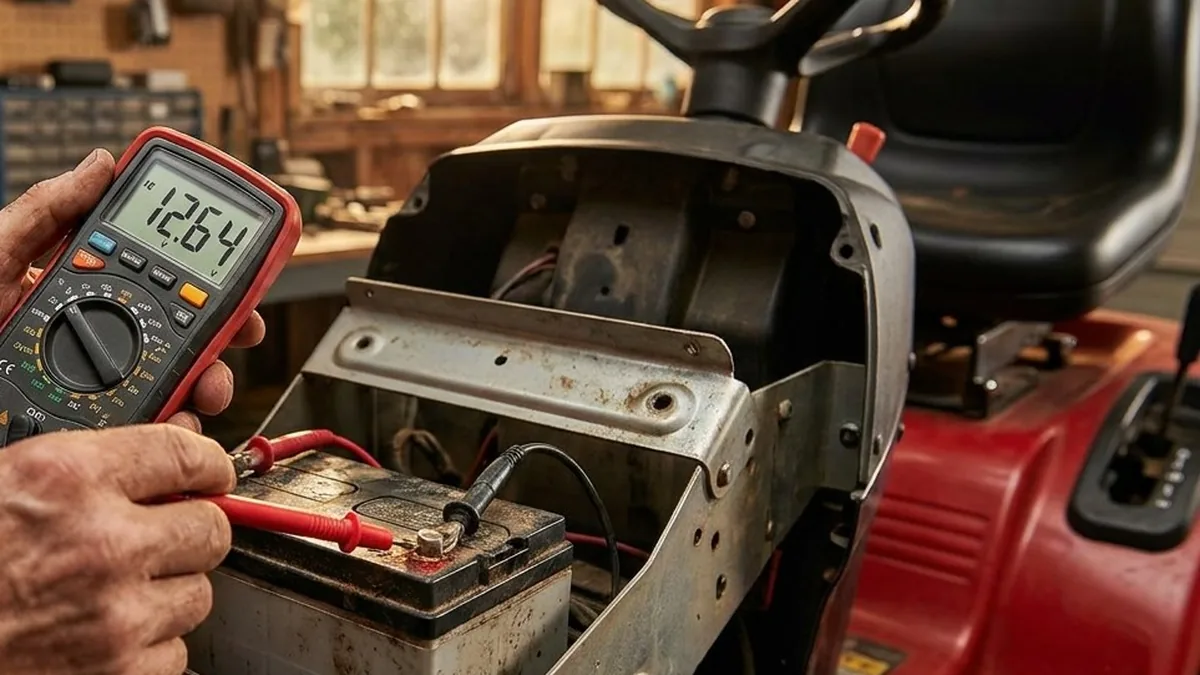
A slow crank is its own symptom, and it's worth treating that way. The engine does turn over, so nothing is broken open in the circuit, but it turns lazy. You hear that heavy, dragging rrr-rrr-rrr instead of the quick spin it used to have, and it either takes forever to catch or never does. That's a machine telling you it can't get enough current to the starter, or the starter can't do anything useful with what it's getting. We sell mowers and compact equipment in Laddonia, and this is one of those problems that almost always has a cheap answer if you check things in the right order.
Two quick redirects first. If it clicks rapidly instead of turning, read our clicking diagnosis, because that's the same underlying weakness one stage further along. If it gives you nothing at all, no click and no motion, that's a break in the circuit and a different hunt. This guide is for a machine that turns, just not fast enough.
Why cranking speed matters at all
A gas engine needs to spin fast enough to build compression and to get the ignition system producing a usable spark at the right moment. A diesel needs speed even more, because it depends on compressing air hard enough to get hot enough to light the fuel. Below a certain cranking speed, neither one will fire no matter how good the fuel and spark are.
So a slow crank isn't just annoying. It's often the whole reason the engine won't start. Fix the speed and the starting problem goes away without you ever touching fuel or ignition.
Step 1 - The battery, and testing it properly
A battery can show a healthy resting voltage and still be incapable of delivering starting current. That's the trap. Voltage tells you the battery has a charge. It doesn't tell you the battery can hold that charge up under load, and cranking is the heaviest load on the machine.
- Charge it fully first. Not a fifteen-minute boost. A proper slow charge, so you're testing a full battery and not a half-flat one.
- Watch what happens to voltage while it cranks. Put your meter across the battery posts and have a helper crank. Voltage always dips, but a battery that collapses to a fraction of its resting reading is done, even if it looked fine a minute earlier.
- Get it load tested if you can. Most parts stores do this free and it takes a couple of minutes. A load test is the honest answer.
- Count its birthdays. Batteries lose cranking capacity gradually, and the loss shows up worst in cold weather. A battery that's several seasons old and cranks slow every cold morning has told you what it is.
- Check the cells on a serviceable battery. One low cell drags the whole pack down and produces exactly this symptom.
Step 2 - Cables and grounds, the ones that fool everybody
If a new battery cranks slow, the current is getting lost between the battery and the starter. Battery cables corrode inside their insulation, where nothing looks wrong from outside. The jacket is intact, the ends look clean, and the copper underneath has turned green and can't carry load.
The way to catch it is a voltage drop test, and it's easier than it sounds. Put one meter probe on the battery positive post and the other on the big post at the starter, then crank. You're measuring what the cable is losing along the way. Ideally that reading stays near nothing. A meaningful reading means the cable or its connections are eating your starting current. Do the same on the negative side, from the battery negative post to the starter body or the engine block.
- Clean every connection in the path. Battery posts, cable clamps, the solenoid posts, the starter stud, and both ends of the ground strap.
- Bare metal on grounds. Paint and rust under a ground lug are insulators. Scrape to bright metal and bolt it tight.
- Feel the cables right after cranking. Warm or hot means resistance. A good cable stays cool.
- Replace, don't patch. A cable that's corroded internally will keep getting worse. A new cable is cheap next to the time you'll spend chasing it.
Step 3 - The starter itself
If the battery is strong and the cables are proven, the starter is next. Starters wear in ways that make them drag: brushes wear down, bushings develop play so the armature rubs the housing, and internal shorts in the windings turn current into heat instead of rotation.
Two useful checks. First, does it get hot fast? A starter that's noticeably hot after a few short cranks is burning current internally. Second, does the engine turn freely by hand? Follow whatever procedure your manual gives to safely rotate the engine at the flywheel or crank bolt. If the engine spins easily by hand and the starter still drags with good voltage at its terminals, the starter is the problem.
While you're there, look at the drive gear and the ring gear teeth. A chewed-up spot can bind the drive and produce a drag you'll swear is electrical.
Step 4 - What the engine is asking the starter to do
Sometimes the electrical side is fine and the engine is simply hard to turn. Worth ruling out before you buy parts.
- Oil that's too thick for the conditions. Cold oil is stiff, and oil heavier than what the machine calls for is stiff all the time. Use the weight your operator's manual specifies for your temperature range, not whatever was on the shelf.
- Cold, plain and simple. A cold morning hits from both ends: the battery delivers less and the engine takes more. A machine that only drags below freezing and spins fine in July is usually a battery nearing the end of its life.
- Hydraulic lock. If fuel, oil, or coolant has gotten into a cylinder, the engine will turn hard or stop dead against it. That's a stop-now condition, not something to crank through.
- Something engaged that shouldn't be. A PTO-driven implement left engaged, or a hydro that isn't in neutral, adds drag the starter has to overcome.
- Heat soak on a hot restart. If it only drags when the engine is hot, that's a different pattern with different causes, covered in our guide on a mower that won't start when it's hot.
Step 5 - Why the battery keeps going flat
If you fix the slow crank by charging the battery and it's back a week later, the battery isn't really the problem. Something is either draining it or failing to refill it.
- The charging system isn't keeping up. Measure voltage at the battery with the engine running at working speed and compare it to the resting reading. It should be clearly higher. If it isn't, the stator, alternator, or regulator isn't doing its job.
- Something is drawing power with the key off. A clock, a light that stays on, an aftermarket accessory, or a switch that isn't fully opening will flatten a battery over a week of sitting.
- Short runs. Starting a machine, moving it fifty feet, and shutting it off takes more out of a battery than that run puts back. Do it repeatedly and the battery goes down no matter how healthy the charging system is.
- Winter storage without a tender. A battery left through a cold off-season loses charge and takes damage doing it. That damage shows up as a slow crank the following spring.
Quick-diagnosis table
Slow crank, new or freshly charged battery → Cables or grounds. Run a voltage drop test on both sides.
Slow crank only on cold mornings → Battery losing capacity with age, or oil heavier than the machine calls for.
Slow crank, battery collapses under load → Battery is finished, regardless of what it reads at rest.
Slow crank, starter gets hot fast → Starter drawing current internally. Replace it.
Turns hard by hand too → Mechanical drag or hydraulic lock. Stop cranking and find out why.
Cranks fine after a charge, dead again in a week → Charging system or a parasitic draw, not the battery.
When it stops being a battery problem
Almost all of this is cheap. A cable, a ground, a battery, sometimes a starter. Those are the good outcomes and they're the most likely ones, so start there. What isn't cheap is a machine where the harness is brittle, the charging system is marginal, and the engine itself is getting harder to turn. That combination doesn't get better and each piece of it costs you a morning you meant to spend working.
If that's your machine, it's worth honestly comparing another season of slow mornings against something that starts on the first turn. We carry Spartan zero-turn mowers and Manitou and Gehl compact equipment, and equipment financing often makes a dependable machine easier to plan around than a run of repairs you can't schedule. And if you get the cranking speed sorted out and it still won't catch, the next question is fuel, air, spark, or compression, which our cranks but won't start guide walks through.
Charge it, clean both ends of every cable, and retest. That's where the answer usually is.