
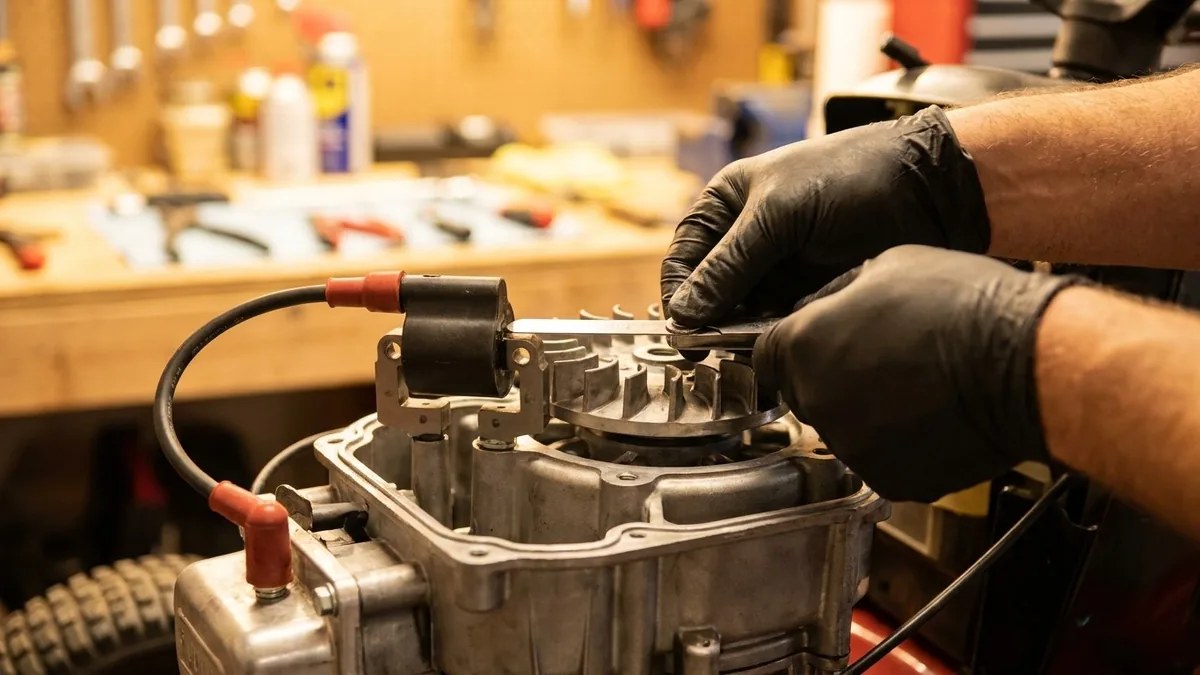
Cold, it fires on the first turn of the key. Warm, it fights you. You finish a pass, shut it off to move a limb or dump the bagger, and now it won't restart until it's had half an hour to cool down. That pattern is frustrating because the machine looks fine every morning, but it's also one of the more diagnosable no-starts there is. The heat is the clue. Something in the machine is changing as it warms, and there are only a handful of parts that do that. We sell mowers and compact equipment in Laddonia, and here's how to sort out which one is yours.
One thing to separate first. If it starts hot and then dies a few minutes into the job, that's a running problem, and our guide on a small engine that runs five minutes then dies covers it. This one is about a machine that ran fine, got shut off hot, and then won't come back.
Start by listening to how it cranks
Before you touch a single part, turn the key on a hot machine and pay attention to what the starter does. This one observation splits the whole diagnosis in half.
- It cranks slow, drags, or barely turns when hot but spins fine cold. You have an electrical or mechanical drag problem. Go to the heat-soaked starter section.
- It cranks at normal speed and simply never fires. You have a spark or fuel problem that shows up with heat. Skip to the ignition and fuel sections.
- It does nothing at all when hot. Check the safety interlocks and the battery connections first, because a marginal connection can open up as things expand. Our no crank, no click guide walks that path.
Getting this split right saves you from buying a coil for a starter problem, which is the usual way this goes wrong.
Suspect 1 - A heat-soaked starter
Once you shut a hot engine off, the heat doesn't go away, it climbs. The engine block and exhaust dump heat into everything bolted near them, and on a lot of machines the starter sits right in that path. Copper windings drop in efficiency as they get hot, and the internal clearances tighten up. The result is a starter that turns a hot engine slowly, or not at all, and works perfectly again once things cool.
How to tell:
- Wait it out. If it cranks normally after twenty or thirty minutes of sitting, with nothing else changed, heat is doing it.
- Check voltage at the starter while cranking hot. If the battery is holding up but the starter is still dragging, the starter is the weak link, not the battery.
- Look for a heat shield that's missing or bent. Some machines ship with one between the exhaust and the starter, and they get removed during repairs and never go back on.
- Feel the cables. A cable that's hot to the touch after cranking has resistance in it. Corrosion inside the insulation gets worse as it warms.
Cleaning both ends of every heavy cable and both grounds is free and fixes a fair number of these. If it's still dragging hot with clean connections and a good battery, the starter is tired.
Suspect 2 - An ignition coil that quits when it's hot
This is the classic one on small gas engines. A coil that's breaking down internally will pass spark cold and fail once it heats up, because the failing insulation inside it only lets go at temperature. It's maddening precisely because the part tests fine on the bench, cold.
The test is simple. Get the machine hot, shut it off, and while it's refusing to start, check for spark using an inline spark tester. Then let it cool and check again.
- No spark hot, good spark cold is a coil that's failing with heat. That's about as definitive as small-engine diagnosis gets.
- Spark both hot and cold means ignition is fine and you're looking at fuel.
While you're in there, check the coil's air gap to the flywheel against whatever your engine manual specifies, and look at the kill wire. A kill wire that's chafed against the shroud will ground the coil out intermittently, and heat and vibration make it worse.
Suspect 3 - Vapor lock and fuel that boiled
Gasoline in a fuel line routed near a hot engine or muffler can boil into vapor after shutdown. A fuel pump can move liquid, but it can't move vapor well, so the carburetor gets nothing and the engine cranks without firing. Then the machine cools, the vapor condenses, and it starts like nothing happened.
Signs it's this:
- It cranks strong and never catches, hot only. No stumble, no cough, just cranking.
- Cooling the fuel line brings it back fast. A wet rag on the line and filter, and it fires. That's a strong tell.
- The fuel line runs close to the muffler or engine block. Look at the routing. Lines get rerouted during repairs and end up where the factory never put them.
- It's worse on hot days and worse with old fuel. Fuel that's been sitting boils more readily than fresh.
Fixes here are usually about routing and shielding: put the line back on its original path, keep it clipped away from heat, and replace any line that's gone soft or brittle.
Suspect 4 - A hot carburetor that floods or starves
Heat does two opposite things to a carburetor, and you can tell them apart by what the engine does when you crank it.
- It smells like raw fuel and cranks without firing. That's flooding. A float that's soaked or a needle that isn't seating lets fuel keep dribbling in while the engine sits hot. Try cranking with the throttle wide open and the choke fully off to clear it. If it eventually coughs to life and runs, that's your answer.
- It fires for a second and dies. The float bowl emptied while it sat hot, and there's only enough fuel for one pop. That points at fuel delivery, not ignition.
- It only starts with the choke on when it's hot. A hot engine shouldn't need choke. If it does, it's running lean hot, which usually means a partly clogged jet or an air leak at the intake gasket.
If you've had the carburetor off recently and it's been odd ever since, check the governor linkage too. It's easy to reconnect wrong, and our governor static-set guide walks through getting it right.
On a diesel compact machine
The same heat pattern shows up on compact tractors and loaders, but the usual causes shift. Hot hard-starting on a diesel more often points at the starter dragging on heat soak, at a battery that's marginal and only reveals it under a hot crank, or at a fuel system pulling air through a fitting that seals cold and leaks warm. Air in the fuel is a common one and it usually gets worse the longer the machine sits hot.
If your loader is also running hot enough to make you nervous, that's worth handling on its own, and our guide on keeping compact equipment cool in a Missouri summer covers the cooling side.
Quick-diagnosis table
Cranks slow hot, fine cold → Heat-soaked starter, tired cables, or a missing heat shield.
Cranks normal hot, no spark hot → Ignition coil failing with heat. Confirm with a spark tester hot and cold.
Cranks normal hot, has spark, never fires → Vapor lock. Cool the fuel line and try again.
Smells like fuel, won't fire hot → Flooding from a stuck float or needle.
Fires once and dies hot → Float bowl emptying on heat soak, or fuel starvation.
Needs choke when hot → Running lean. Clogged jet or an intake air leak.
Keeping it from coming back
A few habits cut down on all of these. Let the engine idle for a minute before you shut it down after a hard run, so it isn't parked at peak heat. Keep the cooling fins and screens clear, because an engine that's already running hotter than it should is more likely to show every one of these symptoms. Run fresh fuel and don't let it sit for months. And keep the fuel line on its factory routing, away from the muffler.
Most of the time, hot-start trouble is one part, and it's a cheap one. But if you're on a machine where the starter is tired, the harness is brittle, and the carburetor has already been apart twice, the repairs stop being one-offs and start being a pattern. When that's where you are, it's fair to compare a season of lost mornings against something that starts every time. We carry Spartan zero-turn mowers and Manitou and Gehl compact equipment, and financing can make that math work better than another round of parts.
Either way, start by listening to how it cranks. That one detail points you at the right half of the problem.